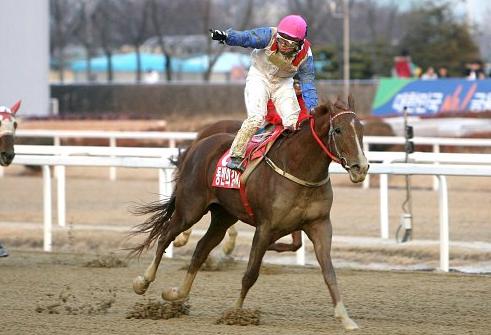
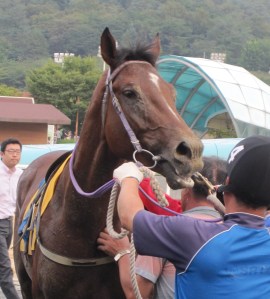
A year after his last start, US bred champion Dongbanui Gangja [Broken Vow-Maremaid (Storm Bird)] has been formally retired aged 8. He is a two-time winner of the Grand Prix Stakes, Korea’s most prestigious race, claiming victories in 2008 and 2009. He also won the Owners’ Association Trophy as he racked up 20 wins from 35 lifetime starts.
Dongbanui Gangja and Choi Bum Hyun (Pic: KRA)
A $20,000 purchase from the OBS Spring Sale of Two-Year-Olds in Training in April 2007, Dongbanui Gangja has a solid but start to his racing career, winning 3 times from 6 starts as a 2-year old. He continued to develop as a 3-year old culminating in his first Grand Prix win in December 2008 beating 2007 winner Bally Brae by 4 lengths.
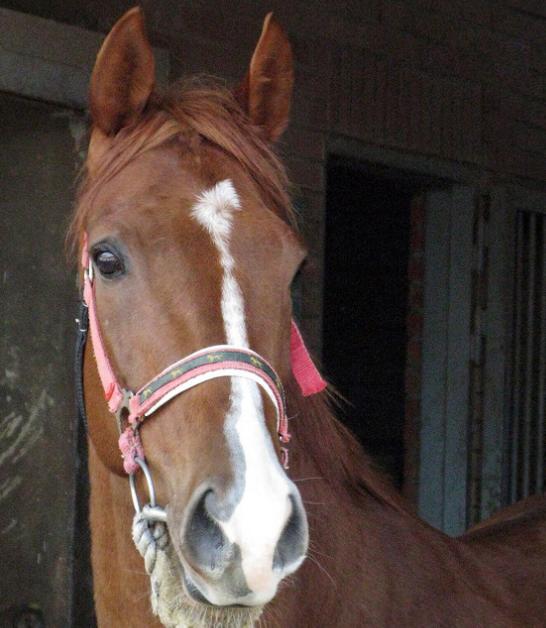
Dongbanui Gangja
That was the 3rd win in a sequence of 12 consecutive triumphs that saw him become the first horse to simultaneously hold the Grand Prix Stakes and Owners’ Association Trophy. He successfully defended his Grand Prix title in December 2009 with a dominant 6 length win.
His remarkable run of victories finally came to an end on his first trip to Busan for the Metropolitan City Mayor’s Cup in July 2010. Billed as the first showdown between Dongbanui Gangja and the young upstart import Tough Win (Yonaguska), Dongbanui Gangja ran inexplicibly wide on the final turn eliminating himself from contention.
This began a period of several races where he became very difficult to control including in that year’s Grand Prix when he could only manage 7th place behind Mister Park.
2011 saw a return to some kind of form and he managed a creditable 2nd place on his return to the Busan Metropolitan as well as picking up 2 big handicap wins. Like all successful imported horses, however, it was becoming harder and harder to find races for him due to the handicapper. On what proved to be his final outing, in February 2012, he carried 62kg. Despite that impost, he won.
One of the most successful horses ever to race in Korea, a retirement ceremoney for Dongbanui Gangja, at which the horse will be present, will be held in the winner’s circle at Seoul Race Park this coming Sunday, February 17.
Since I started writing this blog a few years ago, there has been one particular horse that I’ve received more correspondence about than any other. Receiving more just before the Lunar New Year holiday, I thought it about time I write about her.
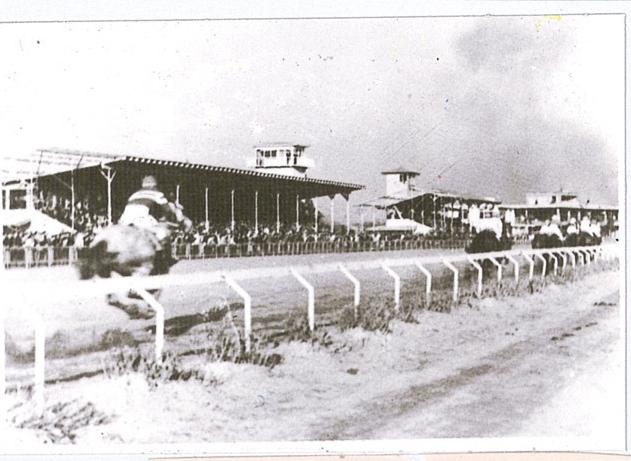
It’s not J.S.Hold or Feel So Good, nor even Smarty Moonhak with his sire Smarty Jones’ legion of followers. In fact, she wasn’t even famous for her exploits on the track. It is, however, back at the old Sinseol-dong Racecourse where her story begins.
A race at Sinseol-dong in the late 1940s
It was 1952 and the Korean War had been raging for over two years. Although the northern invaders had been expelled from Seoul, the track, in the Dongdaemun area of the city had long since stopped hosting racing. The horses were mainly gone – killed in the fighting or taken by the invading force – and the safe had been looted. Among other things, the track was now being used as a landing strip for US aircraft.
With nowhere else to go, however, some of the racing fraternity had returned, some of them with horses. Korean racing didn’t use thoroughbreds until the 1970’s and the majority of runners at the Sinseol-dong track had been ponies; some Mongolian and some from Jeju Island, and almost all had been fillies or mares. One of the most successful runners of the 1940’s was reportedly a mare named Achimhai or “Morning Flame.”
Although Achimhai most likely perished at the start of the war, she was survived by a daughter and it was this filly who was at Sinseol-dong and was bought by US Marine Lt. Eric Pedersen for the rather princely sum of $250 from her owner, a Korean teenager by the name of Kim Huk Moon (not his real name). As the legend goes, Kim needed the money to support his sister, Kim Chung Soon, who had lost her leg stepping on a land mine.
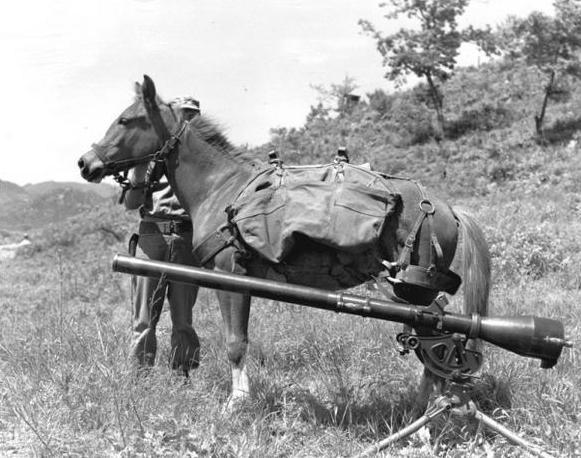
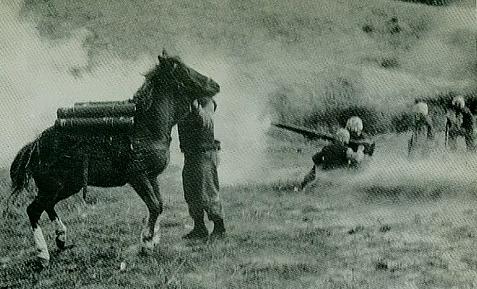
Lt. Pedersen bought her for a reason and the filly was put to work. Her task was to carry ammunition to the frontline for the 75mm Recoilless Rifle (anti-tank) Platoon of the 5th Marine Corp. From the time she was bought until the end of the war, “Reckless,” as the US soldiers called her – after the weapon they used – carried out this task with distinction, remaining calm when the platoon’s gun was fired while all other animals were spooked.
Sgt Reckless in Korea
Her finest hour was in the 5-day battle known as “Outpost Vegas” during which she made 51 trips from the ammunition supply point to the firing sites. Almost always travelling alone, she carried a total of almost 5 tons of ammunition a total of 35 miles in the open and under enemy fire. She was wounded twice but continued in her task. More often than not, on the return journey from the front, she would carry wounded soldiers and thus was responsible for saving a number of American lives.
The horse showed bravery in battle
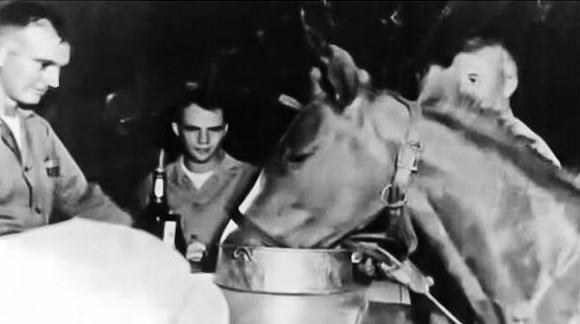
After the battle the US Marine Corp. made the horse the first ever animal to hold an official rank in any military service as she became a Sergeant. Reckless was well taken of by the Marines and became something of a mascot – albeit one well-versed in combat. Guzzling beer and Coca-Cola, Reckless essentially became one of the boys.
After becoming the subject of an article in the Saturday Evening Post which made her famous back home in the States, a campaign was launched to bring Reckless to the USA. With the Korean War over in 1953 – ending in the armistice, not a peace treaty, along the original 38th parallel that lasts until this day, the Marine Corp. duly obliged.
Reckless drinking with Marines
In total, Sgt. Reckless was awarded two purple-hearts, a Good Conduct Medal, a Presidential Unit Citation with star, the National Defense Service Medal, a Korean Service Medal, the United Nations Service Medal, a Navy Unit Commendation, and a Republic of Korea Presidential Unit Citation.
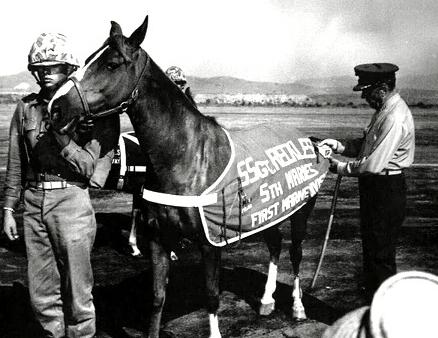
Sgt. Reckless was brought to Camp Pendleton in California where, after giving birth four times and being promoted twice – the second time by the Commandant of the US Marine Corp, to the rank of Staff Sergeant – she died in 1968 aged 19 and was buried at the base. Outranking the soldier who cared for her, she always caused a problem on official occasions as he wasn’t allowed to walk in front of her!
Back at Camp Pendleton, Sgt Reckless was promoted twice
Later this year, Sgt. Reckless will be honoured with a memorial which will be unveiled at the National Museum of the Marine Corps in Quantico on July 26. She has a website here and a Facebook group here both of which have lots more information about her life and the memorial. A Youtube video has received nearly 1.4 Million views.
Interestingly, in the UK, a horse named Sgt. Reckless can be backed at 33/1 for the Champion Bumper at the Cheltenham Festival next month. Get on it!
* While the early parts of her story remain hazy due to a lack of Korean sources, what happened after she was bought at Sinseol-dong is not in doubt. The story was first noticed in Korea in 2006 with an article in the Korea Racing Authority’s in-house newsletter and has since been covered here by a number of major media outlets. However, none of them add anything to the American sources they – and indeed this article – are based upon. All pictures above, with the exception of the one of Sinseol-dong Racecourse, are from http://www.sgtreckless.com
As of February, jockeys at Seoul Race Park can once again designate themselves freelance and eleven local riders have opted to join Japanese jockey Yukio Abe in being unattached to a trainer.
I’m Free! Moon Se Young is among 11 jockeys goinf freelance
The majority of the track’s big names are among them, including current champion Moon Se Young (who is riding in Macau at the moment), current leader Jo In Kwen and all-time great Park Tae Jong.
Kim Hae Sun, who is poised to shortly become the all-time leading female thoroughbred jockey in Korea joins them.
The advantage of a jockey being freelance is that he or she is not restricted in the number of rides they can accept across a weekend of racing while the disadvantage (in theory) is that they have to battle for every mount. They also do not receive a salary from a trainer for trackwork but instead get paid per work.
The full list is as follows:
Kim Young Jin
Moon Se Young
Cho Kyoung Ho
Park Tae Jong
Jang Chu Yeol
Kim Hae Sun
Park Sang Woo
Lee Sang Hyeok
Jo In Kwen
Oh Kyoung Hoan
Yoo Seung Wan
As a foreign rider, Yukio Abe was already a freelancer even when the locals weren’t. Abe recently received an extension to his license to ride at Seoul but is having a quiet time at Seoul despite being a roaring success at Busan.
Down on the South-Coast, where different union agreements exist among the riders, the two Japanese jockeys, Joe Fujii and Narazaki Kosuke remain the only freelancers and both are in demand from owners and trainers.
It’s actually been a rather pleasant week weather-wise on the peninsula and the first weekend of February is set to be the first weekend of the year where the temperature is above 0C.
Here’s what’s happening where and when:
Friday February 1
Busan Race Park: 11 races from 12:00 to 18:00 Jeju Race Park: 9 races from 13:30 to 17:30
Saturday February 2
Seoul Race Park: 12 races from 11:00 to 17:40 Jeju Race Park: 9 races from 12:30 to 17:20
Sunday February 3
Seoul Race Park: 11 races from 11:00 to 18:00 Busan Race Park: 6 races from 12:50 to 17:00
A return to the winner’s circle for one of Korea’s most prolific horses meant another milestone in the career of the nation’s most prolific ever jockey as Park Tae Jong partnered Ace Galloper to victory at Seoul Race Park on Sunday afternoon.
Ace Galloper and Park Tae Jong winning the KRA Cup Classic in 2011 – they partnered on Sunday for the jockey’s 1800th career win
Ace Galloper (Chapel Royal) had been without a win since June of last year but had been coming back into form over the winter. The six-year old duly took advantage of a relatively weak class 1 field to cruise to a 7 length triumph and remind those present while he is still rated the top Korean-born competitor at the track. He now has 18 wins from 31 career starts.
The race marked the 4th win of the weekend for jockey Park Tae Jong and more significantly, the 1800th triumph of his long career. So dominant has Park been for so long that he has ridden over 1000 more winners than any other Korean jockey in history.
The 47-year-old debuted in 1987 at the old Ttukseom Racecourse. By any standard, 1800 is a considerable number of wins but his achievement becomes all the more remarkable given the fact that for the first 18 years of his career, he was – as per the rules at the time – restricted to just 5 rides each week.
Ace Galloper wasn’t the only horse getting back to winning ways after a long time drawing a blank. Lion Santa (Lion Heart) won his first 9 races at Busan in 2010 and 2011 but had only managed to add a single additional victory to that tally in an injury ravaged 14 months since. Yesterday, in the first of co-feature races, he was back to his old self.
Although only sent off as 4th favourite, Lion Santa stormed up the rail in the final furlong to comprehensively defeat a competitive class 1 field with Yeonseung Daero (Creek Cat) and up and coming star Wild Myeongun (D’Wildcat) a full 4 lengths behind. Lion Santa is now on 10 wins from 14 starts and goes straight back into consideration for big Stakes races later in the year.
Japanese to race in Korea in September with Koreans heading to Japan in November
The Korea Racing Authority (KRA) has announced plans to host its first “international race” by inviting three Japanese-trained horses to Korea to compete for a 250 Million won prize on September 1st. Subsequently, three Korean horses will be selected to race in Japan in November.
The Japanese flag is likely to be seen over Gwacheon again this year
The KRA will be picking up the costs of all those involved and plans to promote the race in the same way an international football match would be. At the same time, the Authority also announced plans to hold a truly international race in 2014 with horses trained in the USA, Australia, Hong Kong, Macau and Malaysia expected to be invited.
It’s not the first time the racing authorities here have planned to hold an international event. Such a race was planned to be the culmination of a “five-year plan for intenationalization” drawn up in the early 2000s and a similar race is pencilled in to mark the opening of the now delayed new racecourse at Yeongcheon.
While the International Jockey Challenge, which was also part of that original plan, is now an established feature of the calendar and Korean-bred horse Feel So Good – likely to be one of the Korea horses selected for the event – ran and won in the US last year, progress on hosting foreign horses in Korea has until now, been slow.
The KRA already operates exchange races with a number of its counterparts around the world (the great Irish horse Sea The Stars broke his maiden in August 2008 in a race sponsored by the KRA at Leopardstown), including the JRA and some of these have seen jockeys from the partner organisations visiting. Busan Racecourse also has a partnership with Kokura Racecourse in Japan. However, none of these arrangements have involved horses travelling to compete.
After a slightly warmer week. the temperature is set to plunge back way below zero as another weekend of racing gets underway in Korea.
Going to be very cold and bright again this weekend
Lion Santa (Lion Heart), who’s won 10 of his 14 starts to date returns to action at Busan on Sunday after a long spell out with injury.
The 5 year old will take on Yeonseung Daero (Creek Cat) and up and coming US import Wild Myeongun (D’Wildcat) among a full field of 14 in the first of co-feature races.
Up at Seoul the biggest name on show across the weekend is Ace Galloper (Chapel Royal). The 6 year-old, who looked to be coming back into form at the tail-end of last season, headlines Sunday’s feature race at the track. Here’s what’s happening when and where:
Friday January 25
Busan Race Park: 11 races from 12:00 to 18:00 Jeju Race Park: 9 races from 13:30 to 17:30
Saturday January 26
Seoul Race Park: 12 races from 11:00 to 17:40 Jeju Race Park: 9 races from 12:30 to 17:20
Sunday January 27
Seoul Race Park: 11 races from 11:00 to 18:00 Busan Race Park: 6 races from 12:50 to 17:00
Korean Derby winner Jigeum I Sungan (Ingrandire) was a comfortable three-length winner on his season debut at Seoul Race Park on Saturday.
Winning Start to 2013: Jigeum I Sungan
The colt, who won two legs of the Korean Triple Crown in 2012, was sent off at slight odds-on for the 1900 metre feature Handicap.
With regular rider Moon Se Young currently in Macau, the four-year old was partnered by young up-and-comer Seo Seung Un for the first time and it didn’t take the pair long to gel.
Kept in the middle of the pack for much of the race, Jigeum I Sungan still had five horses in front of him as they entered the final furlong. One after another they were picked off as he eased to the front and ultimately won going away from the field. Magnifique (Menifee) was second with Singgereounachim (Exploit) in third.
Despite his double Classic triumph and subsequent Horse of the Year award, today’s win was only Jigeum I Sungan’s 7th from 16 starts. However, throughout last year he got better with every run and the feeling is that the best is still very much to come from him.
On his last start, Jigeum I Sungan was well beaten into 2nd as Dangdae Bulpae strolled to his third consecutive President’s Cup. November is a long way away but stopping Dangdae Bulpae securing a historic fourth win in Korea’s richest race is surely the season goal for Jigeum I Sungan. The preparation has begun well.
Sunday January 20
Seoul Race Park: 11 races from 11:00 to 18:00 Busan Race Park: 6 races from 12:50 to 17:00
Last Saturday afternoon at Seoul, something happened that would have been unthinkable just a few years ago. Race 7, an otherwise unremarkable domestic class 4 allowance race, was won by jockey Yoo Mi Ra. The second place horse was ridden by Kim Hae Sun and Ahn Hyo Ri was on the third. Female jockeys had swept the placings for the first time ever in Korea.
Earlier in the afternoon, a horse called Dewma had given Lee Shin Young, Korea’s first female trainer, her 39th winner and the following day, Sunday, saw Lee Ah Na ride Imperial Girl to second place behind Tough Win in the afternoon’s feature event.
It is questionable what would be the more unlikely: that by 2013, South Korea would have a female President or that women would be performing so strongly in the traditionally ultra male dominated world of Korean horse racing.
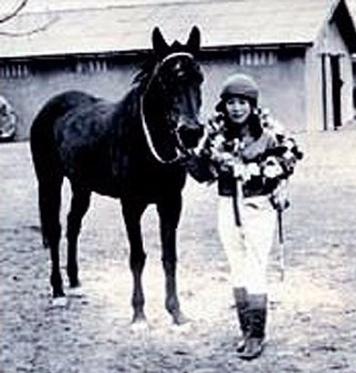
Korea’s first female jockey, Lee Ok Rae in 1975. At the time, the horses were not thoroughbreds
Park Geun Hye was elected the nation’s first female President last month, however, somewhat surprisingly, you have to go back to the now long-gone Ttukseom Racecourse on the north bank of the Han River and to the Spring of 1975 when 21-year-old Lee Ok Rae became the first woman to be granted a jockey license in Korea.
South Korea was, at the time, under the authoritarian rule of President Park Chung Hee – father of the new President Park Geun Hye – who had recently survived the second of three assassination attempts – this one had resulted in the death of his wife. Then, as now, racing held a near monopoly on gambling and Ttukseom was full to bursting on each race-day.
Lee Ok Rae graduated in the same class as Bae Dae Sun and Ji Yong Cheol, who would go on to become two of the top riders of their generation and today are among the country’s most successful trainers. Assigned to trainer Kwon In Deok, on March 17 that year, Lee rode in her first race.
In true storybook fashion it was a winning debut as in race 4 that day, she partnered horse number 1, “Kansas” to victory over five and a half furlongs.
Lee continued to establish herself over the coming months, however, in August that year, disaster struck in the shape of a fall in which she sustained injuries that would end her career. She retired just six months after her first ride with seven wins from forty-eight starts. No Korean woman would ride in a race for the next quarter of a century.
By the time they did, Park Chung Hee had been dead for two decades and his once bitter enemy Kim Dae Jung was now President of South Korea. Seoul had hosted the Olympic games in 1988 and Ttukkseom Racecourse was closed as the huge new track at Gwacheon opened, having been constructed on the site of the Olympic Equestrian events. At the turn of the millennium, the KRA made an effort to get more women into the sport.
From left: Lee Ae Li, Lee Keum Ju and Lee Shin Young in the early 2000s (KRA)
In 2001, two jockeys were granted licenses, Lee Keum Joo and Lee Shin Young. They were followed a year later by Lee Ae Li and Park Jin Hee. Lee Keum Joo and Lee Ae Li are these days occasional riders, the former having only ridden sporadically since her marriage while the latter, despite retaining her popularity with punters with her “Ae Li Gongju” (Princess Ae Li) image complete with pink silks and boots, has only ridden 50 times in the past year.
Of Lee Shin Young and Park Jin Hee, we will return to shortly.
Tragedy struck the next intake. Granted a license in 2005, Lee Myoung Hwa took her own life shortly afterward. She was found to have been suffering from depression that is believed to have been exacerbated by worries about constant reducing to make weight. A year later, newly licensed Kim Seo Jin quit before her first ride.
In 2006, female jockeys received mainstream publicity in Korea with the release of the movie “Gaksoltang” (Lump Sugar). Starring actress Im Su Jeong as a jockey and largely shot at Seoul Race Park, the movie is, for its acting and focus on the horse as a star, arguably one of the best racing movies ever produced (Click here to see trailer.). KBS Television produced a one-off documentary about Lee Ae Li to coincide with the film’s release.
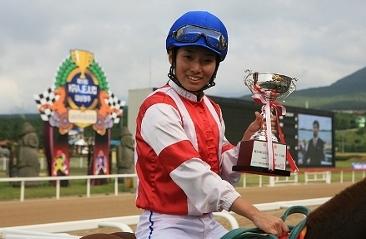
Na Yu Na after winning the Jeju Cup (KRA)
Meanwhile, down on Jeju Island Kim Joo Hee and Na Yu Na became the first women to receive jockey licenses for the pony racing there. Kim was formerly a promising athlete while Na was an Aerobics instructor. Both have become prolific winners with Na becoming the first woman to reach first 100 – and now 200 – career winners as well as landing the prestigious KRA Jeju Cup.
Na and Kim have found it easier to compete riding the Jeju ponies than their counterparts have on the thoroughbreds on the mainland and in a short time have risen to first and third in the all-time female winners list. They’ve been joined in recent years by Kim Da Young who is also winning regularly.
Back in Seoul, Yoo Mi Ra qualified in 2008. She along with 2010 graduate Park Jong Hyun have struggled to gain much of a foothold but are still working hard although Yoo did make all to win that historic race on Saturday.
2010, however, saw another desperately sad turn of events, one that shook everybody involved in racing here. Having begun racing at Seoul in the same graduation class as Lee Ae Li, Park Jin Hee moved to the new track at Busan when it opened in 2005.
She started riding winners and became well established but in 2009 her form began to dip. One Friday in March 2010, she failed to appear for her rides. After the alarm was raised, she was found dead in her apartment. She was 28.
Park Jin Hee
Park Jin Hee left behind a detailed suicide note, outlining what she believed to be unfair treatment and bullying in racing in general and that she in particular had suffered, principally from trainers. The recriminations were bitter with the jockeys and trainers unions engaging in furious rows.
Nearly three years on and for all that Busan is a much more progressive track than Seoul in terms of its raceday operation, its rules and its openness to foreigners, no Korean woman has been licensed at the track since.
Later in 2010, the Korean movie industry once more turned its attention to female jockeys as Kim Tae Hee starred in “Grand Prix” Unlike Gaksoltang, however, this was not a movie to live long in the memory.
At Seoul Lee Shin Young, who qualified as a jockey nine years earlier, sat and passed the exam needed to gain a trainers’ license. She continued riding for nearly a year until, with 90 winners to her name, a barn became vacant. On July 1, 2011 and still only 31 years old, Lee Shin Young surrendered her jockey license and became Korea’s first female trainer.
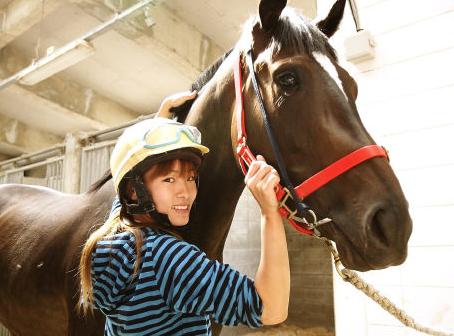
Kim Hae Sun is winning on the track
She has started well, saddling 35 winners including one in a listed race.
Her barn now has 24 horses in it, including Feel So Good, the first Korean bred horse to win a race in the US and she is thought of as one of the most promising talents on the backstretch. As a jockey she had an aggressive style which landed her in the stewards room far too often.
It is an attitude has served her well in an environment where many people were hoping for her failure.
On the track, Lee Shin Young’s protegé is Kim Hae Sun who has 80 winners to her name. A product of the Seoul Jockey Academy, which has started to churn out a series of promising young riders who have been putting their elders to shame, Kim along with 2011 graduate Lee Ah Na and 2012’s Ahn Hyo Ri, have every chance of making it to the very top.
All time List – (Winners/Rides as of January 2013):
1. Na Yu Na* – 219 (1829)
2. Lee Shin Young – 90 (895)
3. Kim Joo Hee* – 88 (1542)
4. Kim Hae Sun – 80 (1147)
5. Lee Ae Li – 53 (1062)
6. Park Jin Hee – 38 (651)
7. Kim Da Young* – 35 (450)
8. Lee Keum Ju – 19 (755)
9. Lee Ah Na – 12 (165)
10. Ahn Hyo Ri – 9 (134)
11. Lee Ok Rae – 7 (48)
12. Yoo Mi Ra – 7 (629)
13. Park Jong Hyun – 2 (110)
14. Lee Myoung Hwa –
15. Kim Seo Jin –
*Jeju Pony Racing
** There have also been three Japanese women riding in Korea and all of them have been successful. Mai Beppu rode at Seoul in 2011 while Hitomi Miyahsita rode plenty of winners at Busan in 2009/2010. Akane Yamamoto also had a successful speel at Busan in 2011/2012. Unfortunately, Akane suffered a serious injury in a paddock accident in Japan last year.
*** This post is an updated version of one published on this blog back in 2009 titled “Korean Racing Girls”. Much of the information for that original post was sourced from the excellent Korean language blog “Enjoy Horse Racing” whcih is still going strong.

 Horse Racing in Korea