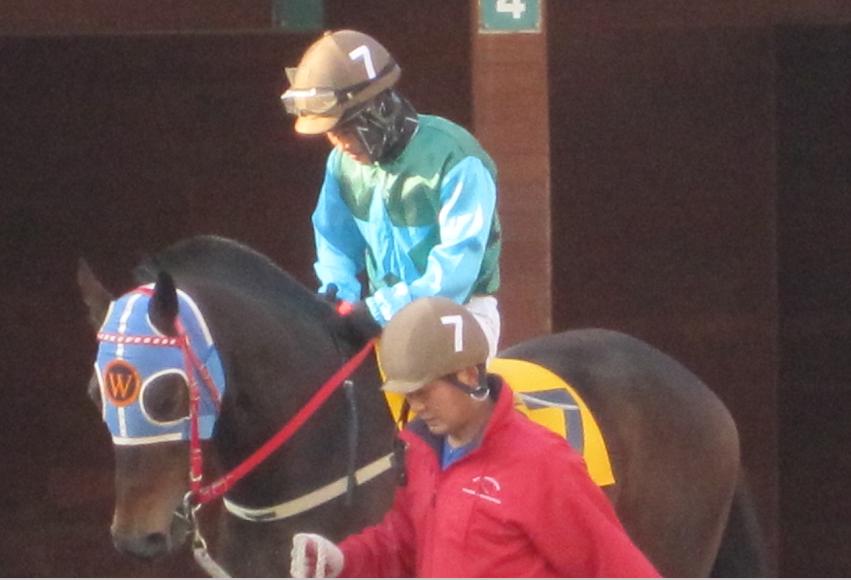
Seoul goes ahead as planned / Suicide Note reported found
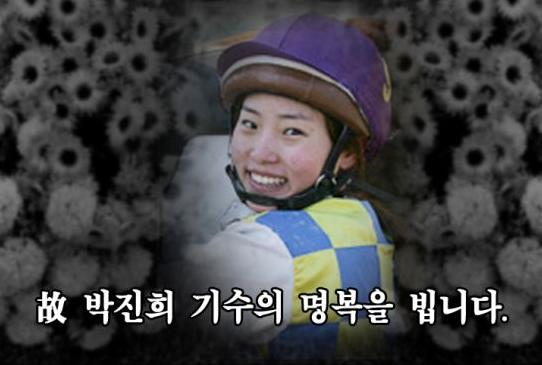
The Korea Racing Authority (KRA), has confirmed that Sunday’s scheduled card at Busan Race Park has been cancelled following the apparent suicide of jockey Park Jin Hee. After no jockeys arrived for trackwork on Saturday morning, official race trials were cancelled and with no-one in the mood for racing, the decision was made to abandon activity at the track until next weekend.
Meanwhile, several local media outlets are reporting that a suicide note was found in Park’s apartment. Written on two sides of A4 paper, the note detailed the extreme stress that Park was suffering following a difficult year which had only yielded one winner; the problems she was now facing in even getting rides and the hardships that resulted from this. The note reportedly also said that she could no longer cope with the intense competition she faced as a jockey.
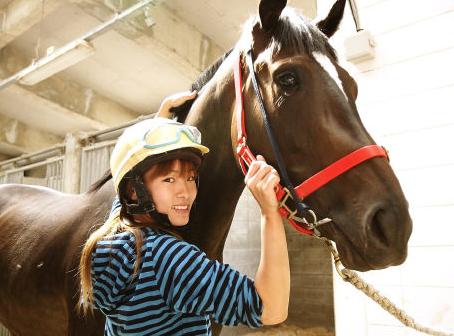
There was a solemn mood over Seoul Race Park today as racing went on. In light of the news from Busan, several jockeys were released from their riding engagements. One of those was Lee Ae Li, who trained with Park at the KRA’s Jockey Academy. The two women gained their professional licenses on the same day, September 13, 2002, as they became only the third and fourth Korean women in history to qualify as professional jockeys.
Racing at Seoul on Sunday will go ahead and the Busan track will be open for simulcasting from Seoul. The race program has been amended slightly at Seoul. The first race is at 11:20 and the last at 17:30.
Korean racing was in shock and mourning this evening with news from Busan that popular lady jockey Park Jin Hee had been found dead in her apartment on Friday.
According to the Sports Chosun, Park did not appear for the first of her scheduled rides at Busan’s Friday meeting and didn’t respond to calls. Officials raised the alert and police discovered her hanged at her home late on Friday afternoon.
Park Jin Hee, who was 28 in February, turned professional in 2002 at the Seoul Racecourse. She relocated to Gyeongnam Province when the Busan Racecourse opened in 2005. Over her career, she scored 38 winners from 651 rides. She was the top female rider on the Korean peninsula in 2008 and represented Korea in the Invitational Lady Jockey Challenge at Busan in 2009.
It is the second such tragedy at Busan following newly licensed jockey Lee Myoung Hwa’s decision to take her own life in 2005. Lee had been battling stress and depression.
Today’s big race at Busan was won by Beukgeukseong – a horse on whom Park won five times.
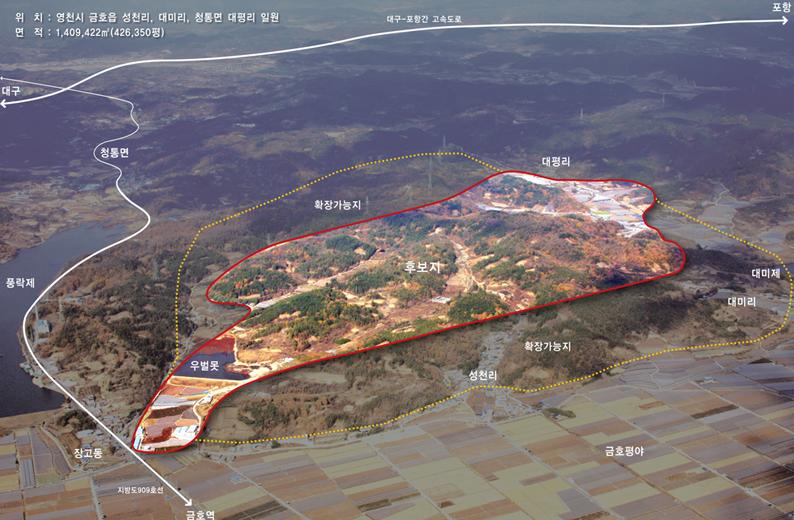
The Korea Racing Authority (KRA) this week announced that Yeongcheon, North Gyeongsang Province, will be the location of Korea’s fourth racecourse.
A number of regions had bid to host the track which will join Seoul and Busan in hosting thoroughbred racing (with Jeju remaining the sole host of Pony racing) but Yeongcheon got the Authority’s nod. In addition to the racecourse, Yeongcheon will also play host to a training centre and “leisure town”.
The site that will be a racecourse by 2014
Yeongcheon is a small city with a population of just over 100,000. It is approximately 350 kilometres south-east of Seoul but only 80 from Busan and is on the the main “Gyeongbu” Expressway that links the peninsula’s two main cities.
With the gambling regulator, the National Gaming Control Commission, shutting down internet and telephone betting last year and also decreeing that a minimimum of 50% of all betting handle must be taken on-track threatening the off-track betting plazas, a new racecourse has become imperative for the KRA. Nevertheless, eyebrows will be raised at the decision to locate the new site in such a rural area with no obvious supply of punters nearby.
Construction at the new site will begin almost immediately with the first races expected to be run in 2014.
Yeongcheon is quick to incorporate racing into its official homepage
Another Japanese rider arrived on Korean shores this week and will make his début at Busan Race Park this coming Friday. Kunihisa Hirase is thirty-years old and has held a licence in Japan since 1996.
Kunihisa Hirase
Over the course of his career, Hirase has ridden 993 winners from 7050 rides, picking up some notable victories along the way. Most recently, he has ridden at Kanazawa Racecourse where he has been competing alongside former Busan star Toshio Uchida.
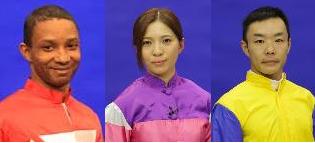
Hirase’s arrival takes the size of the Japanese contingent at Busan back up to two after the departure of Eiki Nishimura at the end of last year after an up-and-down few months. He joins Hitomi Miyashita who has quickly become one of the weighing room’s hottest properties since joining last October.
Martin Wepner, Hitomi Miyashita & Eden Cheung
In addition to Hirase and Hitomi, there are two other foreign riders at Busan. South African Martin Wepner is, alongside Hitomi, one of the track’s stars while Eden Cheung of Hong Kong is yet to really get going, currently sidelined through injury after one win from thirteen mounts.
Hirase debuts on the useful four-year old Cheonman Yeongung in race 1 at Busan on Friday.
He’s nicknamed the “Smile Jockey” but Kim Ok Sung wasn’t doing an awful lot of smiling at Seoul Race Park this weekend. On Saturday the jockey, a twenty-two year veteran of the track, ran into difficulty on a horse named Murim Choegang in race 6. The four-year old was sent off favourite for the eight and a half furlong race but was at the back of the field until they entered the home straight. Passing horse after horse in the final two furlongs, Kim and Murim Choegang finished third and a summons to the Stewards’ room was inevitable.
Stewards decided that Kim was responsible for Murim Cheogang being off the pace and handed him a ten-day ban – which will rule him out until the end of February. Another slap on the wrists for careless riding in race 8 capped a miserable day.
The suspension is a big blow to Kim, who has only recently returned from a three-month lay-off after an injury sustained during trackwork. But his bad weekend was just getting started. On each raceday five jockeys are selected for a random breath-test. Almost inevitably Kim Ok Sung was one of those names pulled out of the hat on Sunday morning and sadly for him, he had evidently been indulging on Saturday evening.
Step Away From The Horse
With a blood alcohol level above the allowable threshold, Kim was stood down from his Sunday rides and handed a further four-day ban on top of the ten days he received on Saturday. To add insult to injury (or to a headache anyway), one of the mounts he missed out on was 100/1 shot Daewangho, who was guided to a shock victory by Park Byeong Yun.
See you in March Kim Ok Sung!
* Stewards reports from each raceday at both Seoul and Busan are produced in English and can be downloaded from the results pages.
The Korean racing media has given its verdict on 2009. There were just six categories and Sangseung Ilro was the star, taking both Champion Female and Champion Three-Year Old. Interestingly, however, Nice Choice, second in the latter of those two categories, was crowned Champion Korean bred on the strength of his President’s Cup win.
On the human side of things, Park Dae Heung and Park Tae Jong took the Top Trainer and Top Jockey awards.
Champion Trainer
1. Park Dae Heung
2. Kim Young Gwan
3. Shin Woo Cheol
4. Kim Yang San
Champion Jockey
1. Park Tae Jong
2. Cho Kyoung Ho
3. Choi Beom Hyun
4. Jo Sung Gon
Last year was another tough one for overseas jocks in Korea
Korea provides a notoriously difficult challenge for ex-pat employees with long hours and alien working practices. A lot of people have bad experiences, some self-inflicted, some not. Racing is no exception.
The most high-profile of foreign employees in the Korean racing industry are the jockeys. On the surface a jockey’s life in Korea is good – purses are big, accommodation is free and they only race twice a week. In reality, it’s anything but. Just like everywhere else in the World, while the top jockeys do indeed earn a lot, the majority don’t.
Japanese riders have generally had the best luck in Korea. The culture shock is less as is the style of racing – Korean racing has been described by more than one observer as being similar to that of Japan. Twenty years ago. The gap left by Toshio Uchida at Busan was ably filled by Ikuyasu Kurakane who moved down from Seoul and quickly became the track’s top rider. Ikuyasu left during 2009 as did Nozomu Tomizawa who returned to Australia after putting in a creditable two years at Seoul without getting the recognition – or more importantly, the rides – he deserved.
Eiki Nishimura joined Busan early in 2009 and battled through a tough start to be rewarded with victory on Sangseung Ilro in the KRA Cup Mile. Sadly Eiki was jocked off the filly for the Korean Derby amid rumours that the militant Seoul Jockeys’ Association did not want a foreigner riding a potential Derby winner. He did, however, regain the ride for the Oaks where Sangseung Ilro was beaten.
Three other Japanese riders joined during the year. Toshiyuki Katoh has found rides difficult to come by at Seoul but is still plugging away. He was joined recently by Yoshiyuki Aoki who has found rides in more quantity than Katoh, if not in quality. Finally, Hitomi Miyashita joined Busan in October. The winner of the International Lady Jockey Invitational at the track in August, Hitomi wasted no time in applying for a full-time license and has had no trouble settling in and being accepted by trainers. As of now, she is arguably the top jockey at the track and is worshipped by lovestruck punters.
As for the non-Japanese, American Santos Chavez was popular with punters and put in a quiet but competent four months at Seoul before returning to the States. At Busan, Vincent Sit rode for two months before returning to Hong Kong where his wife had just become the first woman to be granted a trainer’s license. India’s Rahul Shinde lasted all of one week while Eden Cheung of Hong Kong is currently on the injured list.
That leaves the two South Africans. Stephan Swanepoel started off at Seoul but, as is common at the capital track was given no opportunities and was allowed to relocate to Busan where he had slightly more success. Swanepoel called time in late November and returned to South Africa, retiring from the saddle completely.
Then there is the exception. Martin Wepner arrived in Korea having had considerable experience in Malaysia. With a strong reputation and an ability to do the light weights, he instantly got more rides – not necessarily good rides, just more – than the other foreigners. And he started winning on them. Things haven’t been simple with Wepner. A miscommunication which placed him in an embarrassing situation led to him walking out on the ride of Namdo Jeap in the Derby on the day of race.
With Wepner set to leave Korea, top Busan trainer Kim Young Gwan, possibly appreciating the difficulties faced by foreign riders here, stepped in to offer him the job as his stable jockey. Wepner accepted and it was the start of a prolific partnership. However, late in 2009 their relationship broke down and trainer and jockey went their separate ways. Wepner has once again landed on his feet and, back as a freelancer is, alongside Hitomi, the most in-demand rider at the track.
Peter Wolsley is still the sole foreign trainer working on the peninsula. Just as the foreign jockeys get the horses no-one else wants to ride, when he arrived, Wolsley was given the horses no-one else wanted to train. He toughed it out, however, and has been rewarded with a number of good quality runners in his barn including Ebony Storm, Khaosan and Yeoreumbi, as well as one-time Derby hopeful Impeccable. Now with twenty-four horses in his care, Wolsley saddled twenty-nine winners in 2009.
In terms of the KRA, the last week of 2009 saw the upgrade of their website to include English language racecards and results as well as links to the English language stewards reports. The KRA have a foreign steward at both thoroughbred tracks and James Perry at Seoul and Brett Wright at Busan have been tapping out English translations of the reports for over a year. Behind the scenes, a South African jockey instructor has played a key role in the development of a promising crop of young Korean jockeys.
The word is that another overseas trainer will be granted a licence in 2010. No word yet on the identity or even the nationality. The KRA is also still accepting applications from foriegn jockeys. Any newcomer should hope to be based at Busan which while still challenging, offers a more accepting environment to newcomers than at Seoul where the Jockeys’ Association still wields great power on the backstretch.
Overall there is still plenty of work to be done for the much heralded “Internationalization” plan to be realised. 2010 promises to be another challenging year for those racing professionals who choose to ply their trade on the peninsula
Two of Korean racing’s most distinguished females make long awaited returns to the track at Seoul Race Park on Sunday.
Now eight years old, Galsaem [Adjudicating – Golden Image (Dancer’s Image)] made her debut in 2005 and quickly became one of the most formidable fillies on the track. She won the NACF Chairman’s Race in 2006 and amassed seventeen wins from her thirty-six starts, missing out on the money on just three occasions.
Her last appearance was in the Grand Prix race at the end of the 2008 season in which she finished ninth and was found to be lame. After a long recovery period, she came through an official race trial in December with no problems and will line up for Sunday’s feature handicap.
She’ll have her work cut out with the likes of Secret Weapon, Balhae Janggun, Good Day, New Rider and Namchonuijijon all having claims in the 2000 metre race 10.
Despite having not riddden competitively for over two years, Geum Joo retained her license and, having got married last year, returns to race riding at Seoul on Sunday afternoon. She has just the one mount on six-year old gelding Cheongun Baram, who is himself coming off a nine month lay-off in the competitive looking race 9.
In that race, Soseono is the best known of the thirteen declared, but she’ll face strong competition from Gangho Jewang and Yaho MK among others.
Sunday Racing:
Seoul: 11 races, first post 11:10, last 17:45 Busan: 6 races, first post 12:30, last 16:15
Dongbanui Gangja ran seven times in 2009 and won seven times. Among those wins were an Owners’ Cup and his second Grand Prix. Currently untouchable at Seoul, he comfortably saw off those from Busan who dared to challenge him. By some distance, Dongbanui Gangja is our horse of the year.
Three year olds have had another mixed year. On the domestic front, Nice Choice eventually came good after a disappointing start to the year, his President’s Cup win over older horses the highlight. For the second year running, however, it was Busan horses who dominated the generation.
Namdo Jeap was second in the KRA Cup Mile and Korean Derby before going one better in the final leg of the Triple Crown. Like Nice Choice, Yeonseung Daero started the year with big expectations but only started living up to them late on in the campaign. In 2010, he more than others, will be the one to watch.
And then there was Sangseung Ilro. Overlooked by most before the Classics, the filly stormed to victory in the KRA Cup Mile at 16/1. Bizarrely, she remained unfancied for the Derby, which she proceeded to romp with ease.
Then it all went wrong. Sent off odds-on for the Oaks, she seemed all set for victory with a furlong to run, but tired to the extent that Pangpang managed to catch her. Diagnosed with a shin problem, she didn’t reappear until October when she made her bid for the Triple Crown in the Minister’s Cup at Seoul. Again she tired but bravely ran on for third place behind stablemate Namdo Jeap and Nice Choice.
With a disappointing reappearance last week, whether Sangseung Ilro returns in 2010 or follows 2008’s top filly Jeolho Chance, another plagued by injury, into the breeding shed, is still in doubt.
Those to have already had their careers prematurely ended by injury include Gangho and most notably, Playing Politics. The four-year old won six of his seven races and was considered a potential late season challenger to Dongbanui Gangja before he came back lame after easily winning what proved to be his final race in February.
Some old friends faded in 2009. Subsidy, Gayansanseong and Daiwa Arazi were retired while Golding, a stalwart of Busan since the track’s opening four years ago is in the way out. Meanwhile Subsidy’s great sparring partner Bally Brae was victorious early in the year but by the end of 2009, it was clear that his best days were behind him.
Feelgood story of the year is Baekgwang. Now six years old, the grey was champion three-year old in 2006 before suffering an injury that decimated his four-year old season and then flared up again in his only appearance in 2008. Following stem-cell treatment and a long period of recuperation, he came back in the SBS Cup in August. He ran fourth but went on to win two handicaps and finished second in the President’s Cup. In the unsentimental world of Korean racing, the sight of Baekgwang launching his home straight charge from the back of the field, just as he did three years ago.
Then there is the future. Seonbongbulpae, Northern Ace, Money Car and Night Moves caught the eye in the two-year old ranks this year. Will they push on in 2010? Who are those that we don’t know about yet but will have forced themselves into the Classic reckoning come May?
The road to the Derby is just days away. With that in mind, let’s take a look back at the four Classics of 2009:
1: The KRA Cup Mile – Busan, April 5: Sangseung Ilro stuns the colts by winning the first Classic:
2: The Korean Derby – Seoul, May 17: Sangseung Ilro again takes the honours to set up a possible Triple Crown:
3: The Korean Oaks – Busan, August 9: It’s Sangseung Ilro’s turn to be upset as Pangpang reels her in over the final furlong on a hot night in Busan:
4: The Minster of FAFF Cup – Seoul, October 12 – Namdo Jeap finally makes it to the Winners’ Circle, ending Sangseung Ilro’s hopes of emulating J.S.Hold in winning the Korean Triple Crown:
All these equine athletes become a year older on January 1. We will no doubt say goodbye to some in 2010 and meet a whole host of others for the first time. Wherever a horse is running next year, may it come home safely.
Didyme is Leading Sire in Korea for the third year running. The nineteen year old was responsible for earnings approaching 3 Billion Won over the year, 200 Million Won more than nearest rival Concept Win whose filly, Sangseung Ilro claimed two legs of the Triple Crown. Revere was in third place.
Leading Sires in Korea 2009
Name/Pedigree/Earnings (Korean Won)/Win Rate/Chief Earner
All of the top five’s chief money earners run at Busan, a further demonstration of the stranglehold the southern track has in terms of quality. In races where Seoul and Busan horses faced each other this year, Busan won four and Seoul won two. Crucially though, Busan won all the races which were restricted to Korean bred runners.
Creek Cat was leading sire of two year-olds, ahead of Didyme, but one to look out for though could be Newsprint (USA) [Gone West – Salty Perfume (Salt Lake)]. He finished seventh on the list of sires of two-year olds from just six runners. They included Seonbongbulpae and Money Car, two of the year’s most exciting juveniles. Newsprint was second among first crop sires behind Volponi. Sadly Newsprint died in November at the tender age of seven but his offspring may do him proud in 2010.