News

Seoul Bullet Plays The Claiming Game At Gulfstream

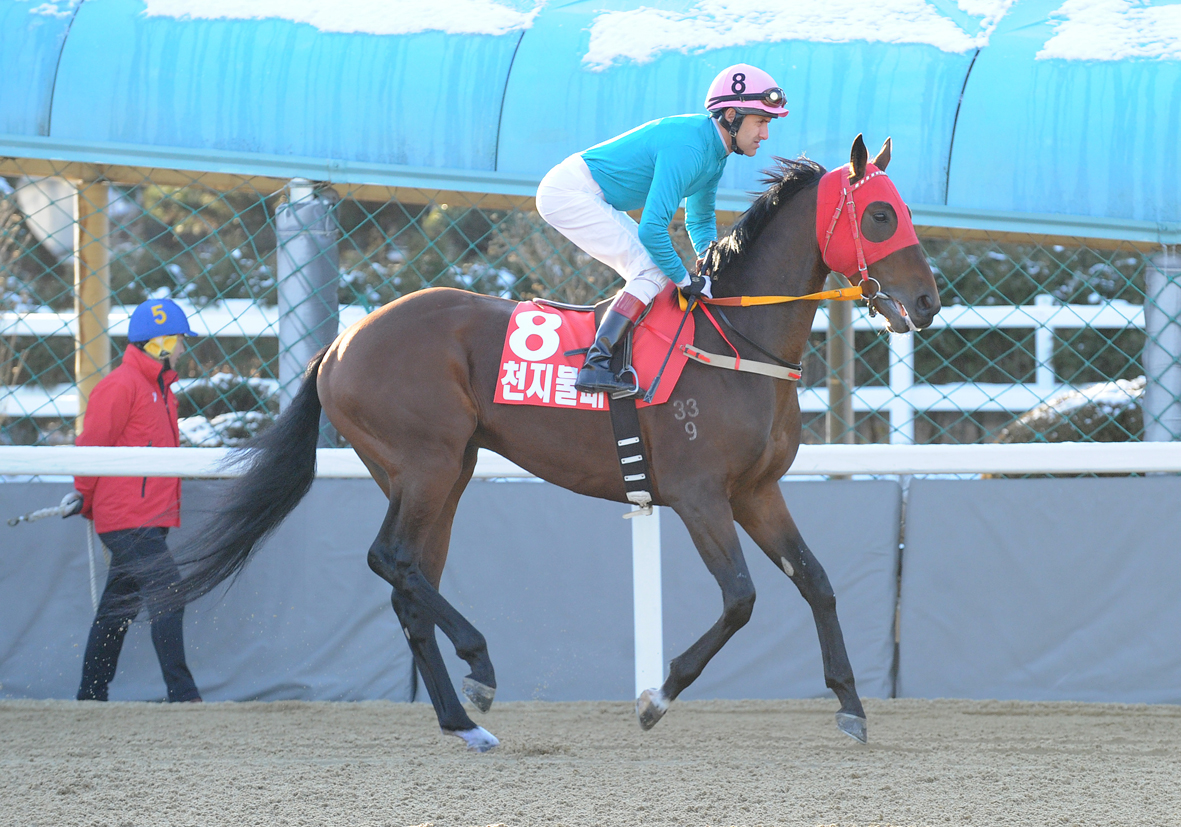
In 2012, Feel So Good became the first Korean horse to win a race in the United States. Last month, Seoul Bullet set a record of his own, albeit a rather less auspicious one, as he became the first Korean-bred horse to get claimed out of a race.

Seoul Bullet on his way to the USA last year (KRA)

Seoul Bullet on his way to the USA last year (KRA)

Seoul Bullet (Peace Rules) is one of three horses who left Korea over a year ago for initial training and racing in the US as part of a program that the Korea Racing Authority (KRA) has been running for three years now.

The gelding made his racing debut at Gulfstream Park on December 8 last year and finished a very creditable 3rd of eight over six-furlongs in a maiden claiming race. His 2nd start came in January, also at Gulfstream in slightly better company ended in him coming home 6th of nine.

Next up he was dropped back in at the same track in race 4 on February 7, with a claiming tag of $20,000. He ran poorly, finishing 5th of 6, however, to general bemusement, he was claimed by Marco Thoroughbred Corp. and found himself on the way to the barn of trainer Bobby S. Dibona.

Neither of the other two horses Stateside, who like Seoul Bbullet, are with trainer J. David Braddy, have had a hugely eventful time. Gangnam Camp (Forest Camp) has managed no better than 7th in three starts to date while Better Than You (Ft.Stockton) grabbed 4th on his debut but has struggled in two starts since.

Just like Feel So Good and all other Korean horses who run in the US, the three are scheduled to be auctioned off to Domestic owners when they return to Korea later this year.

And the KRA needn’t call off the auction just yet. On February 23rd, they claimed Seoul Bullet back out of race 3 at Gulfstream for the same $20,000 tag. The sum total being a fortnight’s worth of stable and training fees saved.

* The Gulfstream Three aren’t the only Korean horses in the US at the moment. Up in Maryland, 2013 Derby winner Speedy First and Minister’s Cup winner Major King have been enduring one of the coldest winters in memory at Laurel Park where they are expected to begin a short campaign of racing later this month.

Smarty Moonhak Retired After Injury Relapse

Smarty Moonhak (Smarty Jones), one of the most talented and talked about horses to race in Korea in recent times, has been retired after suffering a recurrence of the tendonitis that had previously kept him off the track for over a year.

Smarty Moonhak (KRA)

Smarty Moonhak (KRA)

The 5-year-old had been spelled for a month after taking part in the Grand Prix Stakes in December but returned to Seoul Racecourse seemingly in good shape in mid-January. However, after several days of light work, swelling was noticed on January 31 and five days the return of the tendonitis was diagnosed.

Having had stem-cell treatment once already, the decision was taken to officially retire him and the horse has returned to Taepyeong Farm.

A $14,000 purchase from the 2010 Keeneland September Yearling Sale, Smarty Moonhak, out of the Black Tie Affair mare Madeira M’Dear, arrived in Korea in February 2011 and after acclimatizing at Taepyeong, was sent into the care of trainer Ko Ok Bong at Seoul Racecourse.

He made his racing debut in May of that year, finishing 2nd to New Zealand import Mister Captain – a horse who would have his own very promising career cut short through injury after just three starts. Smarty Moonhak was sent off at odds of 24/1 in that race but he was the odds-on favourite by the time of his next start where he broke his maiden with a comfortable win over 6 furlongs.

Phenom: Smarty Moonhak wins the TJK Trophy as a 2-year-old (KRA)

Phenom: Smarty Moonhak wins the TJK Trophy as a 2-year-old (KRA)

He would stroll his next 3 races too, culminating in a eleven-length win in the Listed TJK Trophy at the beginning of November. Despite only being 2-years-old, he came back from that race, which was run over 1800 metres, looking as though he could have quite easily have gone round again.

It was because of this that his name was added to the ballot for the season-ending Grand Prix Stakes – a race similar to Japan’s Arima Kinen in that racing fans get to vote on which horses they want to see run in the season-ending showpiece.

Smarty Moonhak was voted in by a landslide becoming the first ever Juvenile to take part. On the day, He ran a game and valiant 3rd behind Horse of the Year Tough Win and the defending champion Mister Park. Despite not being eligible for the Triple Crown, Smarty Moonhak’s 3-year-old campaign was the most highly anticipated in years.

That campaign started as expected. Four consecutive routine wins meant that he arrived on the South coast for the Busan Mayor’s Trophy – informally known as the “Summer Grand Prix” as the overwhelming favourite.

He ran well that evening but while he was always towards the front of the field, he never looked like catching the winner, Dangdae Bulpae, who he finished two lengths adrift of in 2nd.

When he returned to Seoul, however, detailed veterinary examinations revealed that Smarty Moonhak was suffering from tendonitis in his left-foreleg. It was a very similar injury to the one that ended the career of that year’s Kentucky Derby and Preakness winner I’ll Have Another on the eve of his bid to sweep the US Triple Crown.

The stem cell treatment process was a long one and if truth be told, few expected Smarty Moonhak to ever race again. Nevertheless, in July 2013, a year after his diagnosis, he was quietly returned to the racecourse.

It was with a different trainer – he’d been away for so long that Mr. Ko had retired in the meantime. A month later he breezed through his race-trial before making his comeback in a low-key class 1 race in early October. He finished 6th but more importantly, came through unscathed and looking sharp.

A month later, he was back in the winner’s circle, making a dashing late run to win a class 1 sprint over 6 furlongs. That was enough for him to once more be voted into the Grand Prix Stakes. In what would ultimately be his last race, he showed at the front early before fading into a mid-field finish.

Of course, with hindsight, he shouldn’t have come back at all. But almost all racing fans here will have to admit to have being delighted when he did. Now that delight is replaced with relief that he didn’t suffer an even worse injury.

Smarty Moonhak's final win (KRA)

Smarty Moonhak’s final win (KRA)

A half-brother has just been born. Smarty’s dam, Maderira M’Dear, was imported to Korea in 2012 and recently delivered a colt by Ecton Park. We will be looking out for him on the Korean Triple Crown trail in 2017. As for Smarty Moonhak himelf, he is recuperating at Taepyeong Farm before most likely becoming the resident stallion in the small breeding operation there.

Overall, he ran 14 times, winning 9 of them and won about $600,000. He also gained an overseas following by virtue of being a son of the wildly popular Kentucky Derby and Preakness Stakes winner Smarty Jones. Although he may never have come close to reaching his true potential, in terms of impact, few have matched Smarty Moonhak.

Holland & Wolsley Clean-Up At Busan

The emerging combination of Australian trainer Peter Wolsley and British jockey Darryll Holland was in top-form on Friday with the pair combining for 4 winners at Busan.

Darryll Holland weighed in a winner for Peter Wolsley  4 times on Friday

Darryll Holland weighed in a winner for Peter Wolsley 4 times on Friday

It looked for a time that South African trainer Bart Rice’s debut winner was going to be the story of the day among Busan’s foreign contingent.

However, Wolsley and Holland took over, winning race 5 with 11/1 Never Seen Before (Ecton Park), race 6 with even-money favourite Bulpae Dongja (Purge) and race 7 with 2/1 favourite Cinderella Man (Southern Image), the latter an 8-length stroll.

They weren’t finished either as they returned to take race 10, with 8/1 Gaseumeuro (Pico Central) getting the better of a very tight finish with the Masa Tanaka ridden Sea Monster.

With Wolsley’s stable jockey Jo Sung Gon in Macau for the first few months of 2014, the Wolsley, Holland partnership is one that will be watched closely – by punters and rivals.

Yesterday’s wins took Holland to the top of the 2014 Busan Jockey Chaampionship with 10. Wolsley is joint-top of the trainers’ table with 7 alongside Kim Young Kwan.

* In Friday’s feature race at Busan, there was a welcome return to the winner’s circle for Gyeongbudaero (Menifee).

The 2012 KRA Cup Mile winner was 6th in the Grand Prix Stakes on his last outing in December and out-battled US import Donggeupchoegang (Bernstein) – to who he was conceding 7 kilos – to win the 1900M class 1 event by a nose.

South African Trainer Bart Rice Debuts With Winner

Bart Rice, who arrived in Korea at the end of last autumn, finally sent out a runner at Busan Race Park on Friday afternoon and he fond immediate success as that runner, Gyeongnam Sinhwa, won race 3.

Debut winner: Bart Rice (KRA)

Debut winner: Bart Rice (KRA)

The 37-year-old, who is the 3rd foreign trainer to be licensed in Korea, has put together a string of 22 horses since his arrival although – no fault of the trainer – they appear to be in varying states of race-readiness.

US import Gyeongnam Sinhwa (Keyed Entry) was himself making his racecourse debut and after being sent off at odds of 8/1, landed victory by a length under French jockey Jerome Lermyte, who was himself scoring only his 2nd win in Korea.

Rice’s other 2 runners on Friday were unplaced but his 33.3% strike rate will stand for some time. He doesn’t have any entires on Sunday and racing takes a break next weekend for the Lunar New Year holiday.

Korean Classic Winners Speedy First & Major King In USA For 2014 Campaign

Korean Derby and Oaks winner Speedy First and Minister’s Cup winner Major King are in the United States where they will be trained and raced for at least the first part of the year.

Stateside: Korean Derby and Oaks winner Speedy First

Stateside: Korean Derby and Oaks winner Speedy First

The pair, who between them won 3 of the 4 Korean Classic races in 2013, arrived at JFK Airport last week and are currently in quarantine. They are then expected to transfer to Laurel Park in Maryland to enter training.

Speedy First [Menifee – Speedy Deedy (Victory Gallop)] is a 4-year-old filly who has won 6 of her 10 starts to date. In May last year, she became the 5th filly to win the Korean Derby and added another classic in August with a comfortable win in the Oaks at Busan.

Major King [Pico Central – Still Golden (Gold Fever)] was third in the Derby, but had his revenge in the Minister’s Cup, the final leg of the Triple Crown when he scored a 2-length win. An out of sorts Speedy First finishing last that day.

He might have fluffy ears, but Major King is a Classic winner. he is also in the US

He might have fluffy ears, but Major King is a Classic winner. he is also in the US

Neither finished the 2013 season especially strongly, Speedy First slumping to another defeat in the Gyeongnam Governor’s Cup while Major King was an also ran in the President’s Cup, the effects of a long season being blamed for both.

They are by no means the first Korea bred horses to run Stateside. In 2008, a horse called Pick Me Up went to the US and ran – extremely unsuccessfully – at Charles Town, Laurel and Delaware Park. A year later, 2007 Korean Oaks winner Baekpa also went across and ran similarly poorly.

That prompted the Korea Racing Authority to change their approach a little and to send a small group of yearlings and 2-year-olds to Florida each year in the hope of proving their belief that it wasn’t necessarily that Korean-bred horses could compete if trained the same way as their American counterparts.

They got their reward when Feel So Good won a race at Calder in September 2012. Now they’ve decided to try again with established horses.

If all goes to plan, Speedy First and Major King will make their American debuts in April. We’ll be following their progress.

Speedy First winning the 2013 Korean Derby

Major King winning the 2013 Minister’s Cup

He’s Gon! Top Busan Jockey Jo In Macau For 6 Months

Jo Sung Gon has been granted a 6-month license to ride in Macau. The reigning champion jockey at Busan Race Park will have his first rides at Taipa this weekend.

Going...going...Jo Sung Gon is Macau bound

Going…going…Jo Sung Gon is Macau bound

31-uear-old Jo has won more races at Busan than any other jockey, with 480 since the track opened and has a career quinella strike-rate of 27%.

Jo’s big race wins include the Korean Derby in 2009 on Sangseung Ilro and the Korean Oaks in 2012 on Rising Glory, although he’s best known for his partnership with the recently retired Dangdae Bulpae, on who he won a Minsister’s Cup and 3 consecutive President’s Cups.

Most recently, Jo has been stable jockey to Australian trainer Peter Wolsley. He follows on from Seoul’s champion jockey Moon Se Young who also had a stint in Macau this time last year.

Jo will debut this Sunday with rides in six of the seven races on the card, including two for Korean trainer Seo Beom Seok who since the middle of last year has been simultaneously operating stables at both Seoul and Taipa.

2014 Racing Schedule

Well that was a short break. 2014 racing gets underway at Busan on Friday and the full racing calendar is now online. Be sure to check the blog every Thursday for the preview and any potential changes.

We're back. That was a very short break.

We’re back. That was a very short break.

Click here for the full schedule

As ususal, there is racing at Seoul every Saturday and Sunday, Busan ever Friday and Sunday and Jeju (pony racing) every Friday and Saturday.

The Stakes race schedule will be uploaded very soon.

MBC Gayo Daejun Sees In 2014 At Seoul Racecourse

The MBC network’s “Gayo Daejun” – the annual K-Pop marathon that traditionally sees in the New Year, marked 2014 being the Year of the Horse with a special performance at Seoul Racecourse shown just before midnight last night.

CN Blue at Seoul Racecourse

CN Blue at Seoul Racecourse

The segment, which was pre-recorded, featured “pop rock” group CNBLUE performing under the floodlights on the winning line at a deserted track.

Gayo CNblue2

The 5-hour long live broadcast Gayo Daejun (or “Song Festival”) has been airing in some form on New Year’s Eve since the mid 1960’s.

Record-Breaking Stakes Winner Dangdae Bulpae Retired

Dangdae Bulpae, a three-time winner of the President’s Cup, has been retired.

Dangdae Bulpae in the President's Cup winner's circle - a place he made his own

Dangdae Bulpae in the President’s Cup winner’s circle – a place he made his own

A winner of 19 of his 32 starts, Dangdae Bulpae won a Korean record 10 Stakes victories and amassed a record KRW 2.9 Billion (around US$2.6Million) in prize money. Among those Stakes wins were three consecutive triumphs in Korea’s richest race, the President’s Cup.

By the unfashionable – and generally unsuccessful – Japanese sire Biwa Shinseiki and out of the Alydeed mare Indeed My Dear, Dangdae Bulpae debuted as a 2-year-old in 2009, running a rather inauspicious 5th place over 5-furlongs. He won his next 4 though, which was enough to allow him to take his chance in the 2010 Spring Classics.

Jo Sung Gon reacts as Dangdae Bulpae crosses the finish line (Pic: Newsis)

Jo Sung Gon reacts as Dangdae Bulpae crosses the finish line (Pic: Newsis)

He could only manage 8th in the KRA Cup Mile but on his first trip to Seoul, he was an impressive 3rd in the Korean Derby behind Cheonnyeon Daero. The winner that day would spend most of the rest of his career looking at Dangdae Bulpae’s tail.

Maturing in the autumn, Dangdae Bulpae won the final leg of the Triple Crown, the Minister’s Cup and then landed the first of his President’s Cups.

This set the tone for the next two years and although he had the occasional off-day – neither of his two attempts on the Grand Prix Stakes were successful – he and the late great Mister Park became the dominant Korean bred horses of their era.

He generally came off second-best to Mister Park, including one comical afternoon where the two found themselves facing each other with 1st year apprentice jockeys on their backs as both trainers baulked at the weights they’d been assigned in the handicap.

Most of the time though, things were serious and Dangdae Bulpae was a serious racehorse. While the 2300 metres of the Grand Pix proved out of his distance range, he did win the “Summer Grand Prix”, the Busan Mayor’s Trophy in 2012 in a another golden year that culminated in his 3rd and final President’s Cup triumph.

2013 saw him add another Stakes win – the Busan Ilbo Cup in February – but injury then intervened and it was a very different Dangdae Bulpae who lined up in Seoul last month to try for his 4th President’s Cup. He ran a shadow of his former self and retirement was immediately decided on. Dangdae Bulpae had done quite enough.

Horse racing in Korea although run on the flat, is similar to jumps racing in that its stars can have reasonably long careers on the track. From a sporting point of view, this is an overwhelming positive as we get to follow our favourites for a number of years. From a welfare point of view, it relies heavily on owners doing the right thing by their horses both before and after retirement.

Since I started writing this blog back in 2007, there have been perhaps two big “eras” of Korean racing. The first, from 2007 until mid-2010, was dominated by an American import, Dongbanui Gangja. However, the star of the second, from mid-2010 to the present, was the home-grown Dangdae Bulpae. He’ll be missed but has thoroughly earned his retirement to stud.

Jigeum I Sungan Has Had His Moment

Jigeum I Sungan is set for retirement following his 2nd-place finish to Indie Band in the Grand Prix Stakes last Sunday.

Jigeum I Sungan

Jigeum I Sungan

The 4-year-old colt heads off to Stud with career figures of 13 wins from 25 starts and earnings of over US$1.6 Million.

Champion jockey Moon Se Young rode Jigeum I Sungan in all his big races

Champion jockey Moon Se Young rode Jigeum I Sungan in all his big races

After winning his debut race, Jigeum I Sungan [Ingrandire – Solmaru (Mujaazif)] didn’t return to the winner’s circle until his 8th start, which was his 2nd as a 3-year-old.

He was 5th in the KRA Cup Mile, the first leg of the Triple Crown, but did enough to qualify for the Derby, which he went on to win by a length.

Jigeum I Sungan allows punters to pet him after he won the Jeju Cup. Try doing that with Tough Win or Dongnaui Gangja and they'd have eaten you.

Jigeum I Sungan allows punters to pet him after he won the Jeju Cup. Try doing that with Tough Win or Dongnaui Gangja and they’d have eaten you.

He followed up in the autumn by taking the final jewel of the Crown, the Minister’s Cup, this time by a commanding 4-lengths. A month later he ran 2nd to Dangdae Bulpae in the President’s Cup but to the disappointment of punters, was kept away from the Grand Prix.

It was this year though that he hit his peak. Jigeum I Sungan began 2013 with 6 consecutive wins, among them the Seoul Owners’ Cup and the inaugural Jeju Governor’s Cup.

His run finally came to an end in the Turkey Jockey Club Cup in August although he quickly bounced back from that to record what would turn out to be his last victory in September.

He closed out his career with a 3rd place in the President’s Cup and then finally his 2nd on Sunday, both times behind Indie Band.

Jigeum I Sungan – “This Is The Moment” in English – has been one of the stand-out performers of the last few years in Korean racing and will be missed. He deserves the retirement that he’s been promised.