News

Peter Wolsley, Gyeongbudaero and Tough Win Stories of 2015 So Far

We say goodbye to the Year of the horse and enter the Year of the Sheep…or goat or ram or whichever hooved and horned animal it actually is; there is some disagreement in these parts. There is no racing this weekend on account of the holiday, so it’s a good opportunity to take stock of what has happened during the first six weeks of racing:
image

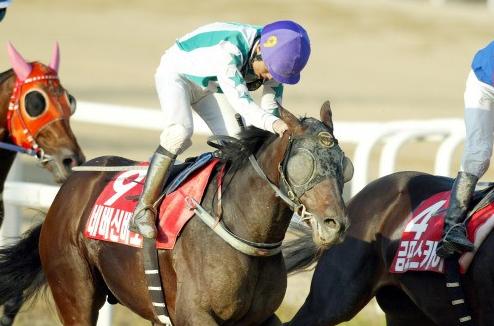
Never Seen Before and Lee Hee Cheon win the Minister's Cup. Lee and Peter Wolsley are in great from this year

* Peter Wolsley is on fire: With five winners across last weekend, trainer Peter Wolsley has shot to the top of the Busan Trainers’ Championship, leading the Kim Young Kwan machine by 14 winners to 12 and 49% of all runners placing first or second. Wolsley has some solid talent in his stable at the moment and also a pair of in-form stable jockeys in the shape of champion rider Jo Sung Gon but also with Lee Hee Cheon, who has been an absolute revelation under the Australian’s tutelage over the past few months. Such is the firepower that is always available to him, Kim Young Kwan will amost certainly take the ultimate prize but it looks set fair for another very good season for Wolsley.

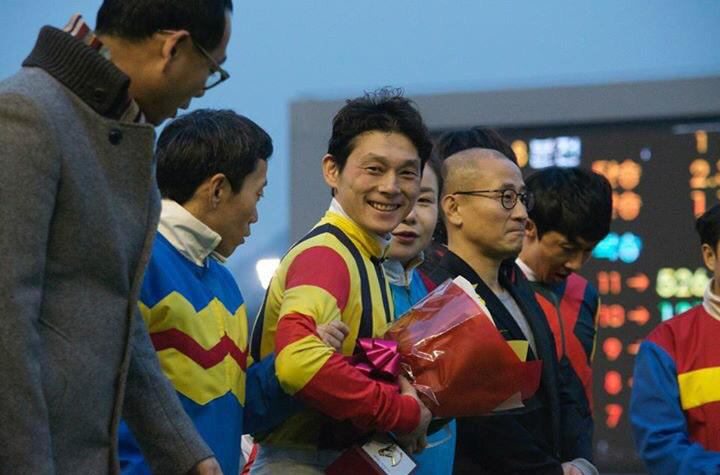
This Korean language blog, which I’ve just seen for the first time has some really good pictures of Wolsley and Lee Hee Cheon winning the Minister’s Cup with Never Seen Before last October.

* Tough Win is back: The 2011 Grand Prix Champion’s best days looked to be behind him but he returned to the winner’s circle for the first time for 18 months in January and then followed it up last week with another victory; his 24th from 37 career starts and took him to over $2Million in prize-money. He’s done it in style too, closing from dead-last in the home straight. As long-time racing observer Thomas Song pointed out on this site, closing to defeat tired frontrunners is the only way Tough Win can run these days, but it is thrilling to watch and hopefully there is plenty more to come.

* We have some good three-year-olds: The likes of Cosmos King at Seoul and Rafale and Doraon Hyeonpyo at Busan have all won around two-turns already and they, along with a number of others, should make for a fascinating Triple Crown series which this year, will be concluded by July.

* The new rating system is here to stay: Every horse in Korea now has a rating and aside for some Grade and Listed races, there are no longer races restricted to Korean bred horses at Class 1 and Class 2. It is hoped that the stronger competition will make for a better quality of Korean racehorse and more competitive racing for punters. The early evidence, especially at Busan, is positive. With horses able to move back down in class for the first time, we’ve seen some compelling contests already. Now that connections at Seoul have belatedly signed up to the changes too, racing in the capital – in need of a new lease of life for some seasons – will hopefully be on an upward spiral soon too.

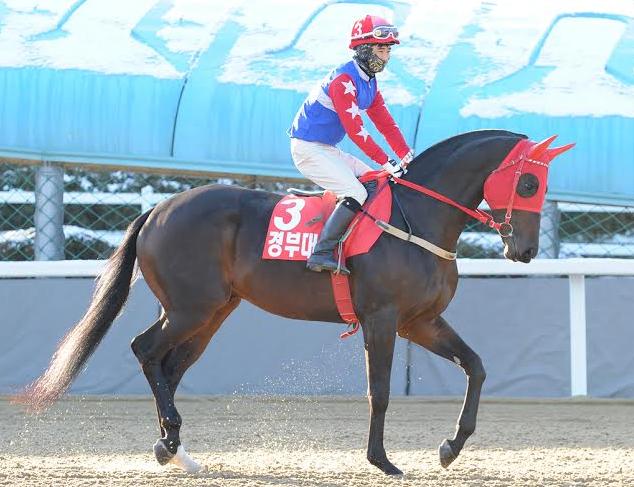
* Gyeongbudaero : If the KRA’s race-planners had scripted the first class 1 to be run under the new system, they would have come up with something like this. Six Korean bred horses faced off against six imported horses and after a tough battle, the locally bred Gyeongbudaero, carrying top weight of 60kg, prevailed. Winner of the 2014 President’s Cup and Grand Prix Stakes, Gyeongbudaero’s image was on the front of the KRA’s 2015 Race Plan booklet announcing the changes and he is undoubtedly the poster-horse of Korean racing right now.

Racing returns next weekend.
Tough Win Trousers Two Billion

Tough Win reached another milestone in his remarkable career at Seoul Racecourse on Saturday as the 8-year-old broke the 2 Billion Won mark in career prize money.

After spending much of 2014 on the sidelines, Tough Win roared back to form last month with an against the odds win in a big handicap. It was his first visit to the winner’s circle since his second triumph in the Busan Mayor’s Trophy in the summer of 2013. He didn’t have to wait long for a repeat.

Despite carrying top weight of 59kg and despite being up against rising-star Haemaru, who came into the race off the back of six consecutive victories, punters made Tough Win the favourite for Saturday’s feature class 1 event over 1800M.

And it was vintage Tough Win. With Cho Kyoung Ho having retired, it was yet another new jockey on board him for the first time. Lee Sang Hyeok had the honours and he took the 2011 Grand Prix Stakes winner right to the back as the exited the gate, giving the rest of the field a full ten lengths head start.

Tough Win likes it that way. Although they closed the gap a little, Tough Win remained last as they entered the home straight, going wide around the field to find his run. Once they did, the race was over. He hit the front a furlong out and eased home comfortably for a three-length victory ahead of outsider Double Shining. Haemaru was 3rd.

It was a 24th career victory for Tough Win (Yonaguska) on his 37th start. While cynics will, with some justification, point to a lack of strong competition at class 1 at Seoul right now giving him this window to return to the top (and it is undoubtedly weaker than it was when he was battling it out with the likes of Dongbanui Gangja four years ago) – his achievement is still  noteworthy.

It is very hard for an imported colt (or gelding as Tough Win is) to amass such an amount of prize money. Korean bred horses have the Triple Crown races and the President’s Cup while the best imported fillies such as Gamdonguibada can harvest the lucrative Queens’ Tour events. Tough Win has always had to do it the tough way.

Now we know that win in January wasn’t a fluke, the question is whether he can maintain it in the long season ahead. Principally, can he keep it up long enough to go to Busan to take on the current set of big boys in the summer for a tilt at a 3rd Mayor’s Cup?

Kurakane Collects NAR Award in Tokyo

Ikuyasu Kurakane picked up his Grand Prize award at the NAR Grand Prix ceremony in Tokyo on Thursday.

Kurakane among the award winners in Tokyo (Pic: Keiba.co.jp)

Kurakane among the award winners in Tokyo (Pic: Keiba.co.jp)

Kurakane was honoured for becoming the first foreign jockey to ride more than 100 winners in a year in Korea and being named Seoul Racecourse Jockey of the Year.

The popular rider is based at Kochi Racetrack in Japan which falls under the auspices of NAR which administers Local Government organised racing in that country.

Kurakane rode 101 winners at Seoul in 2014 from 674 rides including the KRA Cup Classic on Samjeong Jewang, the biggest win of his time in the country. The jockey previously rode at Seoul and Busan in 2007 and 2008 , returning in 2013 after a five-year absence.

That his wins came at Seoul makes his acheivement all the more impressive and his departure means there are currently no foreign riders in the capital’s weighing room. There are four Japanese jockeys riding in the more welcoming environment of Busan.

See here for a full rundown of the awards in English

New Owner Joe Dallao Teams Up With Trainer Bart Rice

Korea’s first foreign racehorse owner has been getting plenty of attention from the local media as he attended orientation for new owners at Busan this past weekend.

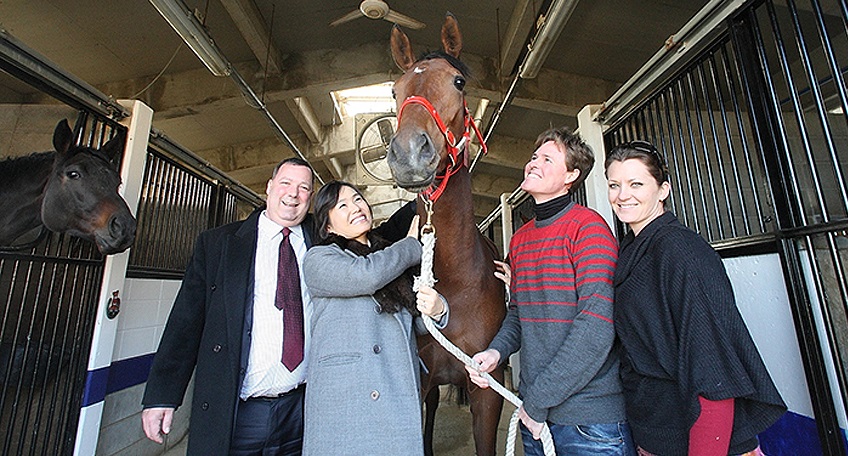
Joe Dallao (left) with his wife Young Sook at the Busan Racecourse stables with Bart and Pam Rice (Pic: Hankyoreh)

Joe Dallao (left) with his wife Young Sook at the Busan Racecourse stables with Bart and Pam Rice (Pic: Hankyoreh)

The Hankyoreh, Segye Ilbo and Kookmin Ilbo newspapers, among others, all carried the story of Dr. Joe Dallao making a little piece of Korean racing history. Having been based in Korea for a long time, Dallao’s path to ownership was a relatively smooth one once the Korea Racing Authority partially eased restrictions on non-Korean owners at the end of last year.

Impressed with his horsemanship and thorough business-like approach, Dallao has engaged Bart Rice as his trainer and the pair will immediately set about identifying and purchasing suitable horses with a view to start racing horses at Busan Racecourse in the late summer or early autumn.

A New York City native, Dr. Dallao has been a semi-regular fixture in the weekend crowd at Seoul Racecourse over the past few years. Having raced horses as a member of a syndicate in the US, he didn’t hesitate to strike out on his own in Korea when the opportunity arose.

The official entry of "Joseph Dallao" on the KRA's list of licensed owners

The official entry of “Joseph Dallao” on the KRA’s list of licensed owners

Dallao, who told the media that his ultimate aim is to take a Korean horse back to his hometown for the Belmont Stakes, is also known in Korea and elsewhere for successfully racing pigeons.

Joe Dallao and Bart Rice can be followed at the links below:

Dallao Thoroughbred Racing
Bart Rice Racing Stables

Gyeongbudaero Set To Lead Korean Racing Into New Era

Last weekend saw the end of any class 1 and class 2 races restricted to Korean bred horses. From now on, it is all against all at the highest level. And the nation’s best locally-bred horse, Gyeongbudaero, is immediately sent out to take on the challenge of the imports at Busan on Sunday.

Leading the line: Gyeongbudaero (Pic: Ross Holburt)

Leading the line: Gyeongbudaero (Pic: Ross Holburt)

The Korea Racing Authority’s decision to no longer set aside some class 1 & 2 races for domestic horses only has been controversial but is intended to eventually improve the quality of the locally bred horses. Every horse is now assigned a rating which will determine which class they can race in so to win the big money, they will need to beat imported horses.

At Busan, they’ve already been doing just that for quite some time. The likes of Mister Park, Dangdae Bulpae, Yeonseung Daero and latterly Indie Band and Gyeongbudaero have been the track’s main stars over the past few years. All were Korean bred and all took on and beat the imports. Among the current top ten rated horses at the track, five are Korean bred and five imported.

At Seoul, it is a little different. Asked to name the best horses from recent years, names likely to come up are Tough Win, Dongbanui Gangja, Smarty Moonhak and going back a couple of years further, Bally Brae and Subsidy. All were American bred. J.S. Hold and Myeongmun Gamun may get mentioned but they never managed to beat the imports and neither did  Jigeum I Sungan, who only ran in an open race one time. In fact, the mare Top Point is the only one who readily springs to mind. Only two of the current top-ten rated horses at Seoul are locally bred.

Beating all-comers: Dangdae Bulpae

Beating all-comers: Dangdae Bulpae

This is simplistic but perhaps helps illustrate one reason why there is more resistance to integrated racing in the capital. While there are class 1 and class 2 races scheduled for Busan this weekend, the KRA has already abandoned the ones it had planned for Seoul after the Owners’ Association made clear its members would not be making any entries. Indeed there is still a threat that this unofficial boycott may extend to all races in the capital. We will know at 4pm on Thursday.

This is unlikely but even if everything goes ahead as planned, one casualty has already been Friday and Saturday’s overseas simulcast. In the event of a large-scale cancellation of races at Seoul, the Busan race schedule could be amended. With that uncertainty, the KRA decided to cancel the simulcast as a precaution and at an early stage in order to allow overseas partners maximum time to secure races from elsewhere.

Whatever the rights and wrongs of its implementation, the change is one that needs to happen. Racing here must become more competitive and sterner tests for locally bred horses are essential in achieving this. For all the many things it can be questioned about, the KRA’s commitment to the breeding industry here isn’t one of them as is shown by its continued investment in better and better stallions. The Triple crown races will continue to be restricted to Korean bred horses.

That brings us back to Busan’s Sunday feature. Gyeongbudaero will be making his first appearance since winning the Grand Prix Stakes at Seoul in December and will be top weight in the 2000M handicap. Fittingly, there will be six Korean bred horses and six imported horses in the starting gate. Also among the Koreans is Gumpo Sky, who has won two consecutive class 1 races and faces imports for the first time.  Among those imports is Cheonji Bulpae, the 6th highest rated horse at Busan as well as Spring Gnarly who is unbeaten in seven starts since returning from a year’s layoff last May.

It makes for a fascinating contest for both the punter and the sportsman. If this is the kind of race we can look forward to on a regular basis, the change is surely one for the better.

Korea’s New Rating System Explained

It is the year of change for horse racing in Korea. The racing calendar has been revamped, foreign ownership of racehorses has been approved (see bottom of this article) and now a new rating system is coming in.

Yeonseung Daero - (Pic: KRA)

Yeonseung Daero usually ran against foreign opposition. In future he will be the rule, not the exception – (Pic: KRA)

Of all the changes, it is the rating system that has caused – and continues to cause – the most debate within Korean racing circles as what it means is that if Korean-bred horses are to win class 1 races, they will need to beat imported opposition. 

The KRA believes this will raise the quality of Korean horses. Local breeders and some owners disagree.

Under the new system, every horse will be assigned a rating from 0-140 to accurately reflect their current ability.  The rating will determine their eligibility for races and their handicap mark.

The ratings are for use in Korea only and are not intended to mirror what a horse’s international rating would be.

Over the past couple of months horses at Class 1 and Class 2 have already been receiving a monthly rating. This will now be rolled out to all classes.

The Current System

There are six classes in Korean racing (only five are used at Busan). Within each class, all races are further split into two categories:

Domestic: Races restricted to Korean-bred runners
Mixed/Foreign: Races open to both Korean and Foreign-bred runners.

Horses move up in class according to points earned for winning or placing in races and prize-money won. They can never return to a lower class, regardless of recent performance.

The New System

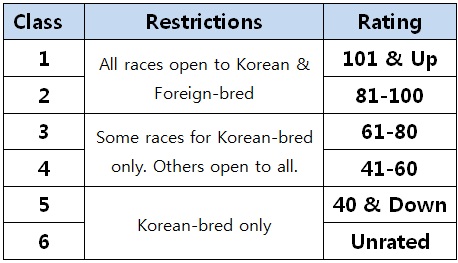
All horses will be assigned a rating which will determine which class they are eligible to run in. With the exception of some Stakes races, such as the Korean Derby, eligibility for all Class 1 and Class 2 races will be determined solely by their assigned ratings. The rating band for each class is as follows:

Ratings table


In Summary:

– All races at Class 1 and Class 2 will be open to both Korean-bred and Foreign-bred runners
– Some races at Class 3 and Class 4 will continue to be restricted to Korean-bred runners.
– All races at Class 5 and Class 6 will continue to be restricted to Korean-bred runners.
– Horse ratings may go up or down according to recent past performance. This means that a horse may move down in class as well as up.

On the subject of foreign ownership of racehorses, they will be allowed to buy up to fifteen horses, which is the same as local owners. However, unlike the locals, foreign owners must buy four Korean-bred horses for every foreign-bred horse they wish to import to Korea. This is one reason why it has been a slightly less controversial development than might otherwise have been expected.

Some of the first batch of foreign owners will be able to start purchasing at the 2-year-old sale on Jeju Island in March.

Beolmaui Kkum Heads January Ratings

Beolmaui Kkum remains the top-rated horse in Korea being pushed up one point following his Class 1 victory on Sunday. The latest Korean ratings, which were published on Monday, has the US-bred 5-year-old one point ahead of Grand Prix Stakes winner Gyeongbudaero.

Gyeongbudaero's Grand Prix Stakes win wasn't quite enough to see him to the top of the ratings. He is though, the top Korean bred horse  (Pic: Ross Holburt)

Gyeongbudaero’s Grand Prix Stakes win wasn’t quite enough to see him to the top of the ratings. He is though, the top Korean bred horse (Pic: Ross Holburt)

Wonder Bolt is Seoul’s top horse and is up two points following his Grand Prix Stakes win although he was scratched from his scheduled start on Sunday. He is now 7 points clear of his nearest rival in the capital. New entrants at the top of the list at Seoul include Clean Up Joy, who was 4th in the Grand Prix Stakes, while at Busan Success Story comes in following two dominant victories over the past month.

Dropping off the list is Indian Blue, who has been retired ready for the 2015 breeding season.

Seoul Top 30
Busan Top 30

For the first time the ratings, which are for domestic use only and are not intended to be compared to international ones, have been expanded to include all horses down to class 5. The ratings are one of a number of changes which have not been universally popular among some stakeholders – principally trainers. For now though, while there will always be disagreements between connections, punters and the handicappers, they are if nothing else, providing a talking point.

Round-Up: Beolmaui Kkum, Success Story, Rafale Impressive Winners / Japanese Riders Going Strong / Opposition To KRA’s Race Plan

While Seoul’s top horse, Wonder Bolt, was scratched from what was supposed to be his 2015 debut in the capital on Sunday, down at Busan there were some strong performances last weekend.

Beolmaui Kkum was a winner on Sunday (Pic: Ross Holburt)

Beolmaui Kkum was a winner on Sunday (Pic: Ross Holburt)

Beolmaui Kkum (Put It Back), who for the second year running, couldn’t quite get it done in the Season-ending Grand Prix Stakes a month ago, returned to Busan and returned to the winner’s enclosure on Sunday afternoon. The 5-year-old carried top weight of 60kg for the 1900M Class 1 race, a full 8kg more than the other nine runners, but that didn’t stop him leading from gate-to-wire, running on for a two length victory, his 12th from 18th career starts.

Another who disappointed on his visits to Seoul last year was Success Story. A late arrival on the Triple Crown trail, he was 4th in the Minister’s Cup and last October and then a disappointing 10th in the President’s Cup a month later. Both those races were run over 2000M but on his return to Busan in December, he blitzed a class 2 field by a full seventeen lengths at 1400M. On Friday, Success Story (Peace Rules) was stepped up to a mile on what was his first try at a class 1 handicap.

And the results were impressive. Jockey Jo Sung Gon took the 4-year-old to the front right out of the gate and the pair stayed there for a very easy 8-length win. Success Story is going to be one to watch out for this year, possibly, with his sprinting credentials as they are, for such event as the Asia Challenge Cup.

There was also interest at Busan last Friday for this year’s Triple Crown. Rafale (Colors Flying), 2nd in the Breeders’ Cup race at Seoul at the end of November, made his own 2015 debut and his first attempt on the Derby distance of 1800M. It was a successful one with the colt streaking away for a 7-length win on the line. Rafale joins Doraon Hyeonpyo at Busan and Cosmos King at Seoul as having made very impressive first tries around two-turns and this year’s 3-year-old crop looks to be shaping up very nicely ahead of the first leg of the Crown, the KRA Cup Mile at Busan on April 5.

In other news, the Japanese jockey contingent continues to go strong. Ikuyasu Kurakane looks set to ride winners right until the bitter end at Seoul. The 2014 Jockey of the Year rode another two on Sunday. At Busan, Joe Fujii continues to be his consistent self, guiding 4/1 chance Battle Master to victory on Sunday while Masa Tanaka’s strong start to the year shows no signs of abating.

Tanaka ride two more winners across the weekend, first on Nobel Shinhwa (Ecton Park) on Friday and then on Sunday on Triple Nine (Ecton Park). The latter was a 5-length win on a favourite for Busan’s top trainer Kim Young Kwan. Even though he managed to pick up a ban as well, that kind of result bodes extremely well for Tanaka. He lies in 5th in the Jockey Championship with 5 winners from 23 mounts, just behind Fujii who is in 3rd with 6 from 33.

On the political front, the Korea Racing Authority’s new race plan for 2015, which has embraced a new rating system, a revamped Stakes calendar and permission for foreign ownership of racehorses, is being resisted by a coalition of breeders, owners and trainers. While such a disparate group is never, within itself, going to have the same priorities, one thing they do appear to agree on was that they were not consulted in the way they would have liked. There are interesting times ahead in the next few weeks

Big Changes As KRA Overhauls Its Racing Calendar

The Korea Racing Authority (KRA) has announced a major shake-up of of the racing calendar for 2015 as it seeks to strengthen the competitiveness of Korean horse racing and further its goal of being promoted to a Part 2 country.

All change in 2015

All change in 2015

The changes – which have been an open-secret for some time but were finally posted on the Authority’s Korean language website on Friday – coincide with the introduction of a new rating system that will see domestic-bred horses run against imported horses with far more regularity than they do now (although the Triple Crown remains restricted to Korean-bred entrants). The new calendar also adds International Open races to the the International Invitational ones which have been held in the past two years.

Here are the major changes:

Triple Crown: While the individual races which make up the Triple Crown remain the same, the final leg will be brought forward from October to July so the three jewels will be as follows:

April 5: KRA Cup Mile (Busan)
May 17: Korean Derby (Seoul)
July 19: Minister’s Cup (Seoul)

The Korean Oaks will also move forward from its previous August date and will be run at Busan on June 21. The Oaks will be the final leg of the “Filly Triple Crown” after the Cup Mile and the Derby.

Queens’ Tour: The three races that made up this series were previously spread over a period of 8 months which meant the line-up for the last leg was often unrecognisable from the first. To remedy this, the Ttukseom Cup at Seoul, has now been put back to June with the two Busan legs, the KNN Cup and South Gyeongsang Governor’s Cup being in September and November respectively.

International: Five races have been designated as open to international runners. The JRA Trophy in May and the aforementioned Ttukseom Cup in June will be international open races while the SBS Asia Challenge Cup will be the centrepiece of a huge weekend at the end of August. The Cup itself will be an international invitational race as it was last year, however, the Singapore Turf Club Trophy and the KRA Cup Classic will be run on the same weekend and wil be designated international open races. Qurantine protocols have already been established with both Japan and Singapore while others are being worked on currently.

Recognised Trial Races: While this blog has talked for years about such and such race being a trial for such and such another race but it’s never been officially that way. Now though, taking March 1 as an example, the Macau Jockey Club Trophy at Busan and the Sports Seoul Cup in the capital will both be official Korean Oaks trials.

More Opportunities For Sprinters: If Korean horses are to eventually compete on the international stage, it is most likely to be at sprint distances and with that in mind, there are more opportunities for them to run for big prizes. Both the Asia Challenge Cup and the Jeju Governor’s Cup will be sprints and both will also have official prep races.

Click here for the full 2015 schedule

More Acclaim For Ikuyasu Kurakane With NAR Special Prize

The exploits of Ikuyasu Kurakane, who was recently named Seoul Racecourse Jockey of the Year, have now earned him recognition in his home country with the Japanese rider set to receive a “Special Award” at the upcoming NAR Grand Prix in Tokyo on February 5.

Ikuyasu is becoming accustomed to receiving prizes (Pic: Hiromi Kobayashi)

Ikuyasu is becoming accustomed to receiving prizes (Pic: Hiromi Kobayashi)

Although he didn’t win the Seoul Jockey Championship, Ikuyasu rode 102 winners in 2014 including his first Korean Group win, which came on Samjeong Jewang in the KRA Cup Classic in October. That, combined with the fact that he had achieved his total with significantly less quality rides at his disposal than his rivals, was enough for the Korean poll to go his way.

Now that news has reached Japan. The Special Award generally goes to a rider who has reached a particular milestone in his or her carrer but it is unusual for the NAR to grant such an award for a Jockey’s performance overseas. Previous winners include one-time Busan based Hitomi Miyashita, who was recognized on her retirement in 2011.

Kurakane, who’s home track is the NAR’s Kochi Racecourse, is currently in his second stint in Korea, having previously ridden at Seoul and Busan between 2007 and 2008.

Taking both times into consideration, he has 285 winners from 2293 rides in Korea. Remarkably, it is a record that puts him 11th on the all-time leading jockey list at Seoul Racecourse.