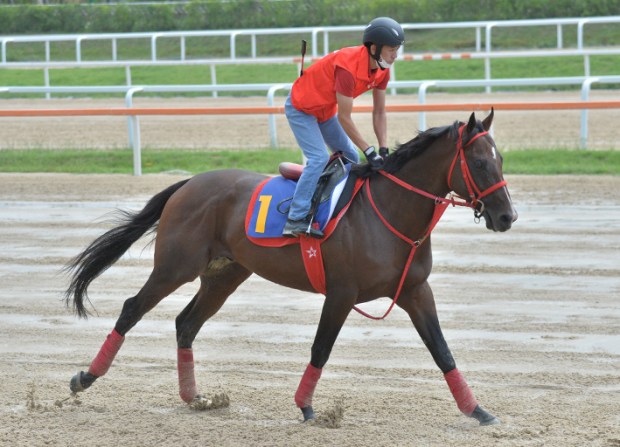
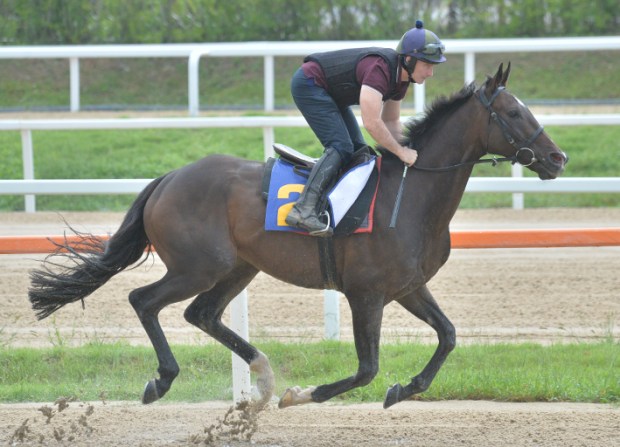
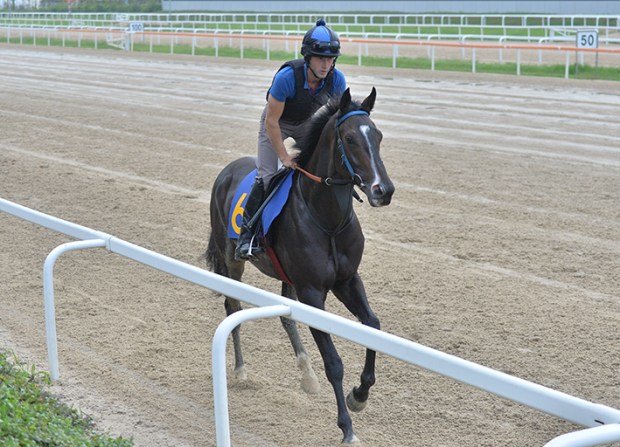
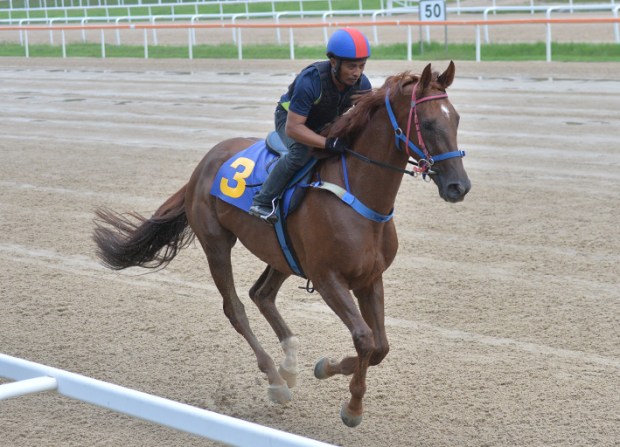
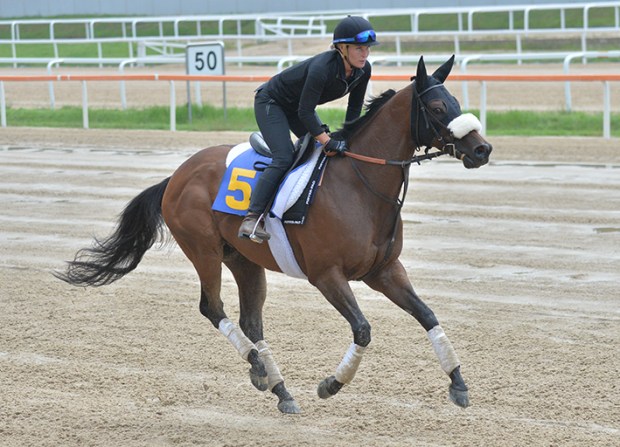
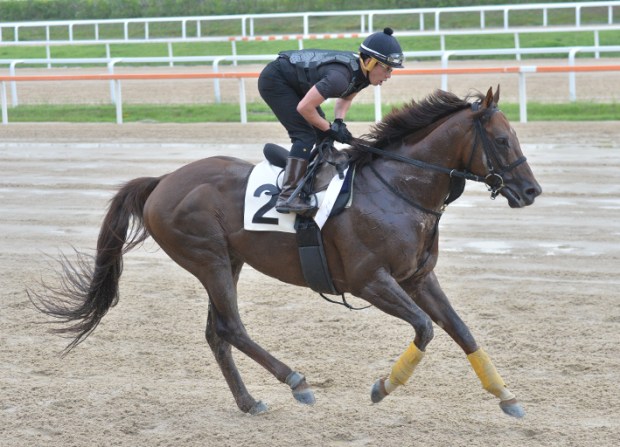
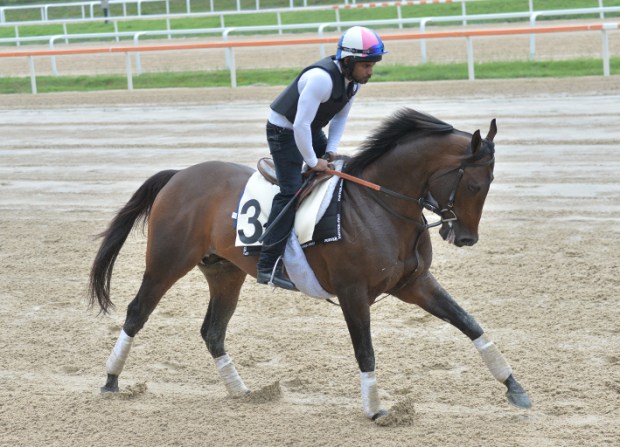
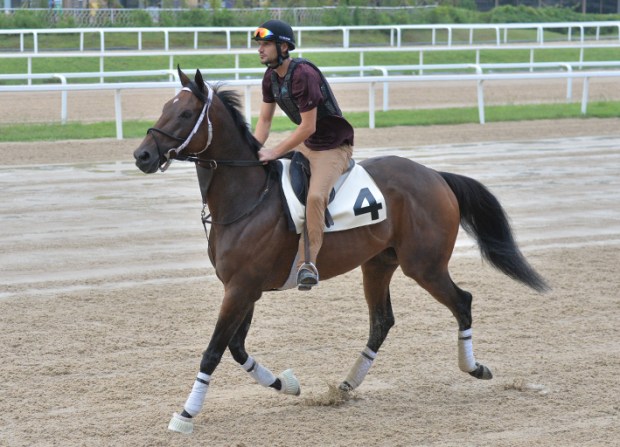
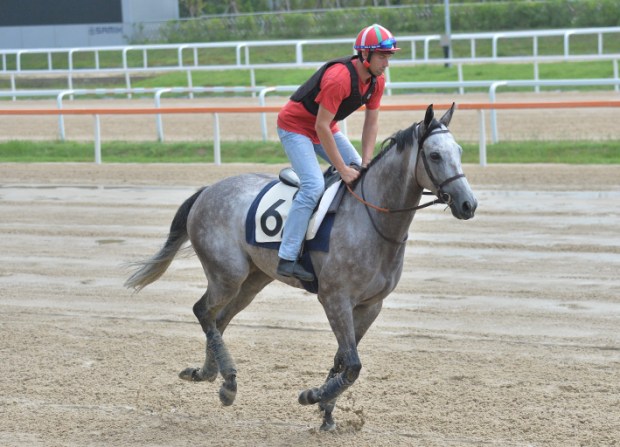
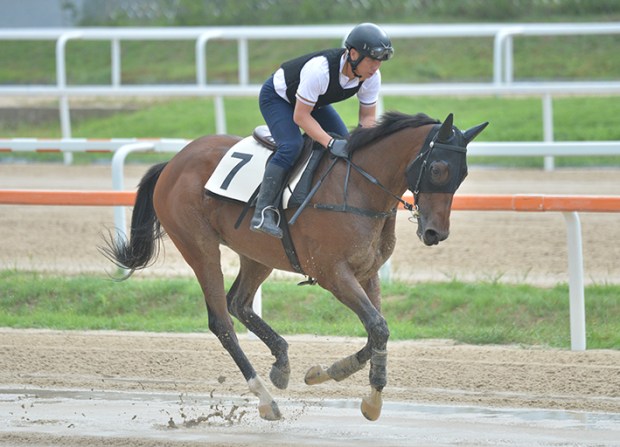
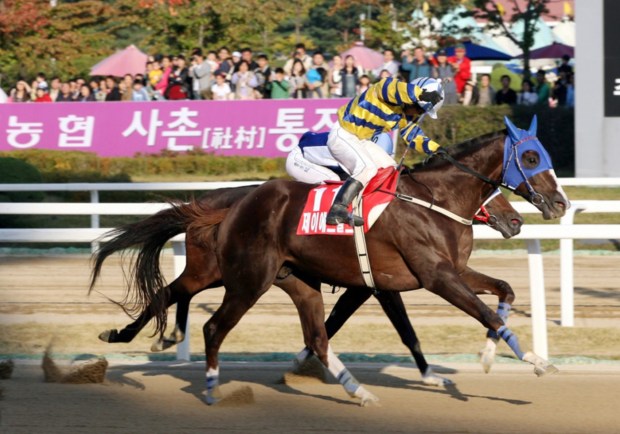
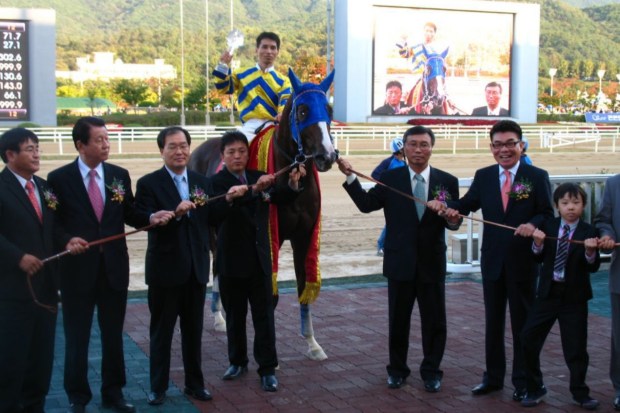
All ten overseas-trained horses for the 2018 Keeneland Korea Cup & Sprint have now arrived and all worked on the track at Seoul Racecourse on Tuesday morning.
Japanese pair London Town and Moanin schooled in the parade ring as did Hong Kong’s Fight Hero. They were later joined by Riven Light and King Malpic, while the remainder did light work on the track. All ten are expected to be out again at 4:30am on Wednesday. All pictures by Ross Holburt for Korea Racing Authority:
“Webtoons” have become very popular in Korea in recent times and the KRA’s broadcasting arm has recently released its own racing-focused one on Facebook.
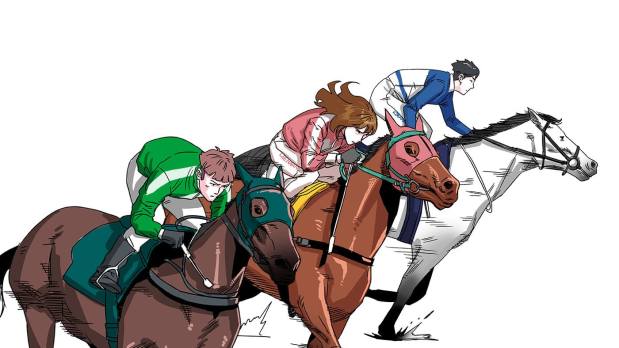
From left: Charming Girl (!), Dangdae Bulpae and Baekgwang in webtoon form (Pic: Track)
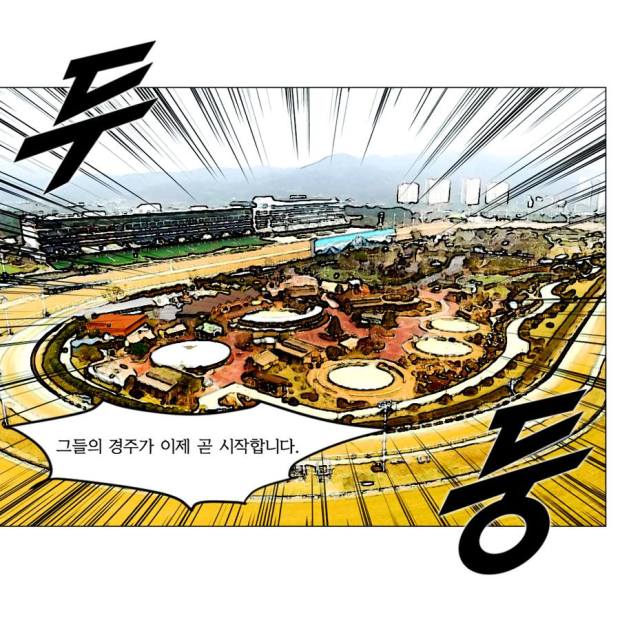
The series, called “Track”, which is so far up to episode 3, tells the story of three apprentice jockeys preparing for the Korea Cup of 2020 and features appearances by three of the best-known horses in Korea; Baekgwang, Dangdae Bulpae and er….Charming Girl.
Currently it’s only in Korean so outside of the peninsula it may only be of interest to those learning the language but the three episodes to date still have some fun pictures to scroll through.
The Korea Racing Authority Trophy will be run at Kranji Racecourse in Singapore on Sunday and for the fourth year in a row, Korean horses will be taking part. The record of those who have made the trip in previous years is somewhat less than stellar so can Today, Gakbyeolhan and Approach do differently this time around?
First the history, and it’s not good from a Korean perspective. 2015 saw the inaugural running of the race with Gamdonguibada, Cheon Gu and Nobody Catch Me making the trip. Cheon Gu led into the home-straight before tiring and being passed. Gamdonguibada, perhaps predictably for a miler dropping down to six furlongs, took a while to get going and never really fired, beating just one. Nobody Catch Me, however, ran on well for 6th place, just over four lengths behind the winner.
In 2016, it was the turn of Always Winner, Triple Five and Parang Juuibo with the latter of them being the best finisher, matching Nobody Catch Me’s 6th. Last year neither Choegangja, who was highly thought-of going into the race, nor Zentenary – who was less so – were able to make much impact, with Choegangja coming back with heat-stroke.
While the surface is evidently very different, that alone is insufficient in explaining away the hitherto poor performances; Korean horses have run well on dirt in Dubai, albeit with a longer acclimatization period. The tempo of the races is also something that tends to test Korean-trained horses when going overseas with a higher “cruising speed” required rather than the “go as fast as you can from the gate” tempo that tends to be prevalent here. They’re capable of doing it but it isn’t easy – Power Blade, for example, ran very well in Dubai but he was an exhausting watch with his rider having to contantly battle simply to keep him in contention.
So can this year’s trio make an impression? On paper, we should be very excited about Today (Drosselmeyer) and if the race was on the Korean sand, he would be the favourite. And if he takes to the polytrack even slightly, then he should be right in it. Paper isn’t polytrack though. A winner of 10 from 13, the one concern is that when Today finally met top class opposition in the SBS Sports Sprint at Seoul in early June, he came up slightly short running 3rd behind Doraonpogyeongseon and Choegang Schiller – both very accomplished sprinters. It was also his first time racing away from his home track of Busan. Da Silva rode him for the first time that day and explained that he didn’t feel the horse was as balanced as he could have been but still ran well.
In Today’s favour, he is still relatively young at four and with just those thirteen starts behind him, is perhaps not so set in his ways as to find it impossible to adapt to a different tempo of race running. He is very nicely drawn in gate 7 but he doesn’t need to lead from the start. This is a horse who has run 1:11.1 for the 1200M on the sand of Busan and 1:12.5 when carrying 58kg, a half kilo above Sunday’s assignment. He can post a competitive time on the polytrack.
A stablemate of Today, Gakbyeolhan (Big Brown) was a standout juvenile who won four of his first five races. He then missed more than a year through injury, returning in the middle of his four-year-old season in June 2017. He’s won twice since coming back but both of them have been in the last four months over 1800M and 2000M respectively. Dropping back to a sprint distance today makes for a bit of an unknown but he will be expertly piloted by Fergus Sweeney, who rides in Singapore for the first time. Gakbyeolhan can give a good account of himself although expectations will not be high.
Approach (Pico Central) beat Gakbyeolhan on the way to his latest victory on what was his most recent start back at the beginning of May. That was over 1800M and he hasn’t raced at Sunday’s distance since his second ever start all the way back in October of 2014. That doesn’t mean he can’t sprint, but once a horse gets up to class 1 in Korea, there are more oportunities around two-turns. As with Gakbyeolhan, a creditable showing is a realistic target. Lee Hyo Sik, who has ridden Approach in his latest two starts (and has won on Today as well), rides.
Both Da Silva and Sweeney have picked up outside mounts and so will be familair with race riding on the track before the Trophy race. As for the Singapore horses, they look as competitive as ever in the race which will jump at 17:05 local time. Based on previous experience with Korean horses in Singapore, where even the ones with expectations upon them have come unstuck, it would be easy to toss out the chances of any of them. However, taking this set of three in isolation, we can be cautiously optimistic about Today at least, holding his own.
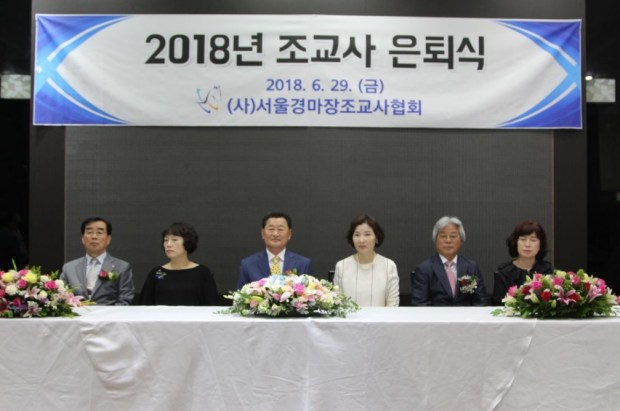
Four of the longest-serving trainers at Seoul Racecourse officially gave up their barns last week. Ha Jae Heung, Kim Yang San, Yang Jae Cheol and Jung Ji Eun all reached the mandatory retirement age of 63 in the year leading up to June 30th.
Three of the four retiring trainers, Ha Jae Heung, Kim Yang Sun and Yang Jae Cheol alng with significant others at a retirement function hosted by their Association (Pic: Seoul Racehorse Trainers’ Association)
All four trainers began their careers at the Ttukseom Racecourse in Seoul, Jung receiving his license in 1982 and Ha, Kim and Yang in 1983. At the time there was no private ownership of racehorses with all horses being owned by the racing authority so it wasn’t until the 1990s, following the relocation of the racecourse to its current site in Gwacheon that the modern racing calender, complete with Stakes races and big purses began to take shape.
Jung Ji Eun – 8496 starters / 748 winners / 856 2nds / 786 3rds: A filly called Dangdae Jeil (Lucky Ruler) was his best horse of the 1990s, winning 25 of 60 starts between 1995 and 2001 including the Ttukseom Cup in 1997. Fillies would continue to be his specialty as he won the Korean Oaks and then a second Ttukseom Cup in 2001 with Espass (Psychobabble). His final Stakes win came in 2009 with the filly Top Point (Tom Point) in the KRA Cup Classic.
Ha Jae Heung – 10535/937/1011/1042: Ha trained the winners of a number of listed races but only got the one Graded Stakes victory. It came with his best horse, Saebyeok Dongja (Fiercely), Korean Derby winner in 2005 and who would go on to 10 of his 37 outings. By far the most active of the four at the time of their retirement, he had sent out 20 winners from just over 300 starters in his final year.
Kim Yang Sun – 9088/907/912/908: Kim made his Classic breakthrough with Seonbong Taegam (Road Of War) in the Korean Oaks in 2000 and was champion trainer in 2001, a feat he would repeat in 2009. He will be most remembered though for handling one of the genuine stars of Korean Racing, Dongbanui Gangja (Broken Vow), who he prepared for back-to-back victories in the Grand Prix Stakes in 2008 and 2009.
Yang Jae Cheol – 6877/550/597/598: While Yang wasn’t able to win a Graded Stakes race, he did win the Sports Chosun Cup on two occasions, first with Dol Kyuk (Port Erin) back at Ttukseom in 1991 and then again at Gwacheon in 2002 with Cheonji Kiun (Glorify).
* Also leaving the training ranks last week was Heo Jae Young. The former jockey took out a license in 2012 but the forty-year-old has now decided to pursue a different path in the industry. He trained 53 winners from 1087 starters.
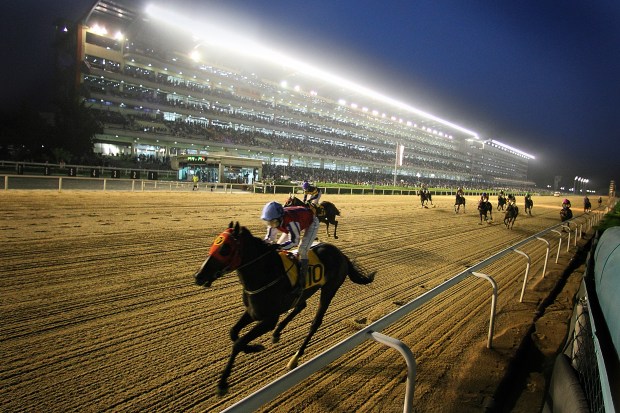
Racing in Korea moves on to a summer schedule from this coming weekend. Up until the first weekend of September, Friday racing will be from 2:30pm until 9pm and Saturday from 2pm to 9pm. Sundays will remain on the normal daytime schedule of 10:45am to 6pm.
Night racing at Seoul (Pic: KRA)
So from Friday July 6 to Sunday September 2 inclusive:
Fridays: Busan / Jeju – 14:30-21:00 Saturdays: Seoul / Jeju – 14:00-21:00 Sundays: Seoul / Busan – 10:45-18:00
Each of the three tracks will also take one weekend off during this time. Jeju will be off on July 27/28 which means Busan will run an extended card on the Friday and Seoul will run an extended card on the Saturday.
Seoul is off on August 4/5. Jeju will run an extended card on Friday while Busan will run on Saturday and Sunday. That means there will be no international simulcast on the Friday.
Busan takes its weekend off on August 10/12. Jeju again runs an extended Friday card while Seoul does the same on Sunday. Once more that means no international simulcast on the Friday.
Racing under the lights at Seoul on a warm summer’s Saturday evening is quite the experience so do be sure to check it out if you have the chance.
Ha Jae Heung, who trained Saebyeock Dongja to win the Korean Derby in 2005 and sits in 2nd place in the all-time winner list among trainers at Seoul, has retired. He saddled his final runner in the last on Sunday.
Among trainers at Seoul, Ha Jae Heung was, at the time of retirement, join 2nd-longest serving behind Jung Ji Eun. 63-year-old Ha gained his license on the same day as Kim Yang San, at the old Seoul Ttukseom Racecourse in 1983. He finished with just shy of 1000 winners from 10500 starters across his career. It may not sound a lot but Ha is from a generation of trainers who navigated the transition from the time when all racehorses were owned by the Authority, no prize money and restrictions on the number of runners a trainer could have, to the modern age of private ownership and Stakes racing.
Ha’s best horse was probably Saebyeock Dongja, who in addition to the Derby also won the Herald Business Cup in 2005 and the Sports Chosun Cup in 2006. He would win the latter race again with Sotong Sidae in 2015. His last Stakes winner was Waikiki in the Gwacheon Mayor’s Cup in 2015.
Ha Hae Heung went out with a winner on his final weekend as his Two Kay won the last at Seoul on Saturday under Manoel Nunes. It was winner 936 of his career.
It was a good start to life in Korea for jockey Fergus Sweeney at Busan on Friday. He rode Rock Hard Seven (Rock Hard Ten) to victory for trainer Bart Rice in Busan race 10:
Sweeney had earlier ridden Thomas Gillespie’s Great Rock (Ecton Park) to 2nd place in race 9 and made all to win by nine-lengths on Rock Hard Seven, who was notching his 4th win in 6 career starts.
There are two new foreign jockeys making their full-time Korean debuts this weekend. Three-time Singapore Champion Manoel Nunes will be in action at Seoul while British racing stalwart Fergus Sweeney will be legged up for the first time at Busan. Both riders are on initial four-month licenses.
Manoel Nunes looks on at Seoul Racecourse last weekend
Manoel Nunes is no stranger to Seoul, having ridden in International Jockey Challenges and also having partnered Singapore-based horses in the Asia Challenge Cup and Korea Cup in the capital but this is his first time riding full time in Korea.
A native of Brazil, Nunes topped the Jockey Premiership in Singapore in three consecutive years between 2014 and 2016 and was runner-up in 2017, picking up numerous big race wins along the way.
42-year-old Nunes is also a six-time champion in Macau where he is the most successful rider in the Macau Jockey Club’s history. Nunes will be based at Seoul where his first ride is in race 3 on Saturday when he partners Lucky Race for trainer Yu Jae Gil.
Belfast-born Fergus Sweeney has had a long and distinguished career in the United Kingdom where he is closing in on 1000 career wins. His biggest success to date was on Twilight Son in the Group 1 Betfred Sprint Cup at Haydock Park in 2016.
The 40-year-old Sweeney has some live chances at Busan on Friday including Great Rock for Thomes Gillespie. He’s the third British licensed jockey to ride at Busan after Darryll Holland and JP Guillambert. And Sweeney doesn’t just ride horses – the Noraebangs of Haeundae have been warned:
Simon Foster is off the mark in Korean racing. The Australian trainer saddled his first winner at Seoul on Sunday afternoon as Yaho Aurora won the 1700M race 6.
Yaho Aurora (Rock Hard Ten) was a twelve race maiden going into the race and started at odds in excess of 20/1. However, under jockey Cho Han Byeol, he sat nice and handy throughout and outstayed the rest in the home straight to win comfortably. For jockey Cho, it was a first win since returning from national service at the start of the year.
Trainer Foster opened his barn towards the end of last year and has been steadily putting together his string. He now has ten horses under his care and Yaho Aurora was just his thirteenth runner. He got his first placed finish last week when Pegasus Farm’s Jungle Beat ran 2nd on his debut.
It would be a surprise if Yaho Aurora went on to do very much but now the breakthrough has been made, hopefully Simon Foster can will be sending out many more winners.
J.S. Hold, who in 2007 won the first ever Korean Triple Crown, has died. The 14-year-old passed away on January 6th from complications of colic on Jeju Island, where he had been living since his retirement in 2008.
J.S. Hold 2004-2018. Here winning the Minister’s Cup in 2007 (Pic: KRA)
J.S. Hold [Ft. Stockton – Hwansangjiljoo (Passetreul)] made his debut on Minister’s Cup day in October 2006 in the very first race on the card, a juvenile allowance over five furlongs. He finished 4th, a full fifteen lengths behind the winner Ganghomyeongjang. Although already, by Korean standards of the time, a physically impressive specimen, there were few indications that J.S. Hold would never be beaten again. His and Ganghomyeongjang had unfinished business.
The first win arrived a month later in a similar juvenile contest. Third in the betting, J.S. Hold went straight to the front this time and never looked back, winning by an eye-catching fourteen lengths. Another facile victory in December, this time a six-length score over Gi Ra Seong and Top Point, both of whom would go on to be multiple winners themselves, saw J.S. Hold head into 2007 as one of the favourites for the new Triple Crown.
The Triple Crown series, intended to bring more of a sporting aspect into racing in Korea, would take two existing contests on the calendar, the Ttukseom Cup and Minister’s Cup and make them into races for three-year-old domestic bred horses, joining the Korean Derby, which would be in its tenth year, as a Triple Crown.
By the time they got to the first race, the Ttukseom Cup over 1400M in April, J.S. Hold was hot favourite having added a further three easy victories between January and March up to the Derby distance of 1800M by a combined twenty-four lengths. It was evident, this was no normal Korean racehorse.
Second-favourite for the Ttukseom was Ganghomyeongjang, who since defeating J.S. Hold on what was both of their debuts, had managed to avoid him while accruing three more victories of his own. It was a mismatch. Moon Jung Kyun on J.S. Hold allowed Ganghomyeongjang to lead from the gate but went past him at the top of the stretch and eased away to a seven-length win.
The Korean Derby followed in May and it was expected to be a formality. It was but the manner of it was still astonishing. J.S. Hold left the field in the back straight and cantered home uncontested with the margin on the line eleven lengths. Ganghomyeongjang had to settle for 4th with Natural Nine and Namchonuijijon – who would both go on to have long and successful careers, in 2nd and 3rd.
With the Triple Crown being modeled at that time on the British version rather than the American, the final leg wasn’t until October, almost five months after the Derby. Accordingly, J.S. Hold was sent out in July against older horses. Chief among them Myeongmun Gamun, who would go on to win the President’s Cup twice, and Secret Weapon also firmly established in the Seoul elite. Punters sent J.S. Hold off as the odds-on favourite and he duly delivered. striking the front two furlongs out and romping away to win by five lengths.
It was then, however, that J.S. Hold, until now reasonably sound, began to experience leg problems which added to a nagging, if not serious, eye issue. Plans for a further prep race for the Minister’s Cup were shelved and it became touch and go as to whether he would make the big race itself. He made it and despite his problems being well-documented, began as long odds-on favourite, such was his perceived superiority. This time it wasn’t so straightforward.
The pace in the 2000M race was set, as expected by Ganghomyeongjang with J.S. Hold slowly away but improving up the back to move up into 2nd place at the top of the stretch but with still four-lengths to make up. This time though he didn’t cruise past Ganghomyeongjang as if he wasn’t there. This time Ganghomyeongjang was still very much there. Still there as they passed the furlong pole and still there at the 100M. J.S Hold was game though. With Ganghomyeongjang all out, Moon Jung Kyun found just a little more and the Ttukseom Cup and Derby winner finally got his nose in front just 30 metres from the line. He crossed it almost a length in front and history was made. J.S. Hold had won the Triple Crown.
He wasn’t fit though and his trainer later admitted that he probably shouldn’t have run. One month after the race, J.S. Hold was diagnosed with tendinitis and accordingly didn’t run in the President’s Cup (won by Myeongmun Gamun, who he had so easily defeated), or the Grand Prix, In fact, he never ran again, In June of 2008, he passed a qualifying trial and was entered in a Class 1 handicap but he never made it to the final declaration stage. In October of 2008, almost exactly one year after his great triumph, J.S. Hold returned to Seoul Racecourse on a race day to be officially retired. He and jockey Moon Jung Kyun cantering down the home straight and through the finish line to the exceptionally rare sound of warm applause from the assembled ranks of usually cynical punters (the full ceremony can be watched at this link).
What would happen to J.S. Hold began a welcome discussion into the care of retired racehorses in Korea. Prior to his retirement ceremony it was noted that with little interest in using Korean bred stallions – even a Triple Crown winner – for breeding, his future may not be secure and a minor uproar ensued in the local racing media. Guarantees were swiftly made for him by his owner, which were honoured, and he lived his remaining years in retirement on Jeju Island, covering a few mares each year until succumbing to illness at a sadly still relatively young age. A handful of his progeny are racing today. The discussion that was started has continued to the point where, almost ten years later, things still have a long way to go to be perfect and, like other places, horses’ post-racing fates still depend on what their owners can or will do for them, but the days of having to automatically fear the worst, are over.
If I may conclude by being self-indulgent for a paragraph or three, J.S. Hold was the horse who got me into Korean racing. By the time of his Triple Crown, I had been living in Seoul for a couple of years and visited the racecourse every few weeks for a recreational punt but while admiring the gleaming facilities, I wasn’t especially impressed by the racing itself and preferred to spend most weekends watching football and getting my racing fix by punting on races back home.
Then J.S. Hold came along. I happened to be at the track during one of his prep races for the Ttukseom Cup and noticed that this was a very different beast to the usual lot. This was, to put it bluntly, a racehorse – something I might have seen at Newmarket (or at least Yarmouth). A few months later I was with a group of friends (yes, I did have some) on Minister’s Cup day and the moment he went past Ganghomyeongjang in the final strides was the moment I was hooked. This was racing – this was sport. A couple of weeks later I started this blog, the header image of which is still a picture taken that day.
J.S. Hold wasn’t the first superstar Korean-bred racehorse and in the years since others have come through, notably his successor in winning the new Triple Crown, Power Blade. But J.S. Hold was special and he won’t be forgotten.