News

Horse Of The Year – And Other Awards

With no racing this weekend and a month gone of the new season, it’s time to take a belated look back at 2010. Last week, the Korean Racing Journal, Korea’s most authoritative racing newspaper (in Gyongmaman’s opinion anyway as he likes to bet their “dark horse” predictions) published their annual award winners. There were numerous categories up for grabs along with some special awards too. One thing to note is that no horse could win more than one category.

Horse Of The Year: Tough Win

Horse Of The Year: Tough Win
He was beaten in the season-ending Grand Prix but before that won six straight races in 2010 including the Busan Metropolitan and the KRA Cup Classic. While Mister Park remained unbeaten, the quality of opposition Tough Win defeated up until the Grand Prix was superior. Doubts about his staying ability appear to have been confirmed by his defeat in his 2011 debut but in 2010, Tough Win was a worthy Horse Of The Year.

Mister Park

Male Horse Of The Year: Mister Park
It was a toss-up between him and Tough Win as to who would take the big prize but Mister Park is both the present and the future of Korean racing. His win in the Grand Prix in December capped an unbeaten nine races in 2010. He wasn’t eligible for the Triple Crown by virtue of having been sired overseas, however, the sire in question, Ecton Park, is now in Korea and his progeny are eagerly awaited.

Champion Filly & Mare: Sangseung Ilro
A remarkable filly, the winner of two legs of the Triple Crown in 2009, Sangseung Ilro takes this crown for the second year running. She has fragile legs and has to be campaigned very sensibly but was kept in training instead of being rushed off to the breeding shed. She ran seven times in 2010, capturing two Stakes victories along the way and she will go down as one of the best fillies or mares in Korean racing history.

Dangdae Bulpae

Champion Three Year Old (open): Dangdae Bulpae
He struggled in the KRA Cup Mile and finished third in the Derby but came good in the autumn as he landed the Minister’s Cup – the final leg of the Triple Crown – at Seoul in October, before returning to the capital a month later to defeat older horses in the President’s Cup. While Seoul’s two most talented three-year olds of 2010, Money Car and Northern Ace, found their careers tragically curtailed, Dangdae Bulpae remains a worthy winner of this award.

Champion Three Year Old (Korean): Cheonnyeon Daero
A bit of a stretch to split to award for champion three-year old between two Korean breds but Cheonnyeon Daero won the korean Derby and has gone on to show that was no fluke by landing the Busan Owner’s Cup at the end of the year.

Cheonnyeon Daero Winning the Derby (Ross Holburt)

Champion Trainer: Shin Woo Chul
With Tough Win and Dongbang Rose leading the way, the vetearn Soul handler scored 64 wins in 2010

Champion Jockey: Cho Kyoung Ho
While the talent may be at Busan, the competition is unquestionably at Seoul. A late season suspension to Moon Se Young helped but Cho Kyoung Ho finally claimed his first jockeys; championship with 120 winner.

Champion Owner: Tamna Feed Co.
A corporate owner wins this for the first time. Tough Win is the best known of a slew of winners for the Jeju based feed company. While feed companies have an obvious interest in sponsoring race horses, in recent years companies from other industries have become involved too, with IT, Construction and Cosmetic companies joining Shinhan Bank in owning racehorses. How the feed companies deal with their retired horses will be watched very very closely.

Champion Breeder: Seongsu Farm
The farm, based in Icheon, Gyeonggi Province, didn’t produce any big race winners this year but its mares are responsible for the likes of Gi Ra Seong, Good Day, Triple Sinhwa, Forest Wind and Breeders’ Cup first and second Sun Hero and Sun Blaze.

Special Awards: In addition to the regular prizes, some special awards were also handed out.

Kim Gui Bae

Lifetime Achievement: Kim Gui Bae
The longest-serving jockey in the weighing room, Kim Gui Bae had something of a renaissance in the latter part of 2010. While in the rest of the world it might be common for a jockey to have a career of thirty plus years, in Korea it is unheard of. Kim Gui Bae debuted in 1979 and is one of only three current riders (along with Park Tae Jong and Shin Hyung Chul) to have ridden at the old Ttukseom Race Park.

Special Award: Kim Seung Pyeong
A KRA employee at Busan, Kim Seung Pyeong was recognised for his work on IT systems.

Special Award: Sorabol College
This Higher Education institute located in Gyeongju, North Gyeongsang Province was recognised for its horse welfare course which specialises in training people to look after racehorses. A significant number of grooms at the Seoul and Busan Race Courses have been through this program

Special Award: Korea Horse Affairs High School
Staying with the education theme, this specialist high school was set up in North Jeolla Province in 2003 and is playing a key role in the development of young jockeys. Kim Cheol Ho, Park Byeong Yun, Jo In Kwen, Lee Gi Woong and Jang Chu Yeol are graduates who are making their way in the jockey ranks at Seoul Race Park.

James Perry Family Flood Relief Trust

Racing Queensland announced last week that it has set up a trust fund for the family of Chief Steward James Perry who was lost in the recent Queensland floods.

James served as a Steward at Seoul Racecourse for two-and-a-half years from the beginning of 2008 until September 2010 when he took the decision to return to his native Australia. With racing in Korea always taking place on a Saturday and Sunday, he needed more weekend time to spend with his family.

He was held in very high regard in Korea.

* A memorial service for James Perry will be held in the Chapel next to the Robb Hall at Seoul Foreign Middle School at 2pm on Friday, simultaneous with a service in his native Sydney.

Was Upstairs, Now Downstairs – Foreigner Info Desk

Not going to win any prizes for that headline, but it’s been nearly a year since the “Foreigner Lounge” at Seoul Race Park was closed. During that time, there has continued to be an information desk outside the old lounge – which is now opened to all punters – offering support in various langauges. However, as that was on the fourth floor, nobody actually went there, so the KRA has relocated it to a prime position next to the general information desk on the first floor of the Luckyville Grandstand right by that stand’s main entrance.

From A Distance: The new "Multi-lingual Information Desk"...that's what we're going to call it!

The KRA operated a lounge with reserved seats for any overseas passport holder for a number of years but decided to stop offering this service in April 2010. While it was well used, the regulars generally consisted of those who had no need of its services – mainly Koreans holding foreign passports while the visiting groups could often prove a substantial handful – Gyongmaman was, on more than one occasion, thoroughly ashamed of the behaviour of some large groups of young foreigners who would bring in and consume large quantities of alcohol (banned by law at the track) and proceed to abuse the infinitely patient staff when they asked them to calm down. And it’s not as if they ever bet anything so it’s no surprise that it was eventually shut.

With many automated betting machines around the track offering service in English, it was felt a designated room was no longer required, however, the information desk remained and has now been made much more prominent. The desk provides multi-lingual staff (English, Chinese and Japanese) as well as guides on how to bet in several different languages. Although when Gyongmaman stopped by to clumsily attempt to flirt with say hello to the staff on Sunday afternoon they had run out of English language racecards, these too are generally available.

The desk is located next to the main Korean language information desk by the main entrance of the Luckyville Grandstand.

Former Seoul Steward James Perry Among Missing in Queensland

The Australian Herald Sun newspaper is reporting that James Perry, former Steward at Seoul Racecourse, is among those missing in floods in Queensland.

The newspaper reports that Mr Perry’s wife and young son were winched to safety from the roof of the car they were travelling in when the flash-flood hit. Mr Perry, however, remains missing.

James Perry was on the stewards’ panel at Seoul for two and a half years before movng back to Australia with his family in Autumn 2010 to take up a Chief Steward position with Racing Queensland.

Why Didn’t I Pick That?!

Hunch Bet Could Have Landed Massive Pay-Out / Quinella One Of Biggest Ever In Korea

It all sounds so obvious now: A filly and a mare taking on mostly males, they both had the word “Sky” in their names on a day when the sky was blue and beautiful and a young lady jockey coming in to replace the injured former Champion jockey on one of them. Surely a hunch bettor’s dream. Forget wondering why I didn’t even consider a few hundred Won, in the cold light of day, I have no idea why I didn’t put the mortgage on Burning Sky and Sky Center in Race 9 at Seoul Race Park on Sunday!

Let's Have A Look At What You Could Have Won...

130/1 shot Burning Sky and Hwang Soon Do led 50/1 Sky Center and Kim Hae Sun across the line to land one of the most unlikely results Seoul Race Park has seen in recent times. The quinella paid 1587.7 while the exacta yielded returns of 5409.0. With 943,233,500 Won (about $850,000) in the exacta pool, someone evidently had a good Sunday evening.

The exacta is generally the second most popular bet after the quinella. The Quinella pool had approximately $3 Million in it while there was $750,000 in the Trio (first three in any order), the returns of which were “only” 786.4 after hot favourite Super Yonggwang finished third. $45,000 was put in the win pool and $70,000 in the place for a total handle for the race of around $5 Million. With the KRA handing over 27% of that to the government for them to distribute as they see fit, one wonders just how seriously politicians want to clamp down on racing).

Sky's the limit: Burning Sky and Sky Center complete a 5409/1 exacta

* Those pay-outs were by no means the biggest in Korean history. Here is a full list of longest odds for all six bet types. With the exception of Dream Team, who made up the second part of the exacta, all involved were fillies:

Win: 382.0 – Seoul, 24 November 2001, Race 1: Three-year old filly Swing recorded her first and only victory.

Place: 59.9 – Seoul, 20 November 2004, Race 2: Filly Big Crown finished second. Her win odds were 571.3

Quinella: 7328.8 – Seoul, 5 December 1998, Race 4: Heukkwang (169.5) and Keumbae (198.4) were first and second but not until the horse over the line first Mubidongja, was disqualified. Some punters would have been left feeling sick as Mubidongja himself was a 90/1 chance.

Exacta: 15954.3 – Seoul, 26 October 2003, Race 5: Storm (77.9) beat Dream Team (193.5. Not many saw it coming.

Quinella Place: 1859.8 – Busan, 12 May, 2006, Race 5. An odds-on shot won but nine lengths behind the winner were Nammyeong and Jisang Choego – both sent off well over 100/1.

Trio: 25661.9 – Busan, 7 February 2010, Race 4 – This bet has only been available for a couple of years but it has already produced by far and away the biggest winning odds. Angel Collar, Dapyeon and Grace Thunder combining for the 1,2,3. However, there were no life-changing sums won that day. The pool contained a comfortable – if probably disappointing to the winner – 30 Million Won in it.

(Figures are from the KRA)

Ton-Up For International Uchida

After victory in race 1 at Busan on Sunday, Toshio “Mr Pink” Uchida let it be known that the win was his 100th success outside his native Japan.

It was a typical coaxing ride from Uchida as he brought second-favourite Hatteuneun Gisang from the back of the field to the front in the final furlong to take the lead at exactly the right time.

Friend of the Punters: Toshio Uchida

Punters’ friend Uchida is in his second spell in Korea. In May 2008, he came to Busan for the first time and quickly established himself as the top rider at the track, winning 69 races by the end of the year. It was a record for a while year at the course, let alone just eight months. When he made an appearance at Seoul to ride in the Minister’s Cup, the capital’s punters thronged the paddock and gave him a standing ovation. It would be no exaggeration to say that at that time he was arguably the most popular Japanese man in Korea.

In early 2009 after leaving Korea, Uchida was presented with an award by the Japanese National Association of Racing (one step down from the JRA) in recognition of his performance overseas which also took into account his earlier time in Macau where he won 20 races including a Group 1.

Uchida had always said he would return to Korea. Many hoped that he would go to Seoul and try to be the first foreign rider to crack the capital. Understandably, however, after nearly two years back home in Japan, it was back to Busan he went where the more internationalized racing procedures – and less pervasive power of the local Jockey Union – make for a much more hospitable environment for visiting jockeys. Since returning he has ridden 11 winners and once more is setting the standard that local jockeys can aspire to.

And that is exactly why the KRA brings over foreign jockeys in the first place. Young Korean jockeys are improving and the influence of South African riding instructor Kenny Michel has been very positive. On the track though there needs to be someone to watch and learn from in terms of tactics and especially – as they all still sprint for the first corner – in judging pace. Uchida provides this. Congratulations to him on reaching this milestone.

2011 Racing Schedule Now Available

We are just three days away from the start of the 2011 Korean racing season at Busan Race Park this coming Friday. Throughout the year, the two thoroughbed tracks at Seoul and Busan will each host 94 days of racing while on Jeju Island there will be 92 days of pony racing.

They're (almost) off in 2011!

Racing takes place at Seoul on Saturdays and Sundays, Busan on Fridays and Sundays and Jeju on fridays and Saturdays.

The Korean Derby is set for Sunday May 15 and the Grand Prix on Sunday December 11. Busan’s bug day is the KRA Cup Mile on Sunday April 3. During late July and early August, there are four weekends of evening racing at all three tracks.

Click here for the full calendar and check back here every week for a preview of the weekend’s action.

Come Racing in 2011!

2010: Trainers, Tragedy & Optimism

We’re just a few days away from the start of the 2011 season so it’s time to look back at some of the key events – randomly selected and not necessarily in order of importance- of 2010:

Number One: Tough Win

Dongbanui Gangja’s Reign Fizzles Out – We got our showdowns. The double-Grand Prix Champion Dongbanui Gangja faced the young pretender Tough Win on three separate occasions and three times he was beaten. Twice though he beat himself as the five-year old proved too much of a handful for his jockey to keep him running straight.

Meanwhile in the Grand Prix itself, Tough Win failed to stay the distance as Korean-born Mister Park took the end of season honours. Despite this, for his Busan Metropolitan and KRA Cup Classic wins, Tough Win is Gyongmaman’s Horse of the Year.

Lee Shin Young

Lee Shin Young Becoming the First Korean Woman to Pass the Trainer’s Exam – Thirty year-old Lee, who was only the second Korean woman to be granted a jockey’s license became the first to pass the Trainer’s exam.

For the moment Lee continues to ride in races but is now eligible to move over to the backstretch when a vacancy becomes available.

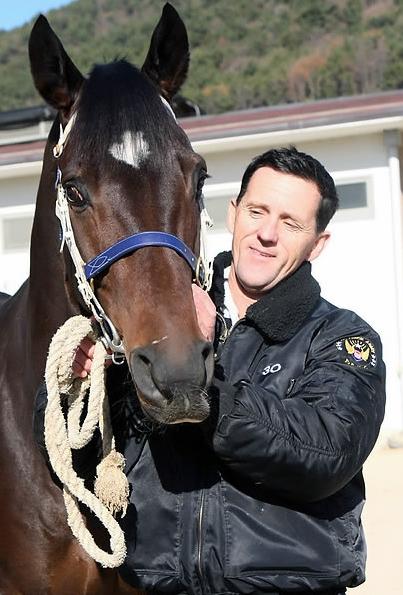
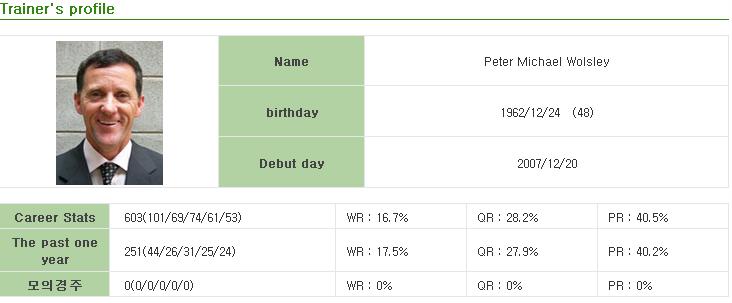
Peter Wolsley’s Success at Busan – Australian trainer Peter Wolsley has now completed three full seasons as a license-holder at Busan. 2010 was his stand-out year saddling 38 winners from 223 starters for a strike rate of 17% with 41% of his starters managing to place. Were it not for a lack of truly top quality horses in his string – hardly his fault – Wolsley would have been a strong contender for Trainer of the Year.

Wolsley’s stable stars have been Gyongkwaehanjilju, winner of five of his seven starts as a three-year old this year and the late-developing filly Ganghan Yeoja and with a number of promising two-year olds in his barn, next year looks set to be a very interesting season. Wolsley now receives the majority of horses from two Jeju farms – Isidore and Pegasus – which both have foreign interests. Indeed, when Pegasus Farm’s two-year old filly Secret Whisper won back in November under Japanese jockey Yoshi Aoki, it made for a winner that was essentially foreign-owned, trained and ridden. Training is the key to improving Korean racing and Wolsley’s presence is setting the bar higher for the local training colony which, while containing some talented handlers, has for many years essentially been an old-boys club of ex-jockeys.

Sires – Officer has become the latest recruit to the stallion colony in Korea. He joins the likes of Menifee, Volponi, Yehudi and Ecton Park as recent additions to what is becoming a strong breeding operation on the peninsula.

Park Jin Hee: 1982-2010

Jockey Park Jin Hee Commits Suicide – Without doubt, those most affected by the suicide of Park Jin Hee were her family, who lost a talented and beautiful daughter in the most awful of circumstances at the age of just 28.

However, in the aftermath of that desperate Friday in March when Park didn’t appear for her rides at Busan and was later found dead in her apartment, Korean racing was shaken. The young jockey had left a suicide note in which she blamed the pressures of racing and her mistreatment by trainers – naming one of Busan’s most prominent as particularly responsible. The KRA faced a barrage of online criticism from Korea’s poisonous “netizens” and, while they quickly moved on to their next target, back in Busan, jockeys boycotted the named trainer’s horses for several weeks. Park Jin Hee was the second lady jockey to take her own life, after Lee Myoung Hwa in 2005.

KRA Levels Up its English – This blog has been known in the past to be slightly unkind about the KRA’s attempts at English but, credit where credit it due, in 2010 it introduced an English language results and race-cards service. It’s not detailed but the vital information is there and, coupled with the race videos which are now freely available as well as the links to the Studbook page for each entrant, makes for a fantastic service. Sadly since he departure of James Perry from the Stewards panel, English language stewards’ reports from Seoul are no longer produced. The KRA says there is a “vacancy” for a foreign steward – whether they plan to fill it is another matter.

The Regulator – As we enter 2011, things are much the same as they were a year ago. The government continues to be stuck in its position of wishing to appear to be tough on gambling but not wanting to do anything that will seriously jeopardise the vast tax revenues racing generates. Trials on an Electronic ID card to track punters’ expenditure began and looks like it will ultimately be made compulsory. Meanwhile, we saw the usual slew of stories about illegal gambling. Corruption stories involving jockeys didn’t help matters and the KRA is still yet to resolve a long-running dispute over an off-track gambling site in the southern city of Suncheon.

Yeongcheon To Build Korea’s Third Thoroughbred Racecourse – The small city of Yeongcheon, just outside Daegu in North Gyeongsang province was named as the location of Korea’s newest racecourse. The track, which is scheduled to open in 2014 will also host a resort and something called a “Horse-Park”. It’s opening also looks likely to spell the end of year-round racing at Seoul and Busan with each of the three tracks taking turns to be “dark” for four months of the year while the other two operate.

Kim Tae Hee

Kim Tae Hee Stars In Grand Prix – OK, so the finished movie wasn’t that great but it had some amazing racing scenes and got the sport some mainstream attention. Plus punters got to see Kim Tae Hee in racing silks.

Young Jockeys – The standard of riding in Korea is definitely on the up. Those who gained their licenses in the last few years such as Lee Sang Hyuk and Jo In Kwen are already well established in the upper ranks of the jockeys’ championship while Kim Hae Sun, who qualified in 2009, looks like she could go on to become the peninsula’s most successful ever female rider. Meanwhile, Busan’s Park Geum Man was a popular winner of the Derby.

Foreign Jockeys – It’s not looking so positive for foreign riders. At the beginning of 2011, there are no non-Japanese foreign jockeys in Korea following the departure of Martin Wepner in May. And even for the Japanese, it still seems as though Seoul is unbreakable with Hiro Hamada the only non-Korean plugging away in the capital. On the front of their English website, the KRA is still advertising for foreign jockeys. Any-takers should click here. Things are very tough here though. Martin Wepner didn’t endear himself to everyone but he was tenacious and a battler and he was able to be successful, but one doubts it would be an experience he would want to repeat.

In no particular order – Mister Park, Yeonseung Daero, Cheonnyeon Daero, Dangdae Bulpae, Money Car, Sangseung Ilro, Love Cat, Tough Win, Triple Seven, Dongbanui Gangja, Baekgwang, Bally Brae, Larrycat, Dongbang Rose, Euro Fighter, Northern Ace, Sun Hero and Magic Party are just some of the 2,810 thoroughbred athletes who entertained us through triumph and tragedy in 2010.

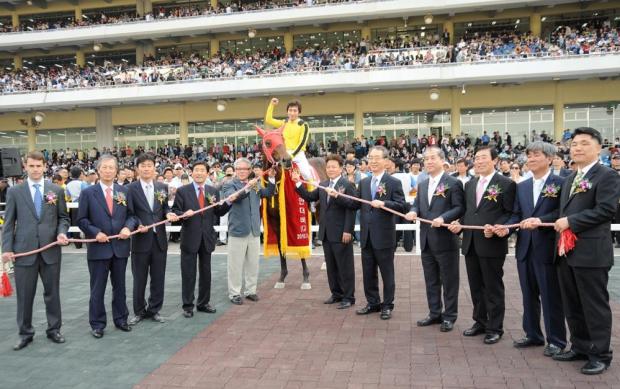
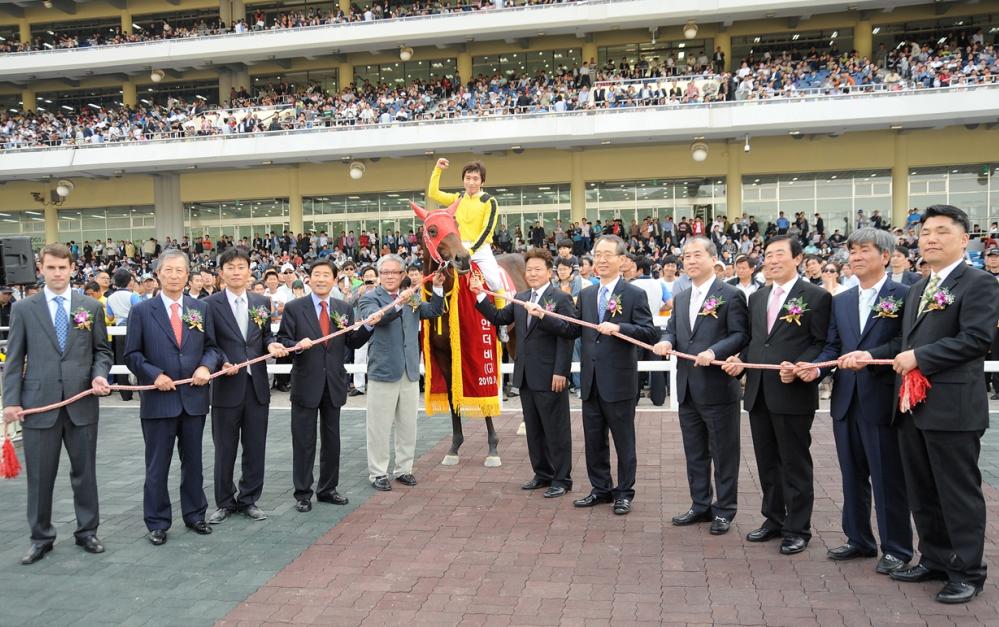
Mister Park and You Hyun Myung in the Grand Prix Winner's Circle

2010 Review: Cho & Jo Take Jockey Crowns

Moon Se Young returned from suspension to ride a final day treble to cut the gap to two, but it was Cho Kyoung Ho who, for the first time in his career, rode off with the 2010 Seoul Jockeys’ Championship.

Cho Kyoung Ho is Champion Jockey 2010

Victory capped a remarkable season for thirty-four year old Cho who also secured four Stakes victories: Tough Win in the Busan Metropolitan and KRA Cup Classic, Geumgangi in the Munhwa Ilbo and Dongbang Rose in the Nonghyup.

As for Moon Se Young, a five day ban picked up in late November ruled him out of all but the last day of racing in December and ultimately cost him the title. Nevertheless, with 118 wins, it was still another extremely lucrative year for the 2008 Champion. Veteran rider Park Tae Jong was third with 87 winners.

2010 Seoul Jockeys’ Championship

1. Cho Kyoung Ho – 120
2. Moon Se Young – 118
3. Park Tae Jong – 87
4. Choi Bum Hyun – 49
5. Ham Wan Sik – 45

Down at Busan, it wasn’t quite so close as Jo Sung Gon had things wrapped up by November, ultimately winning by 26 from Jo Chang Wook, who got the better of Yoo Hyun Myung and Park Geum Man in a three-way battle for second pace. Japnese rider Hitomi Miyashita took fifth place.

Jo Sung Gon Dominated Busan

In addition to winning the Busan title, Jo Sung Gon also picked up a number of major wins. Principally, he travelled up to Seoul twice in the autumn to partner Dangdae Bulpae to both the Minister’s and Presidents Cups. Not exactly a shrinking violet, floppy-fringed Jo was barracked by punters after the President’s Cup challenging him to come up to Seoul full-time to try his luck with the likes of Cho Kyoung Ho and Moon Se Young. For now though, it seems he is content to be the biggest fish in the slightly smaller Busan tank.

2010 Busan Jockeys’ Championship

1. Jo Sung Gon – 84
2. Jo Chang Wook – 58
3. Yoo Hyun Myung – 57
4. Park Geum Man – 54
5. Hitomi Miyashita – 40

At the pony-racing colony on Jeju Island, young rider Jeon Hyun Jun, who turned professional in 2005 took the crown. The 23 year-old scored 76 winners.

2010 Jeju Jockeys’ Championship

1. Jeon Hyun Jun – 76
2. Jang Woo Sung
3. Kang Seong – 62
4. Park Hoon – 60
5. Moon Sung Ho – 53

* A number of overseas riders have appeared at both Seoul and Busan this year. We’ll be having a special report on all of those over the next week as our round-up of 2010 continues.

2010 Review: Creek Cat Is Leading Sire In Korea

Didyme’s Streak Broken / Menifee Waiting

Didyme’s run of three consecutive years as Leading Sire in Korea came to an end in 2010 as Creek Cat stormed to the top of the table by an astonishing margin of over $1M.

Cheonnyeon Daero winning the Derby - he was Creek Cat's biggest earner

Derby winner Cheonnyeon Daero was Creek Cat’s chief earner while Seoul’s Champion filly & mare Love Cat also contributed big winnings for the sire who has been in Korea since 2000 and was fourth in the standings last year. Runner-up was Concept Win for who once again, Sangseung Ilro was the biggest contributor. It was a disappointing year for Didyme but it could have been very different for the now twenty-year old stallion but for the injury suffered by his colt Northern Ace in the Korean Derby and if last year’s chief earner Areumdaun Jilju had not spent most of the year on the sidelines.

Japanese sire Biwa Shinseiki entered the top ten for the first time due to the success of champion three-year old Dangdae Bulpae while Volponi saw his first Korean crop reach three-years old and was ninth on the money list.

Looming on the horizon for all the established sires in Korea though is Menifee. Having arrived in Korea in late 2006, his first crop of two-year olds hit the track this year having been highly sought-after at yearling sales in 2009. They did not disappoint. Menifee was both leading first-crop sire and Leading sire of two-year olds by some considerable distance with colts of his sweeping the placings in the Breeders’ Cup in late November.

Leading Sires In Korea 2010 (Name/Pedigree/Owner/Earnings in Korean Won/Chief Earner)

1. Creek Cat (USA) [Storm Cat – Vivano (Island Whirl)] – (Evergreen Farm) – 3,409,984,000 – Cheonnyeon Daero
2. Concept Win (USA) [Manila – Conveniently (In Reality)] – (Korea Mainland Horse Breeders’ Association) – 2,358,508,000 – Sangseung Ilro
3. Ft. Stockton (USA) [Cure The Blues – Tai The Devil (Tai)] (KRA) – 2,176,639,000 – Cheonun
4. Fiercely (USA) [Danzig – Whirl Series (Roberto)] – (KRA) – 2,107,087,000 – Lucky Dancer
5. War Zone (USA) [Danzig – Proflare (Mr. Prospector) – (KRA) – 2,081,931,000 – Tamnaseontaek
6. Didyme (USA) [Dixieland Band – Soundings (Mr. Prospector)] – (KRA) – 1,928,442,000 – Glory Yeonggwang
7. Exploit (USA) [Storm Cat – My Turbulent Miss (My Dad George)] – (KRA) – 1,795,566,000 – Mr. Rocky
8. Biwa Shinseiki (JPN) [Forty Niner – Oceana (Northern Dancer)] – (Kim Chong Sik) – 1,717,986,000 – Dangdae Bulpae
9. Volponi (USA) [Cryptoclearance – Prom Night (Sir Harry Lewis)] (Korean Mainland Horse Breeders’ Association) – 1,684,316,000 – Dongbang Rose
10. The Groom Is Red (USA) – (Runaway Groom – Sheila’s Gold (Fast Gold)] – 1,575,416,000 – Triple Seven

* Eight registered Stallions passed away in Korea in 2010. They were Gwacheon Ruler (KOR), Time Star (USA), Glorify (USA), Tertian (USA), Bohamian Butler (USA), Jamine Langfuhr (KOR), Yashima Japan (USA) and Five Aligned (USA).