News

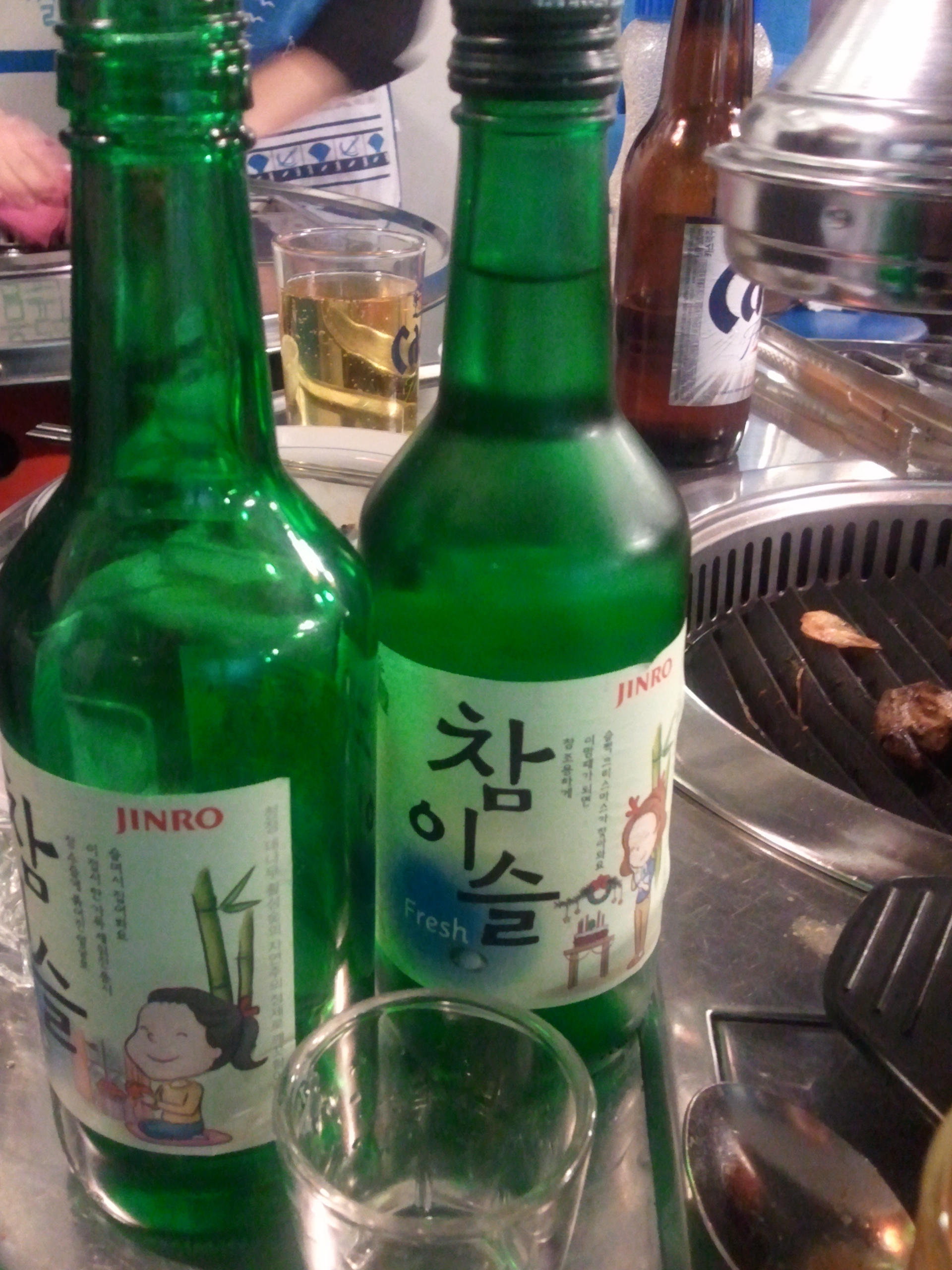
Friday Night Soju & Selections

So the wine really didn’t work last week. This week, we’re going for something altogether more Korean. Soseuldaemun put Seoul to the sword last week by claiming the KRA Cup Mile – the first leg of the Korean Triple Crown – for Busan, but there’s a competitive eleven race card in the capital this Saturday.

Radioactive Sandstorms Expected This Weekend is the kind of headline that Gyongmaman has always wanted to be involved in and it looks like it’s going to happen. Here’s what he will be losing what little remains of his money on:

Race 1: Bunsuryeong
Race 2: Golden Ticket
Race 3: SS Icheon
Race 4: Euro Gangse
Race 5: Triple Gamdong
Race 6: Noble Harmony
Race 7: Wingwing
Race 8: Dan Land
Race 9: Ppopai
Race 10: Holy Dreamer
Race 11: Maskan

Gyongmaman doesn’t do favourites. The majority of this lot are not going to win. So he recommends a small amount (maybe 2,000 won) on each to win and a smaller amount (maybe 4,000won) to place. You’ll not get rich but with any luck, you won’t go bankrupt either. Radioactive or not, it’s going to be a little bit sandy but nevertheless, come racing! Here’s what’s happening when and where on Saturday and Sunday:

Saturday April 9

Seoul Race Park: 11 races from 11:10 to 17:30
Jeju Race Park: 9 races from 12:30 to 17:30

Sunday April 10

Seoul Race Park: 11 races from 11:10 to 18:00
Busan Race Park: 6 races from 12:30 to 17:00

A Tale Of Two Classic Cities

Will Busan Continue Its Triple Crown Domination?

When the final line-up for Sunday’s KRA Cup Mile is declared on Wednesday afternoon, there is likely to be a roughly equal number of horses from both Seoul and Busan taking part. While Seoul has the better known names, if performances in recent years are anything to go by, the ultimate winner is likely to hail from the Southern city.

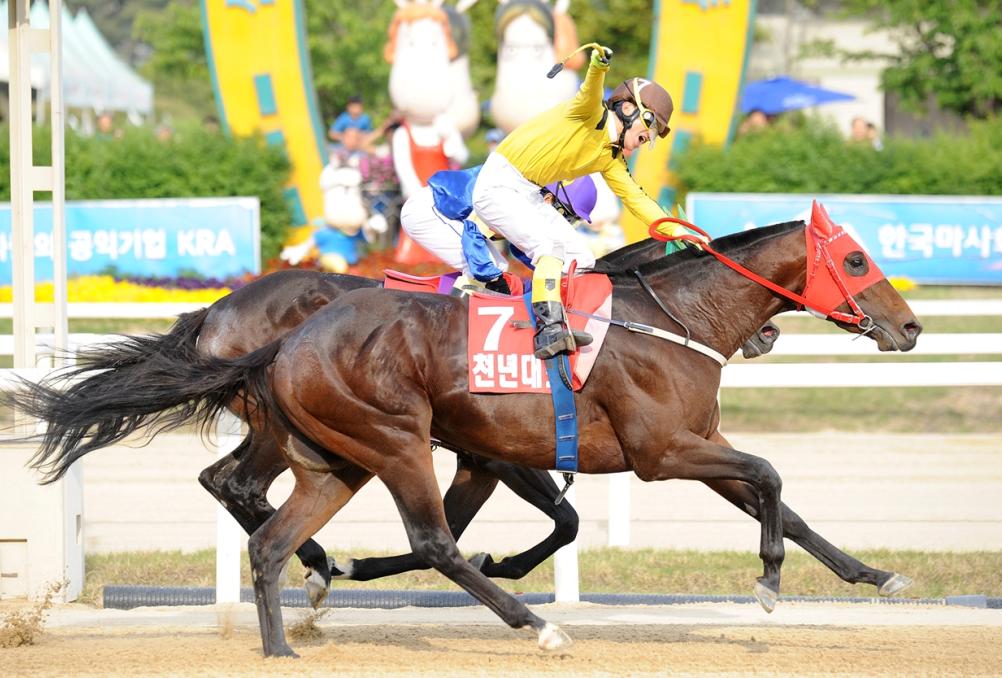
Busan's Cheonnyeon Daero wins the 2010 Derby (Pic: Ross Holburt)

While Seoul Race Park is the undoubted headquarters of Korean horse racing, since Busan horses started competing in the three-year old Classic races in 2008, the capital’s horsemen have found themselves consistently losing out to those of the newer track down South. Of the nine colt Classics run in the past three years, Busan horses have won eight of them. They’ve also won two out of the past three runnings of the Korean Oaks.

So is it just chance or is Busan really doing something better than Seoul? Those with experience of both praise the set-up at Busan as being more conducive to the development of racing. In the capital – as has been mentioned ad-nauseum on this blog before – vested interests; the various unions and horsemen’s associations, really do run the show. There is little incentive to change the status-quo as it’s served them very well. Until that is, their biggest prizes of the year started disappearing down the Gyeongbu Expressway.

Busan's Double Classic winning filly Sangseung Ilro (Pic: KRA)

The unions have had less power at Busan and so – the theory goes – there has been more focus on delivering quality on the track. This is most visible in the success that foreign jockeys have had at Busan compared to Seoul. In Busan, talented jockeys will get rides, regardless of where they are from. Frankie Dettori would struggle to get a ride at Seoul.

It is absolutely proper that there are limits on the numbers of foreign jockeys granted licenses but the presence of talented ones can only be beneficial to local riders. Toshio Uchida may be “taking their money” now, but the likes of Jo Sung Gon and Park Geum Man are surely benefiting from riding alongside him; indeed both are now Classic winning jockeys.

It’s not only jockeys but also trainers. Busan has two foreign trainers – and more reportedly on the way – with Peter Wolsley now helming one of the track’s most successful barns. He’s not won a classic but again, could it be that the competition is raising the all around standard?

On a more practical level, another theory is simply that regularly training on the challenging Busan track produces better horses. Busan has a punishing uphill back-straight, a long sweeping level turn, and then a two and a half furlong stretch. Seoul meanwhile has a reasonably flat back-straight and a steep descent around the turn into the two-furlong home-straight. It’s plausible and is frequently mentioned in the Korean racing media. Or it could just play into the stereotype that eveyone from the capital – both man and beast – is well…a bit soft.

Busan's Dangdae Bulpae and Jo Sung Gon win the Minister's Cup

There is an anomaly though. Imported horses who are based at Seoul have, in the few races in which they have taken on their Busan counterparts, generally come out on top. Bulpae Gisang and Tough Win have won the last two editions of the Busan Metropolitan while Dongbanui Gangja claimed the first Grand Prix to which Busan horses were also invited. Of course, Busan’s Mister Park put an end to that by winning the 2010 Grand Prix but even so, it is worth asking whether Busan owners are just choosing better lots at the yearling and two-year old sales.

They’re certainly spending more money. At the recent March two-year old sales on Jeju Island, Busan buyers were responsible for the three most expensive lots: a filly by Menifee and colts by Forest Camp and El Corredor. If all goes to plan, they’ll be making their track debuts this coming autumn. By which time this could of course, all be forgotten about. Horses from the capital filled the top to places in the Breeders’ Cup – the nation’s top two-year old race, last November. Maybe this will be the year that Seoul strikes back.

Here is a list of the classic winners since Seoul and Busan started competing in 2008:

2010
KRA Cup Mile: Money Car (Newsprint) – Seoul
Korean Derby: Cheonnyeon Daero (Creek Cat) – Busan
Korean Oaks: Euro Fighter (Archer City Slew) – Seoul
Minister’s Cup: Dangdae Bulpae (Biwa Shinseiki) – Busan

2009
KRA Cup Mile: Sanseung Ilro (Concept Win) – Busan
Korean Derby: Sangseung Ilro (Concept Win) – Busan
Korean Oaks: Pangpang (Revere) – Busan
Minister’s Cup: Namdo Jeap (Ft. Stockton) – Busan

2008
KRA Cup Mile: Rainmaker (Revere) – Busan
Korean Derby: Ebony Storm (Buster’s Daydream) – Busan
Korean Oaks: Jeolho Chance (Didyme) – Busan
Minister’s Cup: Gaeseon Janggun (Duality) – Busan

Triple Crown 2011: First Look at KRA Cup Mile Line Up

Sixteen Remain in “Korean Guineas”

It’s almost upon us. The 2011 Korean Triple Crown Challenge Series gets underway this coming Sunday, April 3 with the KRA Cup Mile – The Korean 2000 Guineas – at Busan Race Park.

So far sixteen horses are entered; at least two will be eliminated before the day and therefore if there is going to be a Triple Crown winner, it’s going to be one of these. Both Seoul and Busan have eight entries each. Five of the host track’s representatives are fillies while all of those from Seoul are colts.

Breeders' Cup winner Sun Hero is one of 5 horses by Menifee entered for the Cup Mile

Menifee was both leading first-crop sire and Champion two-year old sire in 2010 and he has five entrants, all with serious claims. Filly Useung Touch finished in a surprise third place in the Breeders’ Cup last year and the filly has brought her good form over to 2011. Meanwhile, Breeders’ Cup winner Sun Hero and stablemate Sun Blaze, along with Double Light will be among those heading the Seoul contingent.

Despite the name, Ophelia's a colt. A handsome one too

There’s been plenty of hype surrounding the grey Ophelia, while Mupaeseungni has the best strike rate in the race with three wins from his four starts. Unusually, there are no unbeaten horses in the race although like Ophelia, the filly Haengunui Mannam, has finished first or second in all of her five starts.

The KRA Cup Mile is a relatively new addition to the Korean racing calendar. It was first run in its current form – for Korean bred three-year olds – in 2008, which was the first year that the Korean Triple Crown series incorporated horses from the new Busan track. The Series itself has only been started the previous year when J.S. Hold scored a clean sweep of the Ttukseom Cup, Korean Derby and Minister’s Cup. For 2008, the Ttukseom Cup was made age-open and the Cup Mile restricted to three-year olds and thrown open to horses from across the peninsula.

Busan won the 2008 and 2009 editions in the form of Rainmaker and Sangseung Ilro, however, Money Car became the first Seoul based three-year old to win a Classic since 2007 when he took the 2010 renewal. Of those, only Sangseung Ilro went on to win the Korean Derby, two months later and she failed at the final Triple Crown hurdle as Namdo Jeap, second in both the Cup Mile and the Derby that year, finally came out on top in the Minister’s Cup in Seoul in October.

Winning the Triple Crown is tough – there are six months between the Cup Mile and the Minister’s Cup and there may be later developing horses, such as Dangdae Bulpae last year, who get better as the season progresses and overtake those who were on top in April. Sangseung Ilro’s fragile shins didn’t hold up for the whole year, while poor old Money Car only ran once more after being caught in the final strides of the Derby.

It’s a long time until October but if we’re to have a Triple Crown winner in 2011, it will be one of one of these sixteen (Name/Pedigree/Race Records/Home Track):

1. Cheonji Horyeong (KOR) [Buster’s Daydream – Sorority Jazz (Dixieland Band)] (7/2/2/1) – Busan
2. Soseuldaemun (KOR) [Meisei Opera – This Ole Way (Vigors)] (9/2/3/1) – Busan
3. Daeseung Yegam (KOR) [Silent Warrior – Tolp’ung-Yegam (Land Rush)] (9/3/1/1) – Busan
4. Dallija (KOR) [Adcat – Great Lakes (Meadowlake)] (Filly) (7/3/1/0) – Busan
5. Shamash (KOR) [Al Naba – Jayeon Juui (Road Of War)] (Filly) (8/2/2/0) – Busan
6. Flower (KOR) [Menifee – Fancy Cheeks (Jade Robbery)] (Filly) (6/2/2/1) – Busan
7. Useung Touch (KOR) [Menifee – Jenny Tudor (Gulch)] (Filly) (5/3/1/1) – Busan
8. Haengunui Mannam (KOR) [Creek Cat – Clever Lil (Lil’s Lad)] (Filly) (5/2/3/0) – Busan
9. Double Light (KOR) [Menifee – Iruda (Glorify)] (7/3/2/1) – Seoul
10. Beongaegangho (KOR) [Vicar – Carson City Dancer (Carson City)] (7/2/2/1) – Seoul
11. Reigns Cat (KOR) [Creek Cat – Eternal Reigns (Eternal Orange)] (7/2/2/0) – Seoul
12. Singgeureounachim (KOR) [Exploit – Singgeureoun (Mr. Adorable)] (7/2/1/2) – Seoul
13. Ophelia (KOR) [Commendable – Miss Personality (El Prado)] (5/2/3/0) – Seoul
14. Sun Blaze (KOR) [Menifee – Claudia’s Secret (Crafty Prospector)] (6/2/3/0) – Seoul
15. Sun Hero (KOR) [Menifee – Strategic Reward (Bold Revenue)] (8/4/2/1) – Seoul
16. Mupaeseungni (KOR) [Ingrandire – Dangdae Eutteum (Pro For Sure)] (4/3/0/0) – Seoul

*Here is Money Car’s 2010 victory:

Friday Night Wine & Wagering

Yeonseung Daero and Cheonnyeon Daero both won at Busan and it’s Cheltenham Gold Cup Day in the UK. Gyongmaman therefore thought it forgivable to break his (lunar) New Year’s Resolution to not mix his two favourite habits beginning with “W”.

Therefore, here’s what he’ll be losing his money on at Seoul Race Park on Saturday:

Race 1: Vicar Dreamer (7)
Race 2: Eagle Stone (8)
Race 3: Hwiyeongcheong (4)
Race 4: Luck Be Star (4)
Race 5: Evergreen (10)
Race 6: Dongbangtamheom (3)
Race 7: Red Monster (11)
Race 8: Yodeongjewang (9)
Race 9: Manchester Miss (4)
Race 10: Mass Media’s Tea (11)
Race 11: Jilpunggangho (4)
Race 12: Lucky Box (4)

Some will be odds-on, some will be long-shots but all have a good chance of at least a place so look at the tote board and see where the value is. And remember, Gyongmaman bets for his subway fare and still has to walk home.

Here’s a reminder of what’s happening when and where on Saturday and Sunday:

Saturday March 19

Seoul Race Park: 12 races from 11:10 to 17:30
Jeju Race Park: 9 races from 12:30 to 17:20

Sunday March 20

Seoul Race Park: 11 races from 11:10 to 18:00
Busan Race Park: 6 races from 12:30 to 16:30

Fortieth Time Lucky For Joe Murphy

It’s been a while coming but Joe Murphy finally saddled his first Korean winner at Busan Race Park on Friday afternoon.

After sending out thirty-nine runners without success, it was fortieth time lucky for Murphy as his four-year old colt Udeumji, the 3/1 favourite, took victory by half a length in the class 2 race 7.

Murphy, who has held a licence since July last year, manages a string of twelve horses at Busan, with Isidore Farm’s mare Ganghan Yeoja who won four races for previous trainer Peter Wolsley, the best known of his charges. Wolsley himself made a similarly slow start as he struggled to get quality horses in his barn but, over the past year, has established himself as one of he track’s top trainers.

Indeed, the Australian was among the winners himself as Volponi gelding Saeroun Taeyang scored a shock win in the afternoon’s feature as favourite Namdo Jeap put in a disappointing run.

Now the pressure is off, we’ll see what Murphy can do. Rather fittingly, it was Wolsley’s former stable jockey Park Geum Man who landed the win on Udeumji.

Stallions Yankee Victor & The Groom Is Red Pass Away

Sad news out of Jeju Island as stallions Yankee Victor and The Groom Is Red have both died within the last month. Yankee Victor succumbed to a colic on February 1 while The Groom Is Red had to be euthanized after sustaining multiple fractures in a paddock accident on January 27.

Yankee Victor (Pic: KRA)

Yankee Victor [Saint Ballado – Highest Carol (Caro)] had been in for five years. On the racecourse in the US, Yankee Victor won eight of his nineteen races. A fine miler, in 2000, he won a pair of Grade 1 races over the distance – the Met Mile at Belmont Park and the Westchester Handicap at Aqueduct.

Retired to Stud, he was moderately successful in the US before being bought by the KRA in late 2005. Just becoming established as a sire in Korea, he’s had just two crops of foals reach the track so far both including some promising runners.

Here are the closing stages of his Met Mile victory:

And his KRA appearance video:

The Groom Is Red (Pic: KRA)

The Groom Is Red [Runaway Groom – Sheena’s Gold (Fast Gold)] won just four times in the US. Just like Yankee Victor, his biggest triumph also came over a mile at Belmont when, as a two year old in 1998, he won the G1 Champagne Stakes. Brought straight to Korea as soon as he retired from the track, he would have been entering his twelfth season.

Siring solid if generally unspectacular horses, he nevertheless produced some champions including the great grey Baekgwang, winner of the Minister’s Cup in 2006, and Triple Seven, Ttukseom Cup winner in 2010 as well as Andy’s Runner, winner of this year’s New Year Stakes.

Here is his KRA appearance video:

American Steward Joins Seoul Panel

Seoul Racecourse has a new foreign steward. James Smith made his first appearance behind the binoculars this past weekend.

James Smith began officiating at Seoul at the weekend (Pic:KRA)

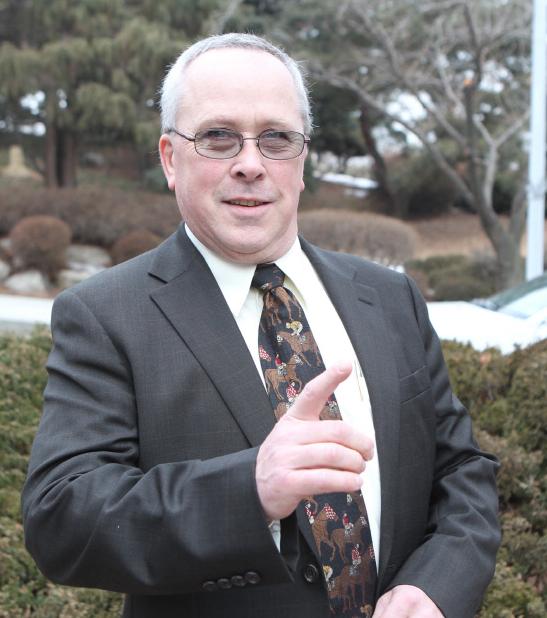
Smith who – if the picture to the left is anything to go by – is a man who clearly appreciates a good tie, is a fifty-six year old American and has spent most of his career officiating at tracks in Oregon, principally Portland Meadows but has also had stints at Minnesota’s Canterbury Park and Iowa’s Prairie Meadows.

He’s joined what is usually a five-man panel at Seoul but will occasionally be seen guesting at Busan and Jeju as the KRA likes its stewards to sit on different panels from time-to-time. Down at Busan an Australian, Brett Wright, is currently Chief Stipendiary Steward.

In addition to race day duties, the job description of overseas Stewards in Korea also includes being a “Special Advisor” on racing related issues, particularly with regard to the “internationalization” of Korean racing – not an easy task in Seoul.

The position had been vacant for five months since previous incumbent James Perry returned to his native Australia last September. Perry was sadly lost in the Queensland flooding last month.

Double Classic Winning Filly Sangseung Ilro Retired

Sangseung Ilro, the filly who won the first two legs of the 2009 Triple Crown has been retired. She ran – and won – her last race in December last year and was retired in January ahead of what would have been her five-year old season. She was officially registered as a broodmare yesterday.

Sangseung Ilro (Pic: KRA)

Although she won three of her first five races, Sangseung Ilro [Concept Win – Ms. Whiskey (Whiskey Wisdom)] was a 17/1 outsider going into the first leg of the Triple Crown, the KRA Cup Mile at her home track of Busan in April 2009.

She wasn’t even the most fancied of four fillies taking part in the race, with Seoul’s Love Cat arriving down South with a big reputation and odds of 8/1 However, under Japanese jockey Eiki Nishimura she scored by a length and a half over stablemate Namdo Jeap and pre-race favourite Yeonseung Daero. It would not be the final time she’d beat these two who would both go on to become stars themselves.

There was intrigue surrounding her trip to Seoul the following month for the Korean Derby. Nishimura, who had been expecting to accompany her to the capital was jocked off in favour of local jockey Jo Sung Gon amid whispers of displeasure in the Jockeys’ Union that a foreigner had won a Classic race. It made no difference to Sangseung Ilro and while local Seoul hope Nice Choice was sent off as favourite, she repeated her feat from the KRA Cup Mile, this time winning by a comfortable five lengths, Namdo Jeap chasing her home once again.

By this time, she was not only talked about as being on course to complete the Triple Crown but, being a filly, possibly securing the Oaks aswell in what wa being termed the “Grand Slam”. However, tt was shortly after the Derby that the first signs of an injury problem – Sangseung Ilro had consistent problems with her shins – started to surface and she didn’t reappear until the Korean Oaks on a hot August evening at Busan. This time, with Eiki back in the saddle, she was sent off odds-on favourite.

All was going well as she entered the home straight clear of the field and seemingly heading to a simple victory. Then, out of nowhere, second favourite Pangpang emerged and as Sangseung Ilro weakened, slowly reeled her in, hitting the front just before the line to score a shock victory and give her jockey, the late Han Sang Kyu, his first and only Classic success.

The “Grand Slam” was off the table and it was a race against time for her to be fit for the final leg of the Triple Crown, the Minister’s Cup, at Seoul in October. That day, after being runner-up in the first two legs, Namdo Jeap finally took the honours with Martin Wepner in the saddle. Sangseung Ilro ran a brave and battling third. She hadn’t quite managed to pull off the Triple Crown, but had made her mark as one of the best fillies in modern Korean racing.

It seemed that an appearance two days after Christmas when she ran fourth in a handicap at Busan would be her farewell but, in a surprising and welcome decision, connections decided that she was fit enough to keep in training as a four year old. Their decision was quickly rewarded when in January she won a valuable handicap. Durung 2010 she would run seven times, winning on four occasions including back-to-back Stakes victories in the KNN Cup and the Gyeongnam Do-Min Ilbo. Her final race, on December 17, ended in a commanding four length victory.

Sangseung Ilro was retired with career figures of 17 races, 9 wins, 3 seconds and 2 thirds for prize money of just over 1 Billion Korean Won (approximately $1 Million). She has been retired by her owner to “Good Day Farm” and is expected to begin her broodmare career this year.

Horse Of The Year – And Other Awards

With no racing this weekend and a month gone of the new season, it’s time to take a belated look back at 2010. Last week, the Korean Racing Journal, Korea’s most authoritative racing newspaper (in Gyongmaman’s opinion anyway as he likes to bet their “dark horse” predictions) published their annual award winners. There were numerous categories up for grabs along with some special awards too. One thing to note is that no horse could win more than one category.
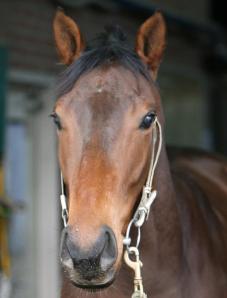
Horse Of The Year: Tough Win

Horse Of The Year: Tough Win
He was beaten in the season-ending Grand Prix but before that won six straight races in 2010 including the Busan Metropolitan and the KRA Cup Classic. While Mister Park remained unbeaten, the quality of opposition Tough Win defeated up until the Grand Prix was superior. Doubts about his staying ability appear to have been confirmed by his defeat in his 2011 debut but in 2010, Tough Win was a worthy Horse Of The Year.
Mister Park

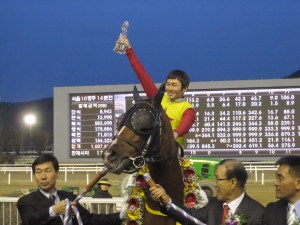
Male Horse Of The Year: Mister Park
It was a toss-up between him and Tough Win as to who would take the big prize but Mister Park is both the present and the future of Korean racing. His win in the Grand Prix in December capped an unbeaten nine races in 2010. He wasn’t eligible for the Triple Crown by virtue of having been sired overseas, however, the sire in question, Ecton Park, is now in Korea and his progeny are eagerly awaited.

Champion Filly & Mare: Sangseung Ilro
A remarkable filly, the winner of two legs of the Triple Crown in 2009, Sangseung Ilro takes this crown for the second year running. She has fragile legs and has to be campaigned very sensibly but was kept in training instead of being rushed off to the breeding shed. She ran seven times in 2010, capturing two Stakes victories along the way and she will go down as one of the best fillies or mares in Korean racing history.
Dangdae Bulpae

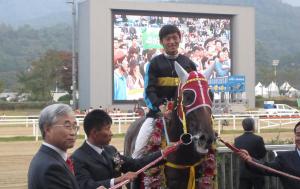
Champion Three Year Old (open): Dangdae Bulpae
He struggled in the KRA Cup Mile and finished third in the Derby but came good in the autumn as he landed the Minister’s Cup – the final leg of the Triple Crown – at Seoul in October, before returning to the capital a month later to defeat older horses in the President’s Cup. While Seoul’s two most talented three-year olds of 2010, Money Car and Northern Ace, found their careers tragically curtailed, Dangdae Bulpae remains a worthy winner of this award.

Champion Three Year Old (Korean): Cheonnyeon Daero
A bit of a stretch to split to award for champion three-year old between two Korean breds but Cheonnyeon Daero won the korean Derby and has gone on to show that was no fluke by landing the Busan Owner’s Cup at the end of the year.
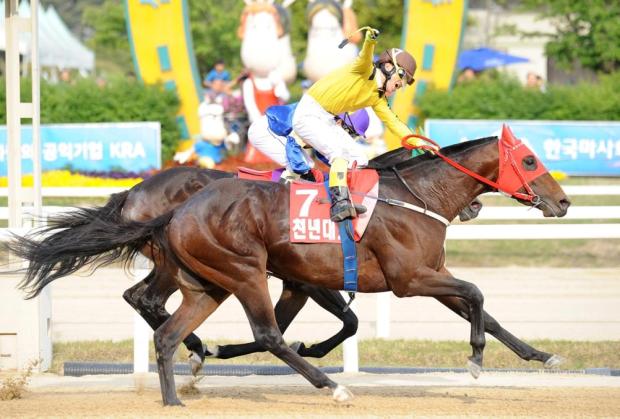
Cheonnyeon Daero Winning the Derby (Ross Holburt)

Champion Trainer: Shin Woo Chul
With Tough Win and Dongbang Rose leading the way, the vetearn Soul handler scored 64 wins in 2010

Champion Jockey: Cho Kyoung Ho
While the talent may be at Busan, the competition is unquestionably at Seoul. A late season suspension to Moon Se Young helped but Cho Kyoung Ho finally claimed his first jockeys; championship with 120 winner.

Champion Owner: Tamna Feed Co.
A corporate owner wins this for the first time. Tough Win is the best known of a slew of winners for the Jeju based feed company. While feed companies have an obvious interest in sponsoring race horses, in recent years companies from other industries have become involved too, with IT, Construction and Cosmetic companies joining Shinhan Bank in owning racehorses. How the feed companies deal with their retired horses will be watched very very closely.

Champion Breeder: Seongsu Farm
The farm, based in Icheon, Gyeonggi Province, didn’t produce any big race winners this year but its mares are responsible for the likes of Gi Ra Seong, Good Day, Triple Sinhwa, Forest Wind and Breeders’ Cup first and second Sun Hero and Sun Blaze.

Special Awards: In addition to the regular prizes, some special awards were also handed out.
Kim Gui Bae

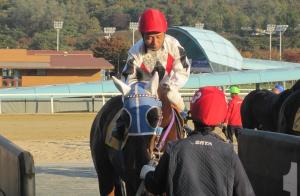
Lifetime Achievement: Kim Gui Bae
The longest-serving jockey in the weighing room, Kim Gui Bae had something of a renaissance in the latter part of 2010. While in the rest of the world it might be common for a jockey to have a career of thirty plus years, in Korea it is unheard of. Kim Gui Bae debuted in 1979 and is one of only three current riders (along with Park Tae Jong and Shin Hyung Chul) to have ridden at the old Ttukseom Race Park.

Special Award: Kim Seung Pyeong
A KRA employee at Busan, Kim Seung Pyeong was recognised for his work on IT systems.

Special Award: Sorabol College
This Higher Education institute located in Gyeongju, North Gyeongsang Province was recognised for its horse welfare course which specialises in training people to look after racehorses. A significant number of grooms at the Seoul and Busan Race Courses have been through this program

Special Award: Korea Horse Affairs High School
Staying with the education theme, this specialist high school was set up in North Jeolla Province in 2003 and is playing a key role in the development of young jockeys. Kim Cheol Ho, Park Byeong Yun, Jo In Kwen, Lee Gi Woong and Jang Chu Yeol are graduates who are making their way in the jockey ranks at Seoul Race Park.
James Perry Family Flood Relief Trust

Racing Queensland announced last week that it has set up a trust fund for the family of Chief Steward James Perry who was lost in the recent Queensland floods.

James served as a Steward at Seoul Racecourse for two-and-a-half years from the beginning of 2008 until September 2010 when he took the decision to return to his native Australia. With racing in Korea always taking place on a Saturday and Sunday, he needed more weekend time to spend with his family.

He was held in very high regard in Korea.

* A memorial service for James Perry will be held in the Chapel next to the Robb Hall at Seoul Foreign Middle School at 2pm on Friday, simultaneous with a service in his native Sydney.