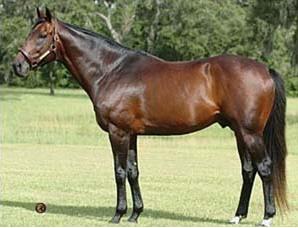
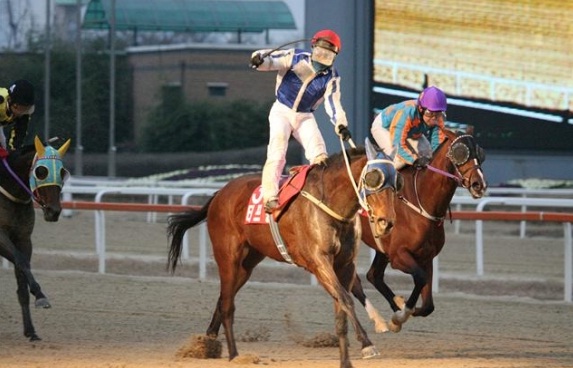
Smarty Moonhak has been diagnosed with tendinitis. Detailed veterinary examinations after the colt was unexpectedly beaten in the Busan Metropolitan City Stakes last month revealed the three-year old to be suffering from the same debilitating injury that earlier this year brought a premature end to the US Triple Crown bid of I’ll Have Another prior to the Belmont Stakes.
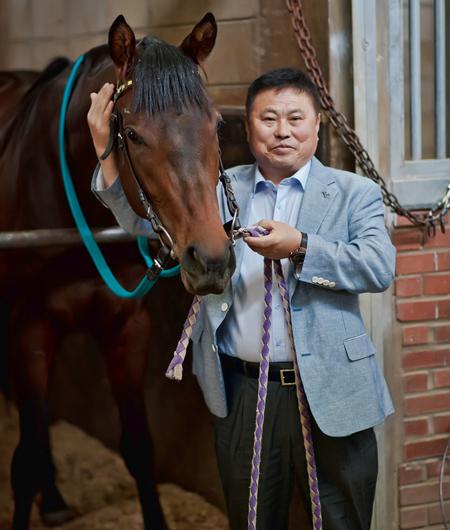
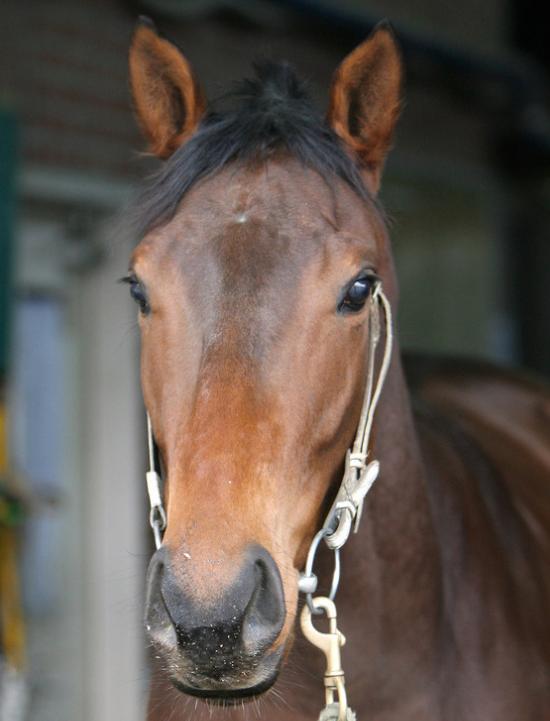
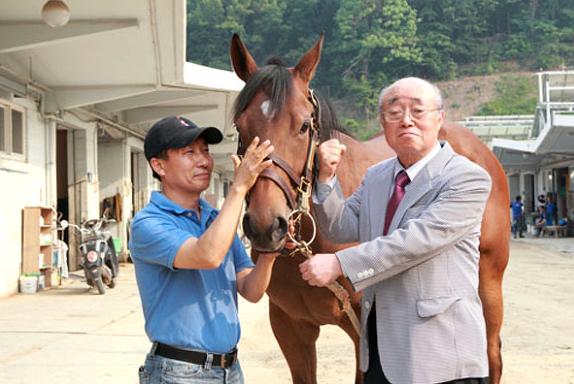
Tendonitis: Smarty Moonhak with owner Ha Jun Hwan (Pic: Sports Hankook)
The tendonitis is in Smarty Moonhak’s left-foreleg and he is to undergo stem-cell treatment in order to try to heal the injury.
It’s a procedure that has been used successfully on racehorses in Korea before, most notably on Classic winner Baekgwang, who returned to racing after a lay-off of over a year after receiving the treatment on a slightly different injury. He went on to race for a further two seasons.
The treatment course is likely to take six months and trainer Ko Ok Bong told the media that he hasn’t given up hope that Smarty Moonhak can race again. However, Korea Racing Authority Animal Hospital vets who made the original diagnosis cautioned that even if the treatment is successful, the likely of a reoccurrence is high.
Three-year old Smarty Moonhak [Smarty Jones – Madeira M’Dear (Black Tie Affair)] burst on the scene last year, winning the Turkey Jockey Club Cup by 10 lengths and becoming the first two-year old to ever qualify for the season-ending Grand Prix Stakes. He finished third in the 2300 metre Grand Prix and was unbeaten this year before his surprise defeat at the hands of Dangdae Bulpae in Busan last month.
He has eight wins from eleven starts and career earnings of just over half a million dollars.
The most exciting horse on the Korean peninsula, Smarty Moonhak had also earned an overseas following by virtue of being a son of the wildly popular Kentucky Derby and Preakness Stakes winner Smarty Jones.
Smarty Moonhak’s career-threatening injury comes as a major blow to Korean racing which earlier this year lost 2011 Horse Of The Year Mister Park (Ecton Park) after he broke down during a race. Smarty Moonhak’s owners have assured concerned racing fans that while no effort will be spared to get their horse to race again, his post-racing future is secure.
Running Stag, who ran on three continents during a forty-race career around the turn of the century, has died aged 18. Having reportedly been ill for some time, he passed away on June 3 at Taepyung Farm, South Korea, where he had been standing at Stud since 2009.
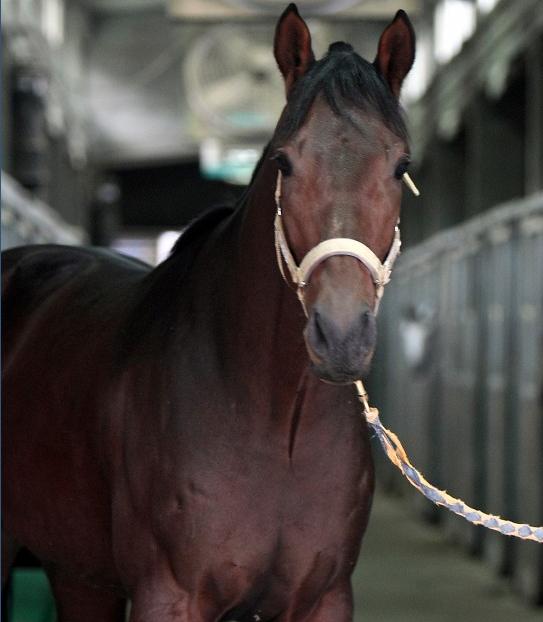
Running Stag, 1994-2012 (KRA)
One of the most popular racehorses of his time, Running Stag [Cozzene – Fruhlingstag (Orsini)] competed everywhere from the open heath of Newmarket to the desert of Nad Al-Sheba, the gentility of Saratoga and the hustle and bustle of Sha Tin.
Owned by British businessman Richard Cohen and trained at Epsom by Philip Mitchell, he became renowned for his frequent forays abroad. After debuting as two-year old in France, he raced in the UK, France and Germany in 1997, picking up his maiden win at Lingfield Park.
As a five-year old in 1999, he began his year at the Dubai World Cup for before returning to the US where he secured his first Group victory, the Brooklyn Handicap at Belmont Park. Shuttling back and forth from the UK, he went on to win another Stakes race that summer, the Saratoga Breeders’ Cup Handicap. After a brief stop at his old haunt of the all-weather surface at Lingfield Park he headed for Hong Kong in December where he was narrowly beaten into second place in the Group 1 Hong Kong Cup.
Another attempt on the Dubai World Cup followed the next March, before he spent the remainder of his final year as a racehorse back in the US, winning the Massachusetts Handicap at Suffolk Downs. His final race was the Arlington Million Stakes in August 2000.
Although never a prolific winner – he won seven of his forty starts – Running Stag earned over $1.6Million in prize money. Retired to Stud, he had middling success, producing six Stakes winners and earnings of approaching $10 Million.
Running Stag first came to the attention of Korean buyers when his filly Pocketful Of Money (out of Miss Deep Pockets by Buckaroo), won the KRA Cup Classic at Seoul Racecourse in 2007. His own tough, grinding style would have been ideal for the sand at Seoul and Busan. He was purchased by C&A for their Taepyung Stud Farm for $350,000 in late 2008 and began Stallion duties in the 2009 breeding season.
By 2011, failing health was limiting the number of mares he could cover, but his first crop of two-year olds went through the sales ring early this year and were enthusiastically received by buyers and his second crop is likely to be sought after too. The two-year olds are set to make their racing debuts soon.
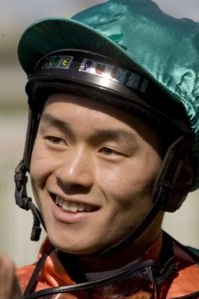
Korean apprentice jockey Seo Seung Un has finished 3rd in the Asia Young Guns Challenge which was held in Macau on Saturday. The challenge, which brings together some of the Asia-Pacific region’s most promising young riders, was won by Hong Kong’s Ka Chun Ng.
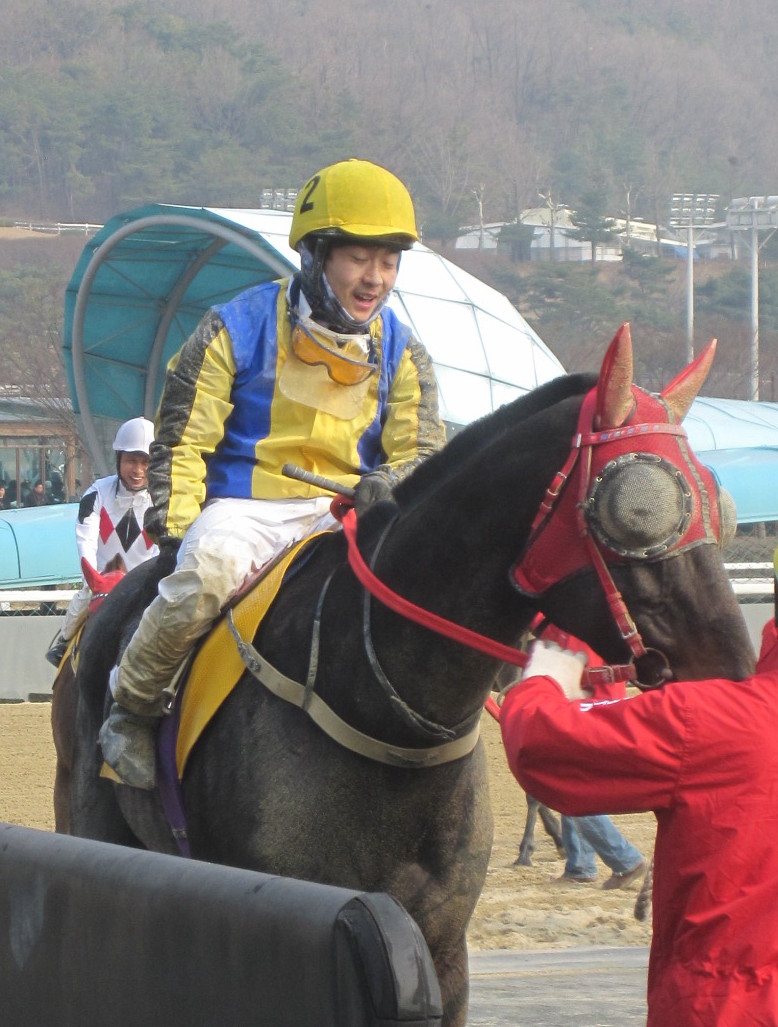
Seo Seung Un – 3rd in Asia Young Guns
In the first race of the challenge, Seo could only manage 8th as his mount, Wind Chaser, raced wide for much of the 1350 metre contest.
However, things got better for the first-year rider in the second heat, an 1100 metre sprint, as he guided Toy’s Power to second place.
Seo matched that in the concluding heat when after overcoming some pre-race confusion with whether or not he was riding with the right saddle, he rode Belt OF Golden to second.
That gave the Korean a total of 31 points (1 for finishing his first race and 15 each for his seconds), behind only Hong Kong’s Ng and Malaysia’s Yazid Kamal.
2012 Asia Young Guns Challenge Macau – Final Standings
1. Ka Chun Ng (Hong Kong) – 40 points 2. Yazid Kamal (Malaysia) – 35 3. Seo Sung Un (Korea) – 31 4. M. Cangas (Macau) – 25 5. Jake Noonan (Australia) – 20 6. C F Wong (Macau) – 18 7. Jason Collett (New Zealand) – 13 8. Zawari Razali (Singapore) – 10 9. Shinsuke Ishikawa (Japan) – 8 10. Keagan De Melo (South Africa) – 7 11. Taichi Nishimura (Japan) – 3
Jung Dong Cheol and Yoo Gwang Hee Win in Queensland
After Seo Seung Un’s recent triumphs in the USA, it was the turn of two more young Korean jockeys to open their accounts overseas today as Jung Dong Cheol and Yoo Gwang Hee both rode their first winners in Australia.
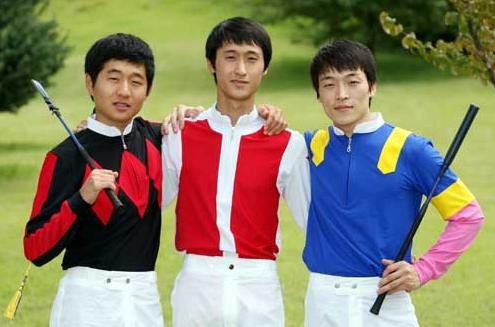
Jung Dong Cheol (left) and Yoo Gwang Hee (centre) both rode winners in Australia on Saturday (KRA).
The two first year apprentices, who are based at Busan Racecourse, both debuted in August last year and are in Australia as part of their ongoing training. Between them they won three of the five races on Saturday’s card at Longreach Racecourse, a small track, seemingly in the middle of nowhere, in Central Queensland.
Yoo got things started in race 3 taking a half-length victory on 11/1 chance Vanguard (Chateau Istana) for trainer Charlie Prow. A race later he completed his double, riding Golden Portrait (Perugino), a 9/2 shot, to a two length win over Jung who grabbed second on 25/1 outsider Heza Flashman (Iglesia).
Jung didn’t have to wait too long to get in the winner’s circle himself, claiming the fifth and final race on Sistabella (Hidden Dragon) by just under half a length.
Since debuting at Busan last year, Jung has ridden 16 winners from 235 rides while Yoo has triumphed 7 times from 188.
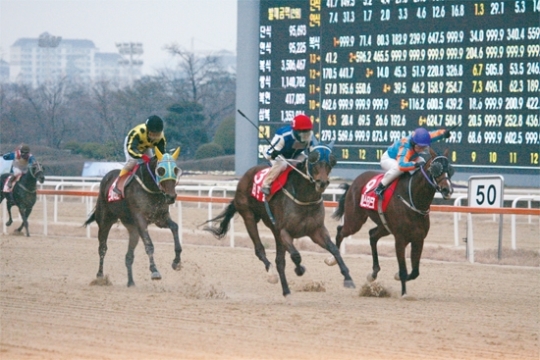
It’s time! The race that we’ve been waiting for all year will take place under the floodlights at Busan Race Park this Sunday evening as Tough Win and Smarty Moonhak square-off in the Busan Metropolitan City Mayor’s Cup. Informally billed as the Summer Grand Prix, it’s the climax of the first half of the season in the same way that the actual Grand Prix – at Seoul in December – rounds off the year.
Tough Win takes the Grand Prix (KRA)
It was in the Grand Prix that Tough Win and Smarty Moonhak met for the first and only time to date. Tough Win won that day, with the late Mister Park beating the then two-year-old Smarty Moonhak into third place. Seven months on and things could very well be different this time.
It’s not a match-race. Last year’s winner Yeonseung Daero returns to try to defend his title while double President’s Cup winner Dangdae Bulpae is also among a field of twelve who will contest the 2000 metre race on Sunday.
Here is a full run-down of all the runners, starting with the big two (gate, name, pedigree (runs/1/2/3) sex, age, weight to carry):
Busan Metropolitan City Mayor’s Stakes (K.G3) – Busan Race Park – 2000M – Sunday July 22, 19:40
Tough Win (KRA)
6. Tough Win (USA) [Yonaguska – Maggie May’s Sword (Sword Dance)] (21/17/2/0) G 5 58Kg – Cho Kyoung Ho (Seoul)
Reigning Grand Prix champion and the best horse in Korea at the moment. He won this race as a three-year old in 2010 but then last year inexplicably got sucked into an early speed duel with Dangdae Bulpae and was exhausted by the time he reached the home straight.
That’s unlikely to happen this time as Cho Kyoung Ho has tended to keep him well back in the early stages of recent races. Tough Win suffered his first bleeding attack last time out while carrying a ridiculous 64kg and while the weight won’t be an issue here, just how much that race took out of him might be. He’s worked well though and is the one to beat.
Smarty Moonhak (KRA)
9. Smarty Moonhak (USA) [Smarty Jones – Maderira M’Dear (Black Tie Affair)] (10/8/1/1) C 3 55Kg – Park Tae Jong (Seoul)
We still have no idea how good this colt is. Aside from his debut, the only time he has had to work in a race was in the Grand Prix and, bearing in mind the distance of the race and his tender age at the time, he wasn’t pushed. His races this year have been little more than public workouts.
This will be his first run at Busan where the back straight is more undulating and the home straight longer than that at Seoul and how he deals with these will be key. With regular jockey Moon Jung Kyun injured, Park Tae Jong, who has ridden more winners than anybody else in Korean racing history, gets the ride. With no disrespect intended to Moon, this can only help his cause. In Korea, jockeys wear their own colours, so Park will be wearing blue.
1. Lion Santa (USA) [Lion Heart – Santa Fe Strip (Phone Trick)] (13/10/1/0) C 4 58Kg – Gerrit Schlechter (Busan)
Won his first nine starts but has only won once from three tries this year and has never even attempted further than 1800M. In Gerrit Schlechter, he has the track’s in-form jockey in board and the South African has picked this one over two others. 2. Cheonjidolpung (USA) [Tactical Cat – Luminate (A.P.Indy)] (34/5/0/4) G 7 58Kg – Seo Do Soo (Seoul)
His third consecutive year running in the race, he took advantage of the favourites’ mistakes to finish fourth last year. He will be hard pushed to equal that this year. 3. Yeonseung Daero (KOR) [Creek Cat – Sensationalkris (Cryptoclearance)] (42/16/8/5) H 6 55kg – Choi Si Dae (Busan)
A wonderful horse, one of the best ever at Busan. Took full advantage of Tough Win and Dangdae Bulpae’s mistakes last year to claim a career capping victory and his been winning since. He can never ever be counted out. 4. Adam One (USA) [Sligo Bay – Toddles (Real Courage)] (30/3/3/3) G 5 58Kg – Lee Gi Hweoi (Seoul)
Smarty Moonhak’s work and stablemate, he’s here because there was space both in the race and in the horsebox on the way down. The only horse in Ko Ok Bong’s stable who can keep up with Smarty Moonhak in trackwork, he’ll not be able to in the race. 5. Jeonseong Sidae (AUS) [Stromberg Carlsen – Jessie’s Journey (Crown Jester)] (13/6/4/3) C 4 58Kg – Jo Chang Wook (Busan)
Without a win this year but with plenty of talent. However, an outside chance of a place at best. 7. Dangdae Bulpae (KOR) [Biwa Shinseiki – Indeed My Dear (Alydeed)] (24/15/2/1) H 5 55Kg – Jo Sung Gon (Busan)
Last year’s favourite and the two-time President’s Cup winner. An in-form Dangdae Bulpae should be able to live with anybody, including Tough Win and Smarty Moonhak. Whether he can beat them though is another question entirely. Looking at it objectively, the conclusion must be that he can’t. 8. Sangseung Geotap (USA) [Indian Charle – Mirta (Theatrical)] (19/7/2/1) F 4 56Kg – Kanichiro Fujii (Busan)
The only filly in the race won the KNN Trophy last time out but the fact that Gerrit Schlechter has decided to get off her may say somethng about her chances here. 10. Smoking Gun (USA) [Hat Trick – Desdemona’s Dream (Announce)] (5/4/1/0) C 3 55Kg – Yukio Abe (Busan)
The wildcard. Lightly raced but very impressive, this may appear to be too much too soon. However, with Yukio Abe on board and a confident trainer (who also trains Lion Santa), he may be worth an outside bet for a place. 11. Jumong (USA) [Johar – Foreign Aid (Danzig)] (30/9/7/4) H 5 58Kg – Ham Wan Sik (Seoul)
A very solid competitor and half-brother to the late Subsidy, Jumong runs in all the big races. He looks overmatched but has every chance of finishing in a moneying position. 12. Ghost Whisper (KOR) [Gotham City – Emmy’s Lullaby (Unbridled’s Song)] (11/7/3/0) G 4 56Kg – Kim Yong Geun (Busan)
Australian trainer Peter Wolsley lets his new stable star take his chance here, the grey was disqualified last time but otherwise was on a run of three straight wins inclusing two at class 1. Kim Yong Geun is an able rider and he may be worth backing for a place.
Verdict: Tough Win is a very strong competitor and most believed that it would not be until later in the year that Smarty Moonhak would be able to challenge him. Neither has put a foot wrong this year but his progress has been such that Smarty Moonhak can be the one who leaves Busan with the title “Best Horse in Korea”.
* Last year’s Busan Metropolitan was a disaster for jockeys Cho Kyoung Ho and Jo Sung Gon on Tough Win and Dangdae Bulpae respectively. They both get a chance to put things right this year – here’s what happened:
Two apprentice jockeys scored their first ever career winners in the unlikeliest of circumstances at Seoul this past Saturday.
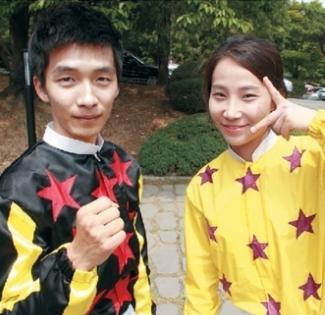
Park Hyun Woo and Ahn Hyo Ri demonstrate traditional awkward Korean poses after their debut wins at Seoul (Pic: Ilgan Sports)
Park Hyun Woo and Ahn Hyo Ri both graduated from the KRA Jockey Academy this year and debuted last month.
Neither had won on from their few rides to date coming into last weekend but that changed as first Park and then later Ahn both rode long priced winners.
Race 2 saw Park ride 280/1 chance Misojanchi to a half-length victory, overtaking champion jockey Moon Se Young on Jeilgosu in the final furlong. It was the longest priced winner at Seoul for some years and an encouraging performance in the saddle from Park who looked very much at home in the finish.
Late on in the afternoon, it was Ahn’s turn. Her win came in race 8 on 53/1 chance Time Zone. Always well-placed, the pair overtook early pacesetter Vicar Summit in the final furlong and went on to record a relatively comfortable length and a half victory.
Winner at Busan: Kim Hyun Joong (Pic: Ilgan Sports)
Down at Busan another new apprentice was also riding a long-priced winner last weekend. Kim Hyun Joong, who debuted at the same time as Ahn and Park, got his second career victory on Sunday.
And it was an impressive performance as, on 48/1 Busan Prince, he beat out South African rider Gerrit Schlechter riding odds-on favourite Gwangsok Engine by a nose in a photo finish.
It’s early days but it seems we have another talented crop of young apprentices. With young jockeys these days being given much more of an opportunity to prove themselves than they once were – owners and trainers knowing that they’ve been better trained than their predecessors – no doubt there will be plenty more visits to the winner’s circle for all of them
Dangdae Bulpae, Yeonseung Daero, Lion Santa, Smoking Gun Also Go In “Summer Grand Prix”
It’s been confirmed that Grand Prix Stakes winner and current top-rated horse in Korea Tough Win (Yonaguska) and the horse considered his closest challenger, Smarty Moonhak (Smarty Jones), will both travel to Busan on July 22nd for the Busan Metropolitan City Mayor’s Stakes.
The “Troika”: Tough Win (centre) will be up against Smarty Moonhak (left) in the Busan Metropolitan. The late Mister Park (right), who split them in the Grand Prix, is sorely missed
The race, the south coast’s richest is also known as the “Summer Grand Prix” and it will see Tough Win and Smarty Moonhak face each other for the first time since last December when the then two-year-old Smarty Moonhak finished third behind the victorious Tough Win in the nation’s most prestigious race.
Tough Win was a narrow winner of this race as a three-year-old in 2010. However returning to Busan last year and sent off as the heavy favourite, he inexplicably became involved in an early speed duel with Dangdae Bulpae. This left both horses exhausted in the home straight and allowed Yeonseung Daero to come through for the win.
Yeonseung Daero (Creek Cat) will also be back this year as will Dangdae Bulpae (Biwa Shinseiki), now a two-time President’s Cup winner. Aussie-bred Jeonseong Sidae (Stromberg Carlson) will be there as will prolific winner Lion Santa (Lion Heart) and young US import Smoking Gun (Hat Trick).
While this race is the biggest of the year so far and the clash between Smarty Moonhak and Tough Win the most eagerly awaited since Tough Win himself then the upstart, faced Dongbanui Gangja in the same race two years ago, there is nevertheless a touch of sadness surrounding the occasion.
Were it not for the break-down and death of Mister Park during his tune-up race last month, this would have been a three-way rematch from the Grand Prix. We still have a great race but we will also be remembering the record-breaking champion.
Here are the entries:
Busan Metropolitian City Stakes – Busan Race Park – 2000M, July 22, 2012
Jeonseong Sidae (AUS) [Stromberg Carlson-Jessie’s Journey (Crwon Jester)] (13/6/4/3) Busan Yeonseung Daero (KOR) [Creek Cat-Sensationalkris (Cryptoclearance)] (42/16/8/5) Busan Sangseung Geotap (USA) [Indian Charlie-Mirta (Theatrical)] (19/7/2/1) Busan Smoking Gun (USA) [Hat Trick-Desdemona’s Dream (Announce)] (5/4/1/0) Busan Lion Santa (USA) [Lion Heart-Santa Fe Strip (Phone Trick)] (13/10/1/0) Busan Dangdae Bulpae (KOR) [Biwa Shinseiki-Indeed My Dear (Alydeed)] (24/15/2/1) Busan Gamdonguibada (USA) [Werblin-Radyla (Country Pine)] (7/4/2/1) Busan Smarty Moonhak (USA) [Smarty Jones-Madeira M’Dear (Black Tie Affair)] (10/8/1/1) Seoul Tough Win (USA) [Yonaguska-Maggie May’s Sword (Sword Dance)] (21/17/2/0) Seoul Adam One (USA) [Sligo Bay-Toddles (Real Courage)] (30/3/3/3) Seoul Jumong (USA) [Johar-Foreign Aid (Danzig)] (30/9/7/4) Seoul Cheonjidolpung (USA) [Tactical Cat-Luminate (A.P.Indy)] (34/5/0/4) Seoul
Three of Seoul’s most experienced trainers have saddled their last runners. Choi Hye Sik, Kim Chun Geun and Park Won Deok all retired at the end of June.
From left to right: Retiring Trainers Kim Chun Geun, Choi Hye Sik and Park Won Deok (and their plus ones) at their retirement ceremony last week (Pic: KRA)
Of the three – all former jockeys – Park, who debuted in 1987, was the most successful, sending out two Grand Prix Stakes winners; Tahamkke (Dance Floor) in 2001 and Tempest West (Silent Tempest) in 2003. Tahamkke would win five Stakes races.
Choi, who took out his license in 1984, also won the Grand Prix. He saddled 1995 winner Dae Kyeun (Northern Regent), an Australian bred gelding who won 29 of his 49 starts over a 7 year career.
Longest serving trainer Kim, who sent out his first runner in 1978, recorded the most wins of the three but the fewest Stakes races. His biggest triumph was winning the 2006 Seoul Owners’ Association Trophy with Waromar (Wallenda).
The retirements open up three barns for those who recently passed the trainer license exam and the KRA will announce shortly who will take up the vacant positions. Training is one of the areas where Korea still lags far behind international standards.
New trainers are now sent to gain experience overseas with the UK, Australia and South Africa the most popular destinations at the moment. When the overseas program was started a couple of years ago, the first participants went to the US, however, unlike jockeys who can learn a lot in the States there’s a growing feeling that trainers would benefit more by going to jurisdictions with similar medication rules to Korea.
Whether it pays off – and with the strong Unions still deterring any foreign trainers from trying their hand at Seoul, we’ll only know some years down the line.
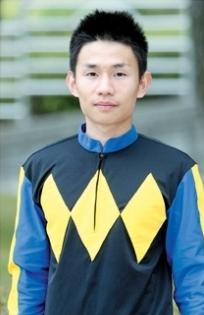
There’s another new Japanese jockey on the South Coast. Kanichiro Fujii will have his first rides at Busan Race Park this coming weekend.
Kanichiro “Joe” Fujii debuts at Busan this weekend
Fujii – who goes by Joe – was born in Nara, Japan but went to Australia at the age of 15 to train as a jockey. He debuted in 2001 and spent the next five years riding mainly in New South Wales, finishing 2nd in the State’s Apprentice Jockey race in 2006.
In 2007, Fujii spent nine months in Singapore where he won the Listed Chairman’s Trophy and rode third-placed finisher Jade in the Group 1 Emirates Singapore Derby.
After Singapore, Fujii went to Europe where he rode work in France for, amongst others, Criquitte Head before returning to Australia in 2008.
In 2009 he went to the USA and rode work at Belmont Park before relocating once more to Australia, this time to Queensland where he has been riding until recently. To date, he has ridden just shy of 300 winners.
Fujii is married and became a father for the first time earlier this month.
Riding on an initial four-month license and joins fellow Japanese riders Narazaki Kosuke and Yukio Abe as well as South African Gerrit Schlechter in making up the foreign jockey contingent at Busan. He will make his racing debut this Friday in race 7.
He told Korea Racing that he became interested in riding in Korea after speaking with Japanese riders Nozomu Tomizawa, Yoshi Aoki, Hiro Hamada and Akane Yamamoto – all of whom rode in Korea and have strong Australian connections, as well as Aussie jockey Garry Baker who rode at Busan from 2005 until 2007.
The most expensive imported racehorse in Korean history has arrived at Seoul Racecourse. The filly, by Henny Hughes and out of the Cape Town mare Cape Discovery, was purchased by owner Oh Ho Kuk at the OBS Spring Sale of Two-year Olds in Training in Florida this April. Having cleared quarantine, she arrived at the track earlier this month.
The Henny Hughes filly, with trainer Choi Bong Ju (left) and owner Oh Ho Kuk (right), who has become the most expensive imported racehorse in Korean history
The filly, who remains unnamed, was the fastest under-tack in the lead-up to the sale, posting a time of 9.8 seconds for 1 furlong – considerably faster than anything has ever run in Korea. According to The Bloodhorse, family members include G2 winners Unbridled Energy and Heart Of Joy and G3 winners Inexplicable, Midnight Cry and White Mischief.
The filly is by far the most expensive purchase made by a Korean buyer since the price cap for imported fillies was removed on a trial basis earlier this year. The cap, which existed to promote the local breeding industry, had been increased in recent years from $20,000 all the way up to $70,000 before being removed completely in order to provide not only a better standard of racehorse but also to improve the breeding stock. Great news for OBS and others who already see the lower end of their sales propped up by Korean buyers but also, the Korea Racing Authority hopes, for the nation’s own breeders.
The cap remains on colts and geldings, however, with the breeding industry here now sufficiently developed in terms of facilities and well stocked with an ever-improving standard of stallion, the KRA believed that the time was right to remove the cap for fillies for racing (mares imported solely for breeding purposes had never been subject to the cap). To encourage the import of quality fillies, the “Queens’ Tour” of valuable Stakes races was introduced this year.
The KRA wants Korea’s breeding industry to develop to such an extent that ultimately the country becomes a net exporter of racehorses. Last year, several horses were sold to Malaysia and ultimately Korea, like every other country in the region (and most of the world) has its eye on China as an export market if and when they begin importing horses.
Of course, on the track the challenge remains for these expensive fillies to be able to live up to their potential as Korean training remains significantly below international standards. The Henny Hughes filly has been sent to the barn of Choi Bong Ju who, although 49, has only been training since 2007 after retiring as a jockey. Choi told the media that he “doesn’t feel a burden” in being put in charge of the star newcomer. Likewise owner Oh has insisted – publicly anyway – that his trainer is under no pressure. We will see.