News

Dongbanui Gangja, Double Grand Prix Stakes Winner, Has Been Retired

A year after his last start, US bred champion Dongbanui Gangja [Broken Vow-Maremaid (Storm Bird)] has been formally retired aged 8. He is a two-time winner of the Grand Prix Stakes, Korea’s most prestigious race, claiming victories in 2008 and 2009. He also won the Owners’ Association Trophy as he racked up 20 wins from 35 lifetime starts.

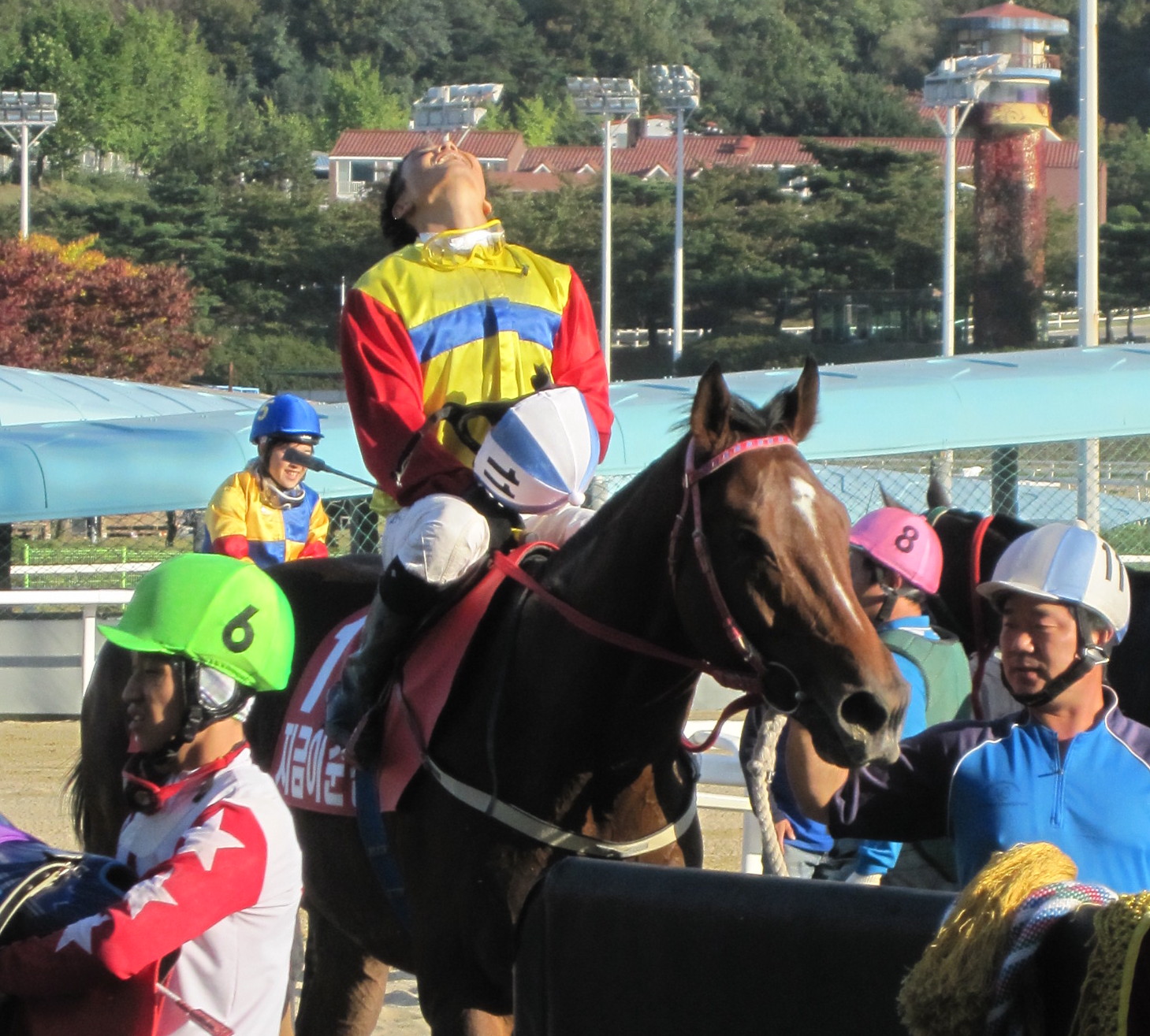
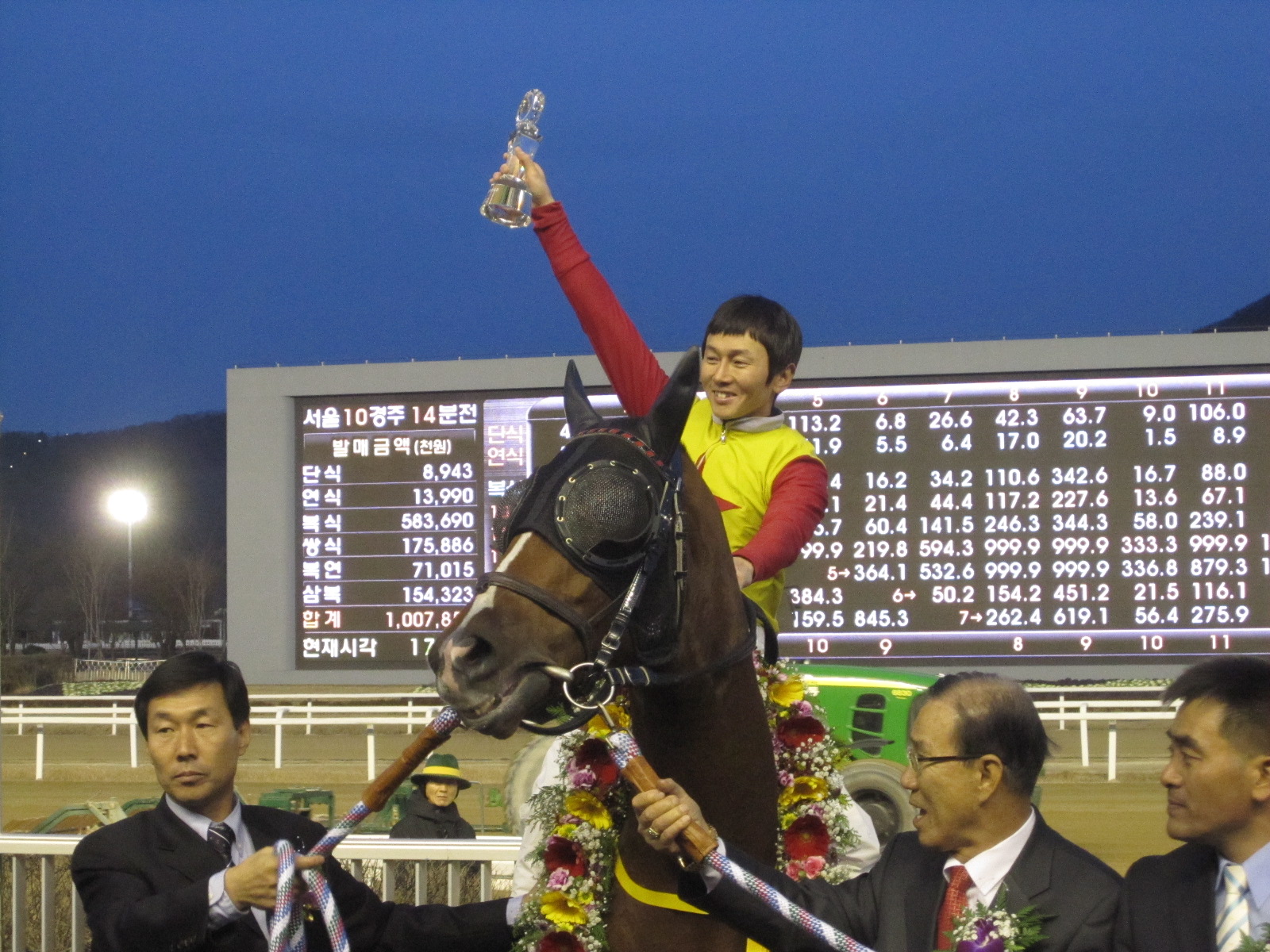
Dongbanui Gangja and Choi Bum Hyun (Pic: KRA)

Dongbanui Gangja and Choi Bum Hyun (Pic: KRA)

A $20,000 purchase from the OBS Spring Sale of Two-Year-Olds in Training in April 2007, Dongbanui Gangja has a solid but start to his racing career, winning 3 times from 6 starts as a 2-year old. He continued to develop as a 3-year old culminating in his first Grand Prix win in December 2008 beating 2007 winner Bally Brae by 4 lengths.

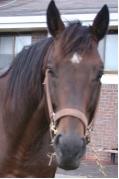
Dongbanui Gangja

Dongbanui Gangja

That was the 3rd win in a sequence of 12 consecutive triumphs that saw him become the first horse to simultaneously hold the Grand Prix Stakes and Owners’ Association Trophy. He successfully defended his Grand Prix title in December 2009 with a dominant 6 length win.

His remarkable run of victories finally came to an end on his first trip to Busan for the Metropolitan City Mayor’s Cup in July 2010. Billed as the first showdown between Dongbanui Gangja and the young upstart import Tough Win (Yonaguska), Dongbanui Gangja ran inexplicibly wide on the final turn eliminating himself from contention.

This began a period of several races where he became very difficult to control including in that year’s Grand Prix when he could only manage 7th place behind Mister Park.

2011 saw a return to some kind of form and he managed a creditable 2nd place on his return to the Busan Metropolitan as well as picking up 2 big handicap wins. Like all successful imported horses, however, it was becoming harder and harder to find races for him due to the handicapper. On what proved to be his final outing, in February 2012, he carried 62kg. Despite that impost, he won.

One of the most successful horses ever to race in Korea, a retirement ceremoney for Dongbanui Gangja, at which the horse will be present, will be held in the winner’s circle at Seoul Race Park this coming Sunday, February 17.

Eleven Jockeys Go Free At Seoul

As of February, jockeys at Seoul Race Park can once again designate themselves freelance and eleven local riders have opted to join Japanese jockey Yukio Abe in being unattached to a trainer.

I'm Free! Moon Se Young is among 11 jockeys going freelance

I’m Free! Moon Se Young is among 11 jockeys goinf freelance

The majority of the track’s big names are among them, including current champion Moon Se Young (who is riding in Macau at the moment), current leader Jo In Kwen and all-time great Park Tae Jong.

Kim Hae Sun, who is poised to shortly become the all-time leading female thoroughbred jockey in Korea joins them.

The advantage of a jockey being freelance is that he or she is not restricted in the number of rides they can accept across a weekend of racing while the disadvantage (in theory) is that they have to battle for every mount. They also do not receive a salary from a trainer for trackwork but instead get paid per work.

The full list is as follows:

Kim Young Jin
Moon Se Young
Cho Kyoung Ho
Park Tae Jong
Jang Chu Yeol
Kim Hae Sun
Park Sang Woo
Lee Sang Hyeok
Jo In Kwen
Oh Kyoung Hoan
Yoo Seung Wan

As a foreign rider, Yukio Abe was already a freelancer even when the locals weren’t. Abe recently received an extension to his license to ride at Seoul but is having a quiet time at Seoul despite being a roaring success at Busan.

Down on the South-Coast, where different union agreements exist among the riders, the two Japanese jockeys, Joe Fujii and Narazaki Kosuke remain the only freelancers and both are in demand from owners and trainers.

Korea vs Japan Race Set For September

Japanese to race in Korea in September with Koreans heading to Japan in November

The Korea Racing Authority (KRA) has announced plans to host its first “international race” by inviting three Japanese-trained horses to Korea to compete for a 250 Million won prize on September 1st. Subsequently, three Korean horses will be selected to race in Japan in November.

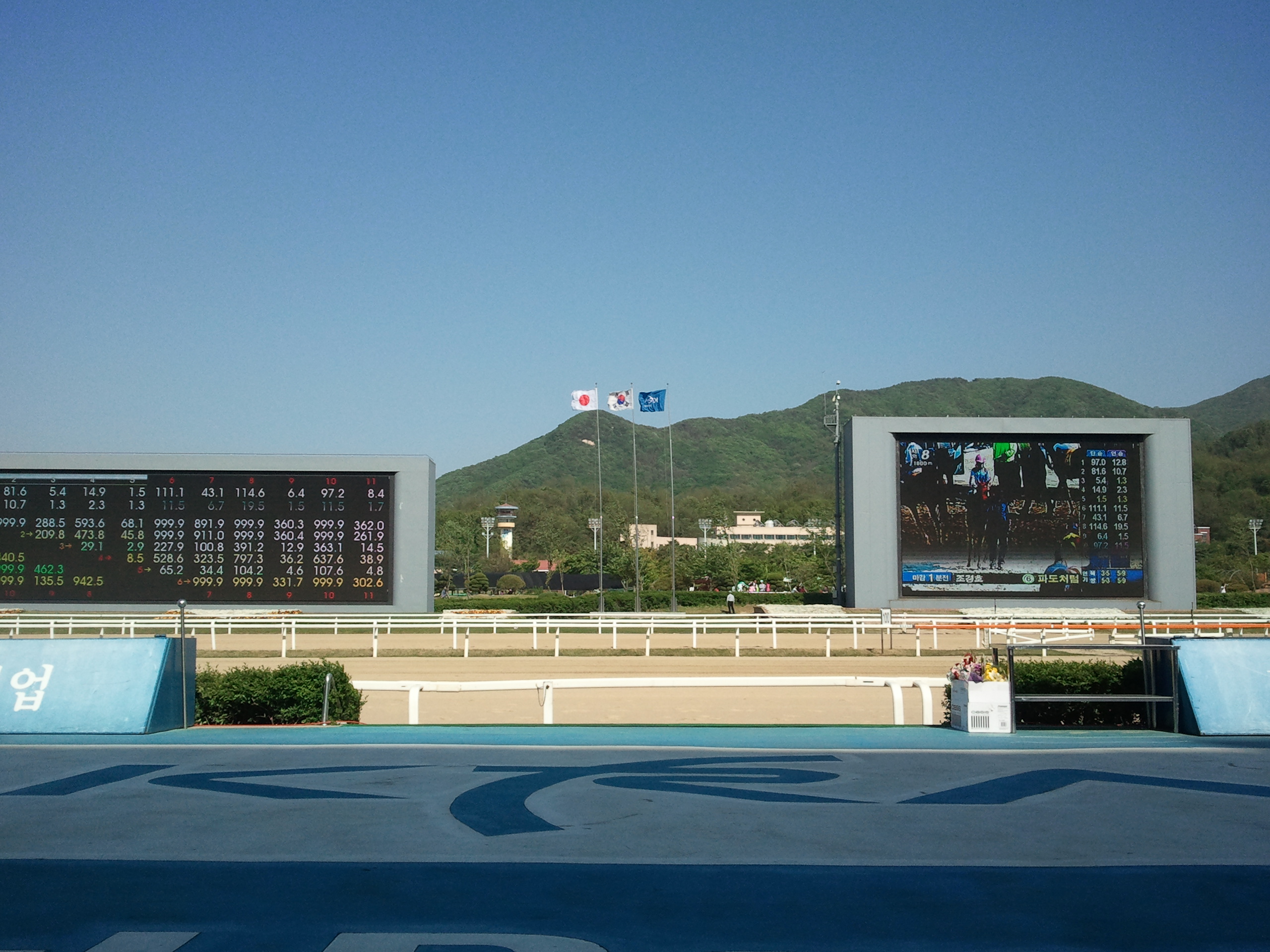
The Japanese flag is likely to be seen over Gwacheon again this year

The Japanese flag is likely to be seen over Gwacheon again this year

The KRA will be picking up the costs of all those involved and plans to promote the race in the same way an international football match would be. At the same time, the Authority also announced plans to hold a truly international race in 2014 with horses trained in the USA, Australia, Hong Kong, Macau and Malaysia expected to be invited.

It’s not the first time the racing authorities here have planned to hold an international event. Such a race was planned to be the culmination of a “five-year plan for intenationalization” drawn up in the early 2000s and a similar race is pencilled in to mark the opening of the now delayed new racecourse at Yeongcheon.

While the International Jockey Challenge, which was also part of that original plan, is now an established feature of the calendar and Korean-bred horse Feel So Good – likely to be one of the Korea horses selected for the event – ran and won in the US last year, progress on hosting foreign horses in Korea has until now, been slow.

The KRA already operates exchange races with a number of its counterparts around the world (the great Irish horse Sea The Stars broke his maiden in August 2008 in a race sponsored by the KRA at Leopardstown), including the JRA and some of these have seen jockeys from the partner organisations visiting. Busan Racecourse also has a partnership with Kokura Racecourse in Japan. However, none of these arrangements have involved horses travelling to compete.

(ht- Flame Racing)

Didyme, Five-Time Leading Sire In Korea, Has Died Aged 22

Didyme, the most successful sire in Korean racing history, passed away last month. He was 22.

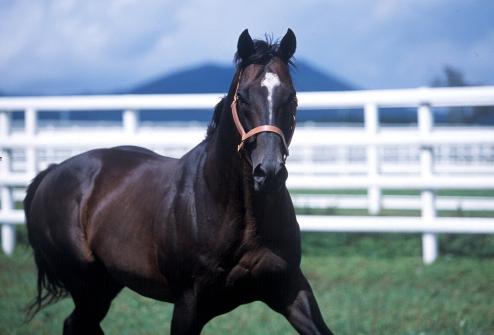
Didyme 1990 - 2012 (Picture: KRA)

Didyme 1990 – 2012 (Picture: KRA)

The stallion, who had been suffering from circulatory issues, died on December 22 after developing blood-clots while receiving treatment for leg abrasions at the KRA Stud Farm on Jeju Island. He had been in Korea for nearly 18 years.

American bred, Didyme [Dixieland Band – Soundings (Mr. Prospector)] started his racing career in France, winning his debut race at Maisons-Lafitte in July 1992. Two weeks later, he won the Group 2 Prix Robert Papin at the same track. He made just two further appearances that year in France and then spent a year away from the racetrack.

When he next appeared, it was in the USA and he would spend the remainder of his racing career in California, picking up two wins at Santa Anita before being retired after a 3rd place finish in the Morvich Handicap in November 1994. A month later, he arrived in Korea.

Didyme’s first foals hit the racetrack in 1998 and that crop led him to the Leading Sire of Three-Year-Olds in 1999. His first Leading General Sire title followed in 2000 and he went on to win four more times, most recently in 2009.

Among his progeny were Korean Derby winner Mupae Gangja and Oaks winner Jeolho Chance. He also sired Areumdaun Jilju, who won 19 out of 32 lifetime starts and the multiple Stakes winning Kwaedo Nanma who has himself gone on to become one of very few Korean bred stallions to be successful at Stud.

The Leading sire of two-year olds in 2011, the best of that crop, Nobel Pokpung, went on to finish 2nd in the Korean Derby.

A fixture in Korean racing for nearly two decades and a horse who has played a huge role in the development of Korean racing, Didyme will be greatly missed.

Here is a video of Didyme at Stud:

Former Seoul & Busan Jockey Yoshi Aoki Has Died Aged 35

Sad news out of Japan this evening with local sports media reporting that jockey Yoshiyuki Aoki, who had two stints riding in South Korea, was found dead at his home in Yokohama earlier today.

According to the Japanese Daily Sports Online, Police believe Aoki took his own life. He was 35.

Yoshi Aoki 1977-2012

Yoshi Aoki 1977-2012

A JRA licensed jockey, Aoki rode 106 winners in Japan since his 1995 debut. He first came to Korea in 2009, spending three months riding at Seoul Race Park.

He returned to the peninsula in autumn 2010, this time to Busan where he was much more successful, landing 21 winners from 165 rides in six months on the south coast, many of them partnering with trainer Peter Wolsley.

Shortly before he was due to return to Japan in order to renew his JRA license in April 2011, Aoki suffered a bad fall at Busan which brought his time in Korea to an early end.

With his distinctive Godolphin-esque blue silks, Aoki was well liked by racing fans during his time here.

(ht @uk_maniax)

Calder Winner Feel So Good Takes 12 Length Victory on Korean Debut

Feel So Good, who in September this year became the first ever Korean bred horse to win a race in the United States, breezed to a 12 length win in his Korean debut at Seoul Race Park on Saturday.

The three-year old gelding was far too good for a class 5 field over seven furlongs in freezing conditions, taking the lead with a furlong and a half to run and easily stretching away.

Feel So Good (Ft.Stockton – Courting Dreams (Eastover Court)] was bred in Korea but was shipped to Ocala in Florida as a yearling to undergo early training as part of an experiment by the Korea Racing Authority who remain perplexed at how locally bred horses – despite a host of good stallions in Korea these days – still regularly get beaten by cheap imports with inferior blood lines.

Feel So Good’s training culminated with victory in a race at Calder Racecourse this September. Immediately after his win, the gelding was returned to Korea where he was sold by the KRA to a private owner for 291,000,000 won (about $260,000)- a record for a Korean bred horse.

He’s become the first high-profile addition to the stable of Korea’s first female trainer, Lee Shin Young and is likely to be a contender for the nation’s biggest Stakes races in 2013.

Sunday 23 December

Seoul Race Park: 14 races from 11:00 to 17:50

D-4: Thirty One Years Of The Grand Prix Stakes

While other races may carry more prize money, in terms of honour and prestige, the Grand Prix Stakes is second to none in Korea. It’s a race that has had movies named after it and is, perhaps, the only domestic horse race to register in the national consciousness.
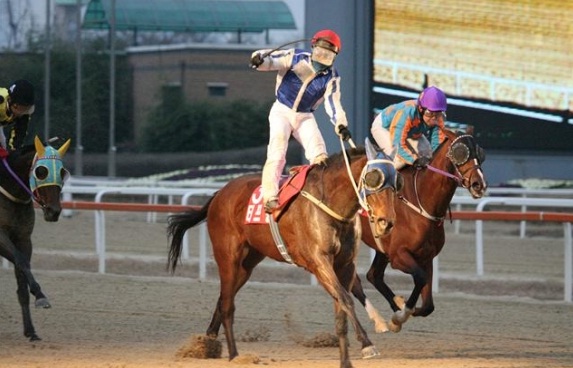
Defending champion Tough Win heads the Grand Prix field (KRA)

Defending champion Tough Win heads the Grand Prix field (KRA)

Sunday at Seoul Race Park sees the 31st edition of the race. It’s young in international terms, but in a country where the private ownership of racehorses – and therefore prize money and big Stakes races – go back less than two decades, it is positively venerable. With race fans invited to vote on which horses they want to see in the starting gate, it is the undisputed Championship race in Korea. There is no question of the best horses trying to avoid each other as there is nowhere else to go. In the Grand Prix, the best face the best.

This is because whereas the Classics are restricted to Korean bred entrants, the Grand Prix is open to all. Indeed in the previous 30 editions, home-bred horses have ended up in the winner’s circle just four times (including Mister Park who was born in Korea after his dam was imported while in foal). Fillies or mares have won the race five times with Ka Shock Do taking back-to-back wins in 1990 and 1991.

The origin of the winners also shows the change in influence on Korean racing. Throughout the eighties and nineties, the vast majority of horses imported to Korea were from the Southern Hemisphere. This is reflected by Australian or New Zealand breds winning thirteen of the first sixteen runnings, compared with just one American. Since the turn of the century, the majority of imports have come from the USA and American breds have won six out of the last eight editions.

As recently as 1999, a non-thoroughbred was triumphant. Saegangja was by the established sire Fiercely, however, his dam Chuk Je, was not in the studbook. That won’t happen again as year on year, Korean racing gradually becomes more mature.

Last year’s winner Tough Win is likely to contend favouritism for this year’s race with the remarkable Dangdae Bulpae, who is now a three-time President’s Cup winner. Dangdae Bulpae didn’t stay the distance in 2010 and didn’t even start last year but at five, he appears at the peak of his powers.
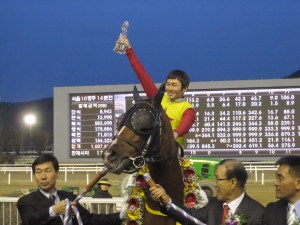
Sadly missed - 2010 winner Mister Park

While Derby winner and champion three-year old Jigeum I Sungan looks set to sit out for sporting reasons, two other names are missing who really should have been here had circumstances been different. 2010 champion Mister Park tragically died after a race at Busan in June this year while Smarty Moonhak, who finished 3rd in the race as a two year old a year ago, was diagnosed with tendinitis after finishing second to Dangdae Bulpae in the Busan Metropolitan.

There is still plenty of interest besides the big two though. US filly Gamdonguibada has won two bg Stakes races and is getting better and better while Sing Sing Cat defeated an out-of-sorts Tough Win to claim the KRA Cup Classic. Meanwhile there are young up and comers such as Smoking Gun and Sydney Jewelry who may also take their chance.

Also set to line up is Dongbanui Gangja, the 2008 and 2009 champion. He’s fit and he’s still fast but he’ll be an outsider to add a third crown.

On Sunday Tough Win will seek to join Dongbanui Gangja, Ka Shock Do and the great Po Gyeong Seon as double winners of the race and prevent a new name being added to the list of horses below who, for one year at least, can claim to have been the undisputed best.

2011: Tough Win (USA) [Yonaguska – Maggie May’s Sword (Sword Dance)]
2010: Mister Park (KOR) [Ecton Park – Formal Deal (Formal Gold)]
2009: Dongbanui Gangja (USA) [Broken Vow – Maremaid (Storm Bird)] The now seven-year old two-time champion is a likely starter this year.
2008: Dongbanui Gangja (USA) [Broken Vow – Maremaid (Storm Bird)]
2007: Bally Brae (USA) [Yarrow Brae – Political Bluff (Unaccounted For)] – Also has two second places to his name, in 2006 and 2008. Like his great rival Subsidy, Bally Brae too passed away this year after a short illness having been retired to the Korea Horse Affairs High School.
2006: Flying Cat (KOR) [Western Cat – Flying Wood (Tapping Wood)]
2005: Subsidy (USA) [Mr. Prospector – Foreign Aid (Danzig)] The last son of Mister Prospector died in a paddock accident earlier this year.
2004: Value Play (USA) [Mt. Livermore – Return Of Mom (Deputy Minister)]
2003: Tempest West (USA) [Silent Tempest – Westabout (Gone West)]
2002: Bohamian Butler (USA) [Patton – Circus Princess (Forli)]
2001: Tahamkke (NZ) [Dance Floor – Cantango (Danzatore)]- has gone on to become a moderately successful sire in Korea
2000: Cheolgeoun Party (KOR) [Big Sur – Party Paint (Acaroid)] – The only Korean bred filly to win.
1999: Saegangja (KOR) [Fiercely – Chuk Je] (non-thoroughbred)
1998: Sin Se Dae (AUS) [Avon Valley – Meroo Star (Starboard Buoy)]
1997: P’Ulgeurim (NZ) [Crested Wave – Evocative (Sea Anchor)]
1996: Hula-Mingo (NZ) [Broadway Aly – Zamatina (Zamazaan)]
1995: Dae Kyeun (AUS) [Northern Regent – Romantic Evening (Sunset Hue)]
1994: Ji Goo Ryeok (AUS) [Pine Circle – Perfect Choice (Lunchtime)] – The first year prize-money was awarded, Ji Goo Ryeok’s connections took home 50 Million won. This year’s winner will receive as record high of nearly 300 Million, the most in its history. The Korean Derby and the President’s Cup are both worth more to the winner.
1993: Gi Peun So Sik (NZ) [Bolak – Belserena (Serenader)]
1992: Chun Pung (NZ) [Coral Reef – Little Jo] (non-thorougbred)
1991: Ka Shock Do (NZ) [Engagement – Nursery Rhyme (Namnan)]- With her second , she became arguably the greatest filly to run in Korea. In all, she won twelve of her thirteen starts.
1990: Ka Shock Do (NZ) [Engagement – Nursery Rhyme (Namnan)]
1989: Cha Dol (USA) [Mr Redoy – Honest’N Do Right]
1988: Wang Bang Wool (AUS) [Moon Sammy – Aqua Nymph (Crepone)]
1987: Cheong Ha (AUS) [Suliman – Pigalle Wonder (Exalt)]
1986: Po Gyeong Seon (NZ) [Danseur Etoile – Leonotis (Lionhearted)] – with twenty wins from twenty-five starts, he is, along with Saegangja and J.S. Hold one of the three
1985: Po Gyeong Seon (NZ) [Danseur Etoile – Leonotis (Lionhearted)]

* Although this is the 31st running of the Grand Prix, Korean racing records officially only go back to 1985.

* This is an updated version of a post that appeared on this blog in the build up to last year’s Grand Prix. And the year before and the year…etc.
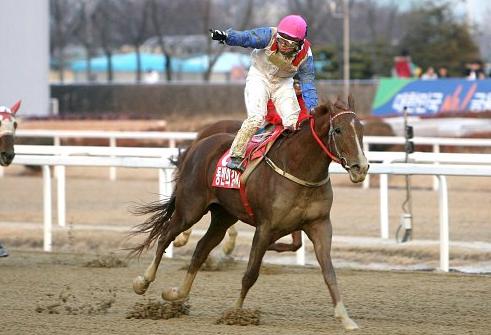
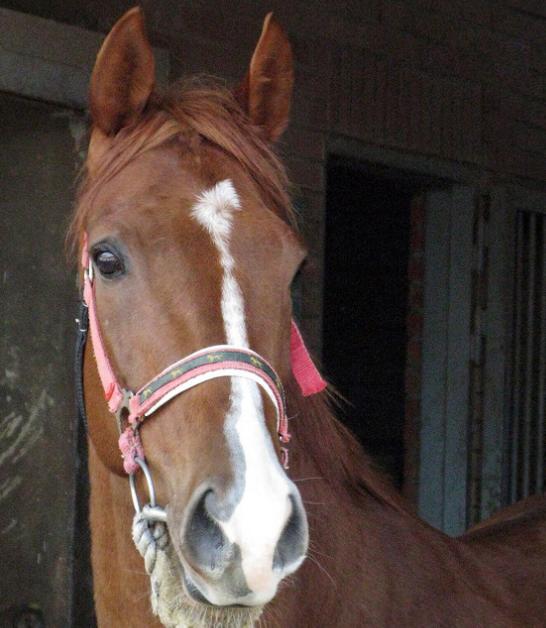
Stallion Social Charter Has Passed Away

Social Charter [Nureyev-Aunt Pearl (Seattle Slew)], who started his racing career in the UK before moving on to Canada and the USA has died at stud in South Korea aged 17.

Social Charter

As a racehorse, in 1999 he won two Group 3 race, the Eclipse Handicap at Woodbine and the Fayette Breeders’ Cup at Keeneland.

He was imported to Korea in October 2000 and was consistantly in the top 15 leading General sires for the next decade.

His progeny was known for being tough and durable and, while he didn’t sire any major race winners, he was responsible for a large number who had long careers with Southpaw, Natural Guy and Bada Jewang among his chief money-earners.

Still standing at the KRA Jeju Stud Farm, he passed away of an unspecified illness in late September.

After Feel So Good wins in the US, KRA tells trainers “Maybe we found out that the problem is not the horse”

There’s a very good write-up on Brisnet about Feel So Good’s victory at Calder Racecourse in Florida last week when he became the first Korean bred horse to win a race outside of Korea. The article quotes Ko Byung Un of the Korea Racing Authority as saying:

“…even though Feel So Good is a Korean horse, we had him in the U.S. since he was young, and the horse learned to race here and was taught by American trainers…I think maybe we found out that the problem is not the horse.”

That’s not exactly news to anyone who’s been watching Korean racing over the last few years although for a KRA official to come out and say it in such explicit terms is unusual.

Having invested shrewdly in the past few years, the stallion stock in Korea is very solid and improving all the time. The broodmares that they get to cover are also, while not among the world’s elite, more than adequate and certainly the equal of those who foal the cheap American imports that arrive here aged two and then regularly run faster than the homegrown talent.

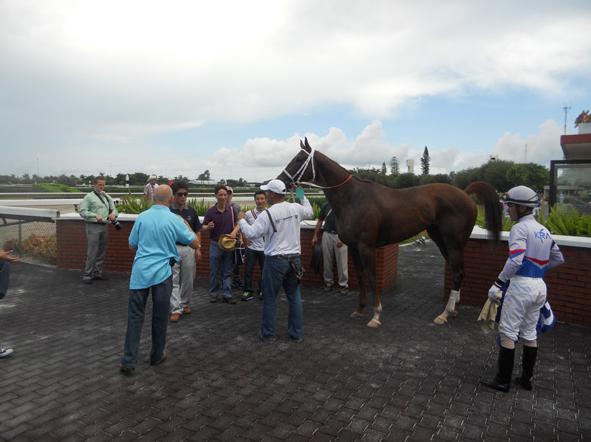
Feel So Good in the winner’s circle at Calder

The idea of “Internationalization” is resisted by many in the industry in Korea for understandable reasons but it is necessary. It’s necessary not only for the sake of the sport but also because of the precarious position that racing – as one of very few legalised gambling options in the country – occupies.

Korean governments are nothing if not impulsive as recent policies attempting to “ban” public drinking (practically the national sport here), internet pornography and Sunday opening of supermarkets have shown. All of them were ill thought out and ended up being unworkable, however, it seems only a matter of time until legal gambling finds itself targeted to an even greater extent than it already is.

Some in the KRA realise this and are eager to make the racing industry, already a major employer, bankroller of Korean agriculture and charity fundraiser – not to mention tax payer – a source of national pride.

It’s difficult to get very excited about Feel So Good [Ft.Stockton – Courting Dreams (Eastover Court)] winning a midweek maiden claimer at Calder. If Dangdae Bulpae had been trained in the US, he could be winning Stakes races. However, the fact that he’s done it is important and sends a big message to those training young horses in Korea that we need to be achieving more. We have a captive audience of hundreds of thousands every weekend but we can’t stand still. And to be fair, most realise this.

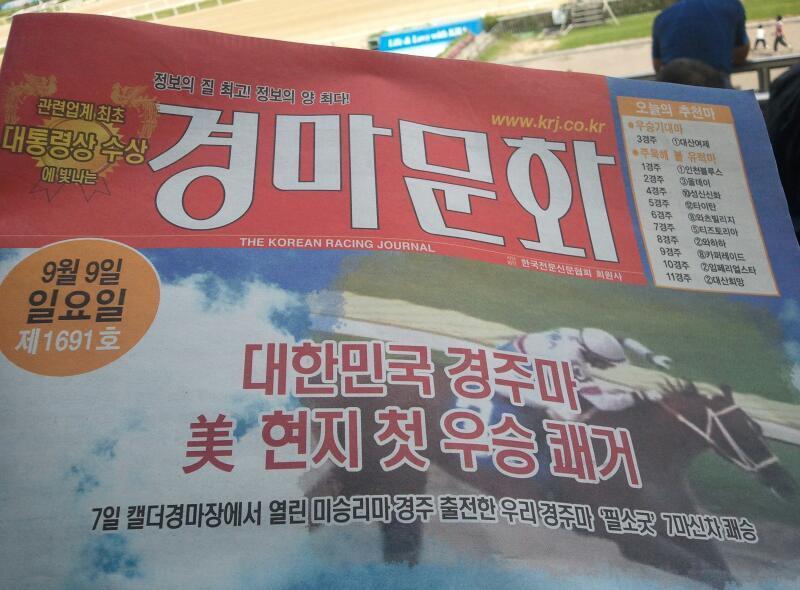
Feel So Good makes the front page of the Korean Racing Journal

Feel So Good has already entered quarantine in preparation to return to Korea. On arrival he’ll be sold to a private owner to begin his domestic racing career. In pictures he looks bigger and stronger than other Korean bred horses his age. With plans to set up their own training centre in Ocala, the KRA is considering making Feel So Good only the first of many to spend the early part of their life outside of Korea.

There is one potential downside to Feel So Good’s win at Calder. As one trainer pointed out at the weekend, he was almost certainly running on Lasix. Like the vast majority of racing jurisdictions outside the US, raceday medication is banned in Korea and hopefully the KRA doesn’t get any foolish ideas.

Hopefully they won’t and if Feel So Good can finally put to rest the idea of “this is a Korean horse, it doesn’t understand western ways”, then the experiment will have been more than worth it.

* Thanks to @KeeneGal on twitter for the link to the Brisnet article.

Korean Oaks 2012 – Runners and Riders

A full field of 14 will line up for the Korean Oaks at Busan Race Park this coming Sunday. Six fillies have travelled down from Seoul to meet eight of the home track’s best. We’ll have a full preview of the race over the next couple of days but in the meantime, here’s a full list of all the runners and riders with pedigree and race records:

Korean Oaks (KOR.GII) – Busan Race Park – 1800M – Aug 26, 2012 – 15:50

1. Naryusya (KOR) [Menifee – New Tan Saeng (Pre Catalan)] – (6/1/0/1) Kim Hae Sun – (Seoul)
2. Rising Glory (KOR) [Menifee – Straight Cash (Straight Man)] – (8/3/3/1) – Jo Sung Gon (Busan)
3. Dolpung Jilju (KOR) [Didyme – Alder Gulch (Gulch)] – (12/3/3/1) – Ham Wan Sik (Seoul)
4. Cheoneun (KOR) [Forest Camp – Naha (Silver Buck)] – (13/6/1/1) – Oh Kyoung Hoan (Seoul)
5. Choego Yeosin (KOR) [Ingrandire – Western Heroine (Western Borders)] – (6/3/0/0) – Lee Sang Hyeok (Seoul)
6. Powerful Miss G (KOR) [Revere – Miss Geology (Jade Hunter)] – (9/2/3/1) – Shin Hyoung Chul (Seoul)
7. Joiner Peace (KOR) [Menifee – Premiered (Unbridled’s Song)] – (9/3/3/1) – Kim Yong Geun (Busan)
8. Gumpo Yeowang (KOR) [Menifee – Lady Forza (Fuji Kiseki)] – (6/2/1/3) – Chae Gyu Jun (Busan)
9. Grand Teukgeup (KOR) [Menifee – Sarartoga Campaign (Mt. Livermore)] – (10/5/1/0) – Gerrit Schlechter (Busan)
10. Nuriui Bit (KOR) [Menifee – Altria (Maria’s Mon)] – (8/3/2/1) – Joe Fujii (Busan)
11. Over Power (KOR) [Ft. Stockton – Roan All Over (Fight Over)] – (11/4/0/3) – Narazaki Kosuke (Busan)
12. Last Love [Volponi – White Aloa (White Muzzle)] (KOR) – (7/1/3/1) – Choi Won Joon (Seoul)
13. Sing A (KOR) [Fortitude – Seollimwon (Wheaton)] – (13/2/3/2) – Choi Si Dae (Busan)
14. Money Queen (KOR) [Psychobabble – Ta Wee Tee Pee (Cherokee Run)] – (7/3/0/1) – Jo Chan Hoon (Busan)