Horse Racing

As the Invasion began, Racegoers kept on Punting

Sinseol-Dong’s last day….

At 4am on June 25, 1950, North Korea launched a massive artillery barrage against the South across the 38th parallel – the artificial boundary that had split the two Koreas since liberation from the Japanese. On that day, a Sunday, one of the biggest races of the year was scheduled with the running of a race at Seoul Racecourse in honour of Shin Ik Hee.

Shin had been a resistance fighter against Japanese colonial rule and, along with Syngman Rhee, was recognised as one of the two “Founding Fathers” of the Republic of Korea and the then Speaker of the “Constituent Assembly” (now “National Assembly” or Korean Parliament). Shin, President Syngman Rhee and Kim Gu – the former President who had died the previous year, were all frequent visitors to the races.
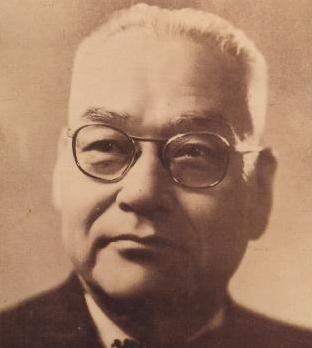
One of the "Founders of the Republic" a race in honour of Shin Ik Hee was run on the day North Korea invaded

Despite the rumours that were flying around the city of the invasion taking place just 30 miles to the North, a big crowd packed into the track in Sinseol-dong – location of Seoul Racecourse since 1928 – and racing got underway as usual at 11am. Many believed that what had happened was just a border skirmish, the likes of which were very common at the time and, while troubling, certainly weren’t worth losing a day’s punting over.

During Race 4, however, an unidentified plane circled the track and dropped hundreds of leaflets from the North announcing that an invasion – or ‘liberation’ – was in progress. Shortly afterward military jeeps arrived at the track equipped with loudspeakers calling for soldiers on leave among the crowd to immediately return to their divisions.

Racing continued and the Shin Ik Hee race (race 7) went ahead as planned, as did all twelve scheduled races, as word slowly filtered through that this was no border skirmish. At the end of racing at 5pm, young men at the track – including trainers, grooms and jockeys – were required to report to the racing office where most were immediately pressed into military service.

And so the Korean War had begun. Within 48 hours Seoul had been abandoned to the advancing Communist forces.

On September 15, the daring Incheon landings were launched under the direction of General MacArthur. Within a week Seoul was back in UN hands. The racing authorities – recently renamed the KRA – reconvened and believing, along with most others, that the Communists had been expelled for good, they discussed the possibility of racing resuming in late October.

The battle for Seoul though had been brutal. The advance of the Allies had been yard-by-yard and was met with fierce resistance in a bloody three-day street battle which left much of the city in ruins. The Communist army had used Sinseol-dong to store equipment, making it a prime target for allied bombing. When racing authorities returned to the track, they found it devastated, the safe looted and the horses gone. Most likely they had been used by the advancing army to carry supplies with the majority likely to have perished under fire as the Northern invaders were expelled.

Nevertheless, the Racing Authority was initially determined to go ahead with the re-opening and made plans to bring in horses from the South of the country. This plan was dashed – along with hopes for a swift end to the fighting – when China officially entered the war and promptly drove the Allies back across the 38th parallel and out of Seoul once more.

So began a long period of stalemate. Seoul would change hands several more times and would be little more than a burnt out shell of a city when nearly three years – and millions of military and civilian lives later – a truce would be agreed leaving both sides with roughly the same territory that they had before the war.
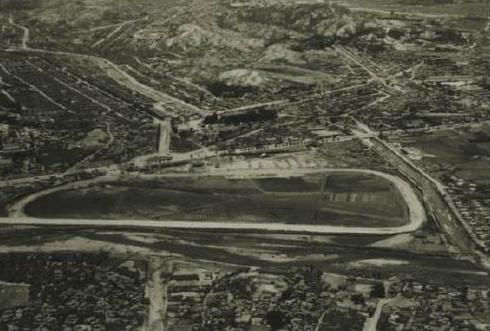
Seoul Racecourse in Sinseol-dong, some time prior to 1950

Racing never did return to Sinseol-dong. When the Authorities brought racing back to the shattered capital in 1954, it was to the north bank of the River Han at Ttukkseom. This new track would be home to Seoul Racecourse until the 1988 Olympic Games.

As for Shin Ik Hee, history doesn’t definitively record whether he showed up at the track as scheduled that fateful day to present the trophy named in his honour. He survived the war though and was a candidate in the 1956 Presidential elections but while campaigning, fell ill and died at the age of 62.

* Sources: The Korean language newspapers Ilgan Sports and Gyeonggi News both wrote on Sinseol-dong Racecourse’s last meeting last year. Information in English on Shin Ik Hee (also known as “Hae-Gong”) is scarce but some can be found here. General information on the Korean War is from Hastings, Max “The Korean War” (Pan, 1987, 2000).
Updated See this post for information on what became of Sinseol-dong.
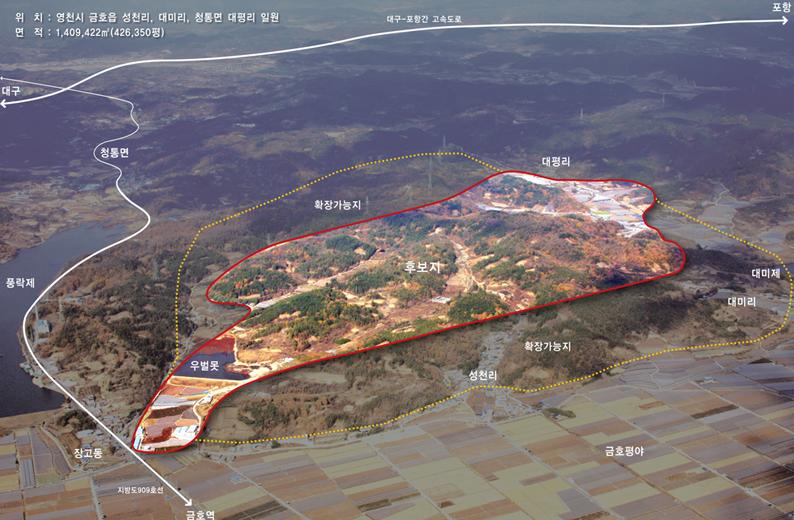
New Racecourse Set For Yeongcheon

The Korea Racing Authority (KRA) this week announced that Yeongcheon, North Gyeongsang Province, will be the location of Korea’s fourth racecourse.

A number of regions had bid to host the track which will join Seoul and Busan in hosting thoroughbred racing (with Jeju remaining the sole host of Pony racing) but Yeongcheon got the Authority’s nod. In addition to the racecourse, Yeongcheon will also play host to a training centre and “leisure town”.

The site that will be a racecourse by 2014

Yeongcheon is a small city with a population of just over 100,000. It is approximately 350 kilometres south-east of Seoul but only 80 from Busan and is on the the main “Gyeongbu” Expressway that links the peninsula’s two main cities.

With the gambling regulator, the National Gaming Control Commission, shutting down internet and telephone betting last year and also decreeing that a minimimum of 50% of all betting handle must be taken on-track threatening the off-track betting plazas, a new racecourse has become imperative for the KRA. Nevertheless, eyebrows will be raised at the decision to locate the new site in such a rural area with no obvious supply of punters nearby.

Construction at the new site will begin almost immediately with the first races expected to be run in 2014.

Yeongcheon is quick to incorporate racing into its official homepage

Yeongcheon City English Homepage

Chulgigi has a full account (in Korean) as well as video of the award ceremony

The Foreigners in Korea

Last year was another tough one for overseas jocks in Korea
Korea provides a notoriously difficult challenge for ex-pat employees with long hours and alien working practices. A lot of people have bad experiences, some self-inflicted, some not. Racing is no exception.

The most high-profile of foreign employees in the Korean racing industry are the jockeys. On the surface a jockey’s life in Korea is good – purses are big, accommodation is free and they only race twice a week. In reality, it’s anything but. Just like everywhere else in the World, while the top jockeys do indeed earn a lot, the majority don’t.

Japanese riders have generally had the best luck in Korea. The culture shock is less as is the style of racing – Korean racing has been described by more than one observer as being similar to that of Japan. Twenty years ago. The gap left by Toshio Uchida at Busan was ably filled by Ikuyasu Kurakane who moved down from Seoul and quickly became the track’s top rider. Ikuyasu left during 2009 as did Nozomu Tomizawa who returned to Australia after putting in a creditable two years at Seoul without getting the recognition – or more importantly, the rides – he deserved.

Eiki Nishimura joined Busan early in 2009 and battled through a tough start to be rewarded with victory on Sangseung Ilro in the KRA Cup Mile. Sadly Eiki was jocked off the filly for the Korean Derby amid rumours that the militant Seoul Jockeys’ Association did not want a foreigner riding a potential Derby winner. He did, however, regain the ride for the Oaks where Sangseung Ilro was beaten.

Three other Japanese riders joined during the year. Toshiyuki Katoh has found rides difficult to come by at Seoul but is still plugging away. He was joined recently by Yoshiyuki Aoki who has found rides in more quantity than Katoh, if not in quality. Finally, Hitomi Miyashita joined Busan in October. The winner of the International Lady Jockey Invitational at the track in August, Hitomi wasted no time in applying for a full-time license and has had no trouble settling in and being accepted by trainers. As of now, she is arguably the top jockey at the track and is worshipped by lovestruck punters.

As for the non-Japanese, American Santos Chavez was popular with punters and put in a quiet but competent four months at Seoul before returning to the States. At Busan, Vincent Sit rode for two months before returning to Hong Kong where his wife had just become the first woman to be granted a trainer’s license. India’s Rahul Shinde lasted all of one week while Eden Cheung of Hong Kong is currently on the injured list.

That leaves the two South Africans. Stephan Swanepoel started off at Seoul but, as is common at the capital track was given no opportunities and was allowed to relocate to Busan where he had slightly more success. Swanepoel called time in late November and returned to South Africa, retiring from the saddle completely.

Then there is the exception. Martin Wepner arrived in Korea having had considerable experience in Malaysia. With a strong reputation and an ability to do the light weights, he instantly got more rides – not necessarily good rides, just more – than the other foreigners. And he started winning on them. Things haven’t been simple with Wepner. A miscommunication which placed him in an embarrassing situation led to him walking out on the ride of Namdo Jeap in the Derby on the day of race.

With Wepner set to leave Korea, top Busan trainer Kim Young Gwan, possibly appreciating the difficulties faced by foreign riders here, stepped in to offer him the job as his stable jockey. Wepner accepted and it was the start of a prolific partnership. However, late in 2009 their relationship broke down and trainer and jockey went their separate ways. Wepner has once again landed on his feet and, back as a freelancer is, alongside Hitomi, the most in-demand rider at the track.

Peter Wolsley is still the sole foreign trainer working on the peninsula. Just as the foreign jockeys get the horses no-one else wants to ride, when he arrived, Wolsley was given the horses no-one else wanted to train. He toughed it out, however, and has been rewarded with a number of good quality runners in his barn including Ebony Storm, Khaosan and Yeoreumbi, as well as one-time Derby hopeful Impeccable. Now with twenty-four horses in his care, Wolsley saddled twenty-nine winners in 2009.

In terms of the KRA, the last week of 2009 saw the upgrade of their website to include English language racecards and results as well as links to the English language stewards reports. The KRA have a foreign steward at both thoroughbred tracks and James Perry at Seoul and Brett Wright at Busan have been tapping out English translations of the reports for over a year. Behind the scenes, a South African jockey instructor has played a key role in the development of a promising crop of young Korean jockeys.

The word is that another overseas trainer will be granted a licence in 2010. No word yet on the identity or even the nationality. The KRA is also still accepting applications from foriegn jockeys. Any newcomer should hope to be based at Busan which while still challenging, offers a more accepting environment to newcomers than at Seoul where the Jockeys’ Association still wields great power on the backstretch.

Overall there is still plenty of work to be done for the much heralded “Internationalization” plan to be realised. 2010 promises to be another challenging year for those racing professionals who choose to ply their trade on the peninsula

2009 – The Horses

Dongbanui Gangja ran seven times in 2009 and won seven times. Among those wins were an Owners’ Cup and his second Grand Prix. Currently untouchable at Seoul, he comfortably saw off those from Busan who dared to challenge him. By some distance, Dongbanui Gangja is our horse of the year.

Three year olds have had another mixed year. On the domestic front, Nice Choice eventually came good after a disappointing start to the year, his President’s Cup win over older horses the highlight. For the second year running, however, it was Busan horses who dominated the generation.

Namdo Jeap was second in the KRA Cup Mile and Korean Derby before going one better in the final leg of the Triple Crown. Like Nice Choice, Yeonseung Daero started the year with big expectations but only started living up to them late on in the campaign. In 2010, he more than others, will be the one to watch.

And then there was Sangseung Ilro. Overlooked by most before the Classics, the filly stormed to victory in the KRA Cup Mile at 16/1. Bizarrely, she remained unfancied for the Derby, which she proceeded to romp with ease.

Then it all went wrong. Sent off odds-on for the Oaks, she seemed all set for victory with a furlong to run, but tired to the extent that Pangpang managed to catch her. Diagnosed with a shin problem, she didn’t reappear until October when she made her bid for the Triple Crown in the Minister’s Cup at Seoul. Again she tired but bravely ran on for third place behind stablemate Namdo Jeap and Nice Choice.

With a disappointing reappearance last week, whether Sangseung Ilro returns in 2010 or follows 2008’s top filly Jeolho Chance, another plagued by injury, into the breeding shed, is still in doubt.

Those to have already had their careers prematurely ended by injury include Gangho and most notably, Playing Politics. The four-year old won six of his seven races and was considered a potential late season challenger to Dongbanui Gangja before he came back lame after easily winning what proved to be his final race in February.

Some old friends faded in 2009. Subsidy, Gayansanseong and Daiwa Arazi were retired while Golding, a stalwart of Busan since the track’s opening four years ago is in the way out. Meanwhile Subsidy’s great sparring partner Bally Brae was victorious early in the year but by the end of 2009, it was clear that his best days were behind him.

Feelgood story of the year is Baekgwang. Now six years old, the grey was champion three-year old in 2006 before suffering an injury that decimated his four-year old season and then flared up again in his only appearance in 2008. Following stem-cell treatment and a long period of recuperation, he came back in the SBS Cup in August. He ran fourth but went on to win two handicaps and finished second in the President’s Cup. In the unsentimental world of Korean racing, the sight of Baekgwang launching his home straight charge from the back of the field, just as he did three years ago.

Then there is the future. Seonbongbulpae, Northern Ace, Money Car and Night Moves caught the eye in the two-year old ranks this year. Will they push on in 2010? Who are those that we don’t know about yet but will have forced themselves into the Classic reckoning come May?

The road to the Derby is just days away. With that in mind, let’s take a look back at the four Classics of 2009:

1: The KRA Cup Mile – Busan, April 5: Sangseung Ilro stuns the colts by winning the first Classic:

2: The Korean Derby – Seoul, May 17: Sangseung Ilro again takes the honours to set up a possible Triple Crown:

3: The Korean Oaks – Busan, August 9: It’s Sangseung Ilro’s turn to be upset as Pangpang reels her in over the final furlong on a hot night in Busan:

4: The Minster of FAFF Cup – Seoul, October 12 – Namdo Jeap finally makes it to the Winners’ Circle, ending Sangseung Ilro’s hopes of emulating J.S.Hold in winning the Korean Triple Crown:

All these equine athletes become a year older on January 1. We will no doubt say goodbye to some in 2010 and meet a whole host of others for the first time. Wherever a horse is running next year, may it come home safely.

Twenty Eight Years of the Grand Prix

Sunday is the 28th running of the Grand Prix Stakes, the season ending race which in theory, clears up the matter of the year’s top thoroughbred in Korea. It’s one of the most valuable races on the calendar and also the longest running “name” race.

Whereas the Classics are restricted to Korean bred entrants, the Grand Prix is open to all. Indeed in the previous 27 editions, home-bred horses have ended up in the winner’s circle just three times. Fillies or mares have won the race five times with Ka Shock Do taking back-to-back wins in 1990 and 1991.

Dongbanui Gangja will be bidding to become the third horse to win in two consecutive years – along with Ka Shock Do, the great Po Gyeong Seon won the first two editions of the race in 1985 and 1986 – carrying 65kg in the latter.

2008: Dongbanui Gangja (USA)
2007: Bally Brae (USA) – Also has two second places to his name, in 2006 and 2008.
2006: Flying Cat (KOR)
2005: Subsidy (USA)
2004: Value Play (USA)
2003: Tempest West (USA)
2002: Bohamian Butler (USA)
2001: Tahamkke (NZ) – has gone on to become a moderately successful sire in Korea
2000: Cheolgeoun Party (KOR) – The only Korean bred filly to win.
1999: Saegangja (KOR)
1998: Sin Se Dae (AUS)
1997: P’Ulgeurim (NZ)
1996: Hula-Mingo (NZ)
1995: Dae Kyeun (AUS)
1994: Ji Goo Ryeok (AUS) – The first year prize-money was awarded, Ji Goo Ryeok’s connections took home 50 Million won. This year’s winner will receive 212 Million, slightly down on last year.
1993: Gi Peun So Sik (NZ)
1992: Chun Pung (NZ)
1991: Ka Shock Do (NZ) – With her second , she became arguably the greatest filly to run in Korea. In all, she won twelve of her thirteen starts.
1990: Ka Shock Do (NZ)
1989: Cha Dol (USA)
1988: Wang Bang Wool (AUS)
1987: Cheong Ha (AUS)
1986: Po Gyeong Seon (NZ) – with twenty wins from twenty-five starts, he is, along with Saegangja and J.S. Hold
1985: Po Gyeong Seon (NZ)

Choi Beom Hyun will be bidding to become just the second jockey to win the race twice. While the current top four of Choi, Moon Se Young, Cho Kyoung Ho and Park Tae Jong have all won the race once, only Lee Sung Il, who retired in 2005, has won twice.

The origin of the winners also shows the change in influence on Korean racing. Throughout the eighties and nineties, the vast majority of horses imported to Korea were from the Southern Hemisphere. This is reflected by Australian or New Zealand breds winning thirteen of the first sixteen runnings, compared with just one American. Since the turn of the century, the majority of imports have come from the USA and American breds have won six out of the last seven editions.

* Although this is the 28th running of the Grand Prix, Korean racing records officially only go back to 1985.

Melbourne Cup to be shown live in Korea

There’s a rare treat for Korea based racing fans on Tuesday as the Australia Network Cable Channel will be broadcasting live coverage of the Melbourne Cup from Flemington.

The programme runs from 11:10am to 2pm Korean time and features three races, including the Cup itself at 1pm. The Australia Network can be found on most Digital Cable platforms across Korea but for those without the right package or for those who will be tied to their office desks, it can also be viewed here.

It will be the first live racing to be shown on television in Korea since coverage of domestic cards was banned in July this year. The ban came in to try to stop illegal gaming houses from moving into the gap in the market created by the outlawing of online betting and enforced shutdown of the KRA’s “KNetz” betting platform.

The YTN News Channel managed to get away with broadcasting their own sponsored race (The “YTN Cup”) live during a news bulletin back in August but racing has been absent from screens since then.

Head over to Foolish Pleasure for a full preview of one of the greatest occasions in world racing.

Setbacks and Sports Days

Reverses for Secret Weapon, Bally Brae / Aoki shines in Jockeys Vs Punters

Secret Weapon is Seoul’s top rated Korean bred horse but he suffered a shock defeat on Saturday as SBS Cup winner Hallyu Star bested him over 1900 metres. Secret Weapon is one of the “Po-In-Ma Troika” – “Po-In-Ma” referring to horses foaled in Korea by mares who were pregnant when imported. They are therefore classed as Korean bred but are ineligible for the Triple Crown races as well as some other big races which are restricted to Korean breds, such as this month’s President’s Cup.

The other two members of the “Troika” are Gi Ra Seong and the mare Top Point, ranked third and fourth respectively in the Korean bred rankings. With all three absent from the President’s Cup, the prospect of the great grey Baekgwang completing a remarkable comeback is a real one. Early entries have been announced and Baekgwang heads them along with Seoul’s top three year old Nice Choice. We’ll start the build-up to the race later this week. The winner of the President’s Cup will almost certainly go on to the Grand Prix in December where the “Troika” will most likely all be present.

Looking increasingly doubtful to be present in the Grand Prix is 2007 winner Bally Brae. The seven year old struggled when returning from a three month lay off in September but came back to be sent off odds-on favourite over the Grand Prix distance of 2300 metres on Sunday with a return to the winners’ circle looking on the cards. It wasn’t to be. Park Tae Jong’s saddle slipped as they rounded the first corner and the former champion jockey was left with little control for the rest of the race. That Bally Brae still finished in touch with the field was testament to both horse and rider. Angus Empire took advantage to land the victory.

Bally Brae still has talent and if he was to get into the Grand Prix, a race where he wouldn’t be handicapped out of contention, anything could happen. However, with Myeongmun Gamun and Subsidy now retired and Bally Brae in the twilight of his career, a new generation are likely to be the ones challenging Dongbanui Gangja in December. Unless of course, Baekgwang can pull off somthing very special.

* It was the ninth annual Jockeys Vs Punters Sports Day in the Seoul Race Park infield last week. No idea who won – although Yoo Mi Ra was given the “MVP” award. In any case, as the “sports” included skipping and dodgeball, it probably doesn’t matter. The Chulgigi blog was there and he has some pictures as well as a video.

Watch out for new Japanese jockey Yoshi Aoki who first introduces himself and then procedes to interrupt an interview with Seoul Jockeys’ Union President Kim Dong Kyun. Sadly Aoki doesn’t ask Kim for his organization’s views on foreign jockeys coming to Seoul. Nevertheless, it seems as though everyone enjoyed themselves. The jury is still out on Aoki but he’s had a good start and he certainly seems an interesting – and English speaking – addition to the ranks.

It’s Busan Vs Seoul as Hardride Defends Cup

Six head down to try to break Busan’s domination
It’s Busan vs Seoul part 5, but this time it’s different. While up until now, only the three year old classics have been contested by horses from both tracks, this coming Sunday, six older overseas bred horseswill travel to Busan for the first Group 3 Busan Mayor’s Cup. Eight will be waiting for them from the home team, among them a mixture of the Busan’s top imports as well as its home bred stars.

Hardride is back to defend his title from last year but it’s the Korean bred runners who provide most of the interest from the Busan side. Areumdaun Jilju and Gaeseon Janggun will get another crack at Yeongung Manse, who surprised both of them in last month’s Governor’s Cup, while three year old Yeonsung Daero has another tilt at glory after failing in the classics.

Vicar Love, Saerounbisul and Bulpae Gisang head the Seoul contingent who will be looking to regain some pride for the capital track. In clashes between the two, Busan leads 8-0. Will things change on Sunday? We’ll find out when they go to post for the ten furlong race at 3:40pm.

Let’s have a look at the runners and riders.

Busan Mayor’s Cup (KOR. G.III) – Busan Race Park – 2000M – Nov 1, 2009 – 15:40

1. Saerounachim (NZ) [Pyrus – Jouet (Langfuhr)] (18/2/5/3) – Seoul – Shim Seung Tae
Second in the JRA Trophy, it’s hard to argue that he’s come along for any other reason then to keep stablemate Saerounbisul company.
2. Yeongung Manse (KOR) [Sharp Appeal – Saratogasplash (Wild Again)] (17/9/3/2) – Jo Chang Wook
Pulled off a stunning win over Areumdaun Jilju and Gaeseon Janggun last month in what was billed as a match race between the track’s top two stars. Not to be ignored.
3. Tiffanyuikkum (AUS) [Iglesia – Blue Lady (Western Symphony)] (18/5/1/2) – Seoul – Shin Dae Jun
Three out of his last four runs have been dreadful. Unproven at the top level, will his best form return?
4. Gamadongja (NZ) [Howbaddouwantit – Miss Martha (Iades)] (23/9/3/4) – Seoul – Stephan Swanepoel
Likely to set the early pace, Gamadongja is a sprinter but consistantly places at the longer distances.
5. Balbora (NZ) [Keeper – Deutzia (Chem)] (21/3/0/3) – Seoul – Bang Choon Sik
Hasn’t finished in the money this year. Perhaps his connections know something we don’t.
6. Saerounbisul (NZ) [Danske – Miss Golly (Casual Lies)] (25/6/4/4) – Seoul – Martin Wepner
Finished in the money on all but one of his last twenty-three races, the five year old won the Seoul Owners’ Cup last year and must be respected.
7. Bulpae Gisang (USA) [Lightnin N Thunder – Neat Trick (Clever Trick)] (11/6/2/0) – Seoul – Choi Beom Hyun
Won on his first attempt at class 1 and has two solid second places since. Choi Beom Hyun accompanies him down from Seoul.
8. Angle Slam (USA) [Gold Case – Platinum Code (Lost Code)] (42/8/7/8) – Han Sang Gyu
Like Gamadongja, he excels at shorter distances – he may contest the minor placings but a win would be a shock.
9. Vicar Love (USA) [Vicar – Canberra (Silver Hawk)] (17/9/1/3) – Seoul – Oh Kyoung Hoan
One of the top three year olds of last season, he’s back in form with a good win last time out.
10. Hardride (USA) [Colony Light – Lametta (Lomond)] (24/6/5/2) – Chae Gyu Jun
Winner of this race last year, he’s not in quite the same form as he was a year ago but can’t be ruled out.
11. Gaeseon Janggun (KOR) [Duality – Diamond Star (Dixieland Band)] (16/8/4/1) Jo Sung Gon
Last year’s champion Korean bred three year old has won four of his five outings this term, his only defeat being to Yeongung Manse last month. A real contender.
12. Luna (KOR) [Concept Win – Wu Su Hae (Exactly Sharp)] (31/12/5/2) – Eiki Nishimura
The only female in the race, the seven year old mare is a Busan stalwart. The 2007 KRA Cup Mile is the highlight of her career to date but she also pulled off a shock win in last year’s Owners’ Cup.
13. Areumdaun Jilju (KOR) [Didyme – Chills Of Nepal (Nepal)] (21/14/3/1) – Lim Sung Sil
Always in the money and usually in the winners’ circle. His defeat last time was a shock but Lim Sung Sil retains the ride and he will be in the mix at the end.
14. Yeonseung Daero (KOR) [Creek Cat – Sensationalkris (Cryptoclearance)] (15/8/1/2) – Park Geum Man
A disappointment in the classics, he’s the “nearly colt” of this year’s three year old group. Has always finisined in the money.

It’s nice but…

….What about that “Internationalization”?

The KRA’s new homepage was unveiled at midnight last night at www.kra.co.kr. And it is as impressive as you would expect complete with pretty graphical representations of the tracks and plenty of laptop crashing animations.

New KRA Homepage

KRA's new homepage

The race card layout has been much improved and overall it gets a thumbs-up. There’s just one issue at the moment: As far as can be made out, there’s no link at all to the English section of the website!

Pari-Mutuel Machines Learning English

Arriving early at Seoul Race Park on Saturday morning, Gyongmaman was surprised to be accosted by KRA officials outside the Foreigner Lounge on the fourth floor of the Luckyville grandstand. Nursing a hangover and fearing that last Monday’s article about the Karaoke expense claims had hit a little too close to the mark, Gyongmaman broke into a sweat and started looking for the exit.

It transpired that they wanted him to try out a new English language betting terminal. The fourth floor of both grandstands at Seoul (and most of Busan) is entirely automated with machines instead of tellers at all the betting windows. Gyongmaman doesn’t like this – if he’s watching from the fourth floor, he always goes down to the third to bet with one of the armada of women (they are all women) staffing the regular betting windows whom the KRA is hoping to replace with the soulless – and non wage demanding – machines.

Naturally, in the face of officaldom, Gyongmaman was suitably gushing about the brilliance of the proposed new machines. And in fariness, they look very promising. Currently the machines only have Korean instructions and though easy to use, they can deter first-timers. Not only will the new machines accept bets, they will also provide searchable information on the racecard and give results from all three tracks.

End of writing in the third-person. The “Foreigner Lounge” at Seoul Race Park is located on the fourth floor of the Luckyville grandstand and looks out over the furlong marker. With a capacity of approximately 120, it provides an English Language Race Program and “how to” leaflets and once you sign in on arrival, you have a reserved seat for the rest of the day (first come, first served). English and Japanese speaking staff are also on hand to assist. While quiet on Saturdays, it tends to get very busy on summer Sundays and no visitor to the track should spend all their time in there – there’s so much else to see, but it is an extremely useful facility.

One final question the officials had was how could the betting process be made easier for overseas visitors. In truth, betting at the track in Korea is as simple and logical as it could possibly be. The only imprevements that could be made are ones that the regulator won’t allow the KRA to do. But that is another story.