Star’s Dam Now Based On Jeju Island As Part Of Korean Breeding Program
It will be breakfast time in Korea on Sunday, President’s Cup day, when thousands of miles away at Churchill Downs, the Breeders’ Cup Classic comes under orders. However, plenty of Korean racing fans will be on the internet scouring for streams to watch the big race and the vast majority of them will be supporting Game On Dude.
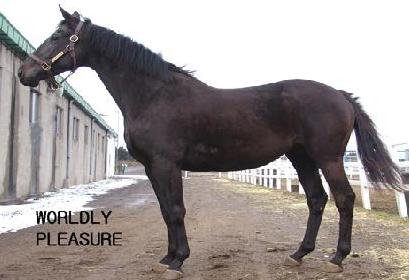
Worldly Pleasure - given the typically unflattering Korean StudBook treatment
This isn’t because they’ll have had a bet on the horse who is currently sixth favourite – for the most part they won’t have as there is no legal means of doing so here – but more to do with the fact that the four year old’s dam, Worldly Pleasure, currently resides at Nokwon Farm on Jeju Island.
As a racehorse, Worldly Pleasure [Devil His Due-Fast Pleasure (Fast Play)] was a decent filly on the American cicrcuit. From 2003 to 2005, she won 8 out of 38 starts mostly running at tracks such as Laurel, Delaware Park, Pimlico and Tampa Bay Downs. On retirement, she gave birth to a colt by Smart Strike in 2006 called Wild Spirit and then in 2007 to another colt this time by Awesome Again. This colt (who would be gelded) would be Game On Dude.
In late 2009, with Game On Dude still a two-year old, Worldly Pleasure was sent through the sales ring at the Keeneland November Breeding Stock Sale and was bought by Korean interests for $15,000 and a month later, on Christmas Eve, she arrived in Korea for her new life at Nokwon Farm.
The Korean racing media has jumped on the Game On Dude bandwagon
At the time, Worldly Pleasure was in foal to Macho Uno and she gave birth to a colt on February 8, 2010. He is scheduled to reach the racetrack in just under a year. Perhaps fittingly – and maybe presciently – her first mating in Korea was with Volponi, himself a Breeders’ Cup Classic winner in 2002, and a filly was born early this year. For 2011, Nokwon Farm sent Worldly Pleasure to their own stallion, the little known Japanese import Admire Don [Timber County-Vega (Tony Bin)].
Of course, there’s no guarantee that any of these foals will even make the racetrack let alone be a shadow of their illustrious half-brother but either way, a win for Game On Dude this weekend, however unlikely it may be, will be a real shot in the arm to a Korean breeding industry which has made great strides in recent years in the quality of imported stallions and is looking to do the same with broodmares.
With the Cup Classic over breakfast and then the domestic President’s Cup in the afternoon, Sunday is set to be a big day for Korean racing.
Tuesday November 1 sees one of the biggest races of the year and as usual, the Melbourne Cup is available for Korean viewers on the Australia Network. Coverage starts at 11am Korean Time and runs through until 1:30pm. The big race is at 1pm. The Australia Network is available on most Digital Cable and Satellite packages.
For those without Digital Cable, the Australia Network can be viewed from within Korea free of charge on the English language website of the Donga-Ilbo Newspaper. Click Here to go straight to the feed.
Should make for a better than usual Tuesday morning.
Classic Winner One Of Many Big Names Settled Into Life In Korea
Whatever happens on the track at Churchill Downs next week, there’s a high chance that one or more of the horses taking part in the 2011 Breeders’ Cup may one day end up plying their trade as a stallion in Korea. If they do, they’ll find themselves alongside the horse who holds the record for the biggest margin of victory in the biggest race of them all; 2002 Breeders’ Cup Classic Winner Volponi.
Volponi (KRA)
He was an unlikely champion. As a two-year old, Volponi [Cryptoclearance-Prom Knight (Sir Harry Lewis)] had won the Pilgrim Stakes at New York’s Belmont Park and at three claimed victory in Monmouth Park’s Pegasus Stakes. Back at Belmont in June 2002 he won the Poker Stakes.
With those three Stakes wins under his belt, the now four-year old Volponi was undoubtedly a good horse but there was little to suggest he would pose much of a threat to a Classic field that included the Kentucky Derby and Preakness Stakes winner War Emblem as well as the punters’ favourite Medaglia d’Oro. Accordingly, Volponi was sent off at 43/1 – the longest shot on the board.
What happened next on that day at Arlington Park is well-known. War Emblem had left his racing form in the early part of the season and while showing at the front early was never a threat. Meanwhile Volponi, under Jose Santos, hit the front as they turned for home and sprinted away in the stretch to record a six and a half-length victory from Medaglia d’Oro in second and Milwaukee Brew in third. It was a stunning performance, one that set a record winning margin that is yet to be beaten, exposed a betting scam and also set the wheels in motion for Volponi’s future life.
Volponi wins the 2002 Breeders’ Cup Classic at Arlington Park
The horse would appear eight times as a five-year old in 2003, regularly placing but he couldn’t add to his win total and he was retired to Stud at the end of the year. His initial performance as a stallion was not encouraging and in 2005, an offer from the Korea Racing Authority (KRA) was accepted and Volponi was on his way to the Korean Peninsula.
Volponi is perhaps not the kind of stallion the KRA would be buying today. However, in 2005 the market was very different to the one in recent years which has allowed Korea to purchase more established producers such as Menifee, Vicar, Ecton Park and Officer. In 2005, the leading sire in Korea was by far and away Concept Win (Manila), ahead of Ft. Stockton (Cure The Blues) and Fiercely (Danzig). These had been around for quite some time along with the likes of Revere (Dancing Brave), Lost Mountain (Cox’s Ridge), Psychobabble (Caerleon) and Didyme (Dixieland Band).
With the opening of the Busan Racecourse and subsequent substantial increase in the number of thoroughbred races run in the country, new blood – literally – was needed in the Stallion ranks and a Breeders’ Cup Classic winner was hard to turn down.
Volponi’s appearance video at stud on Jeju Island
Fast forward to 2011 and Volponi has now been in Korea for six years with three crops hitting the track. In 2009, he was leading first-crop sire ahead of fellow debutants Yankee Victor (now sadly deceased) and the Japanese Biwa Shinseiki. With his first three-year olds in 2010 he finished ninth in the Leading General Sire list. Currently he is in seventh place for 2011 (there’s little to choose between Vicar, Menifee and Exploit at the top).
While Medaglia d”Oro, the horse he beat in 2002, is most famous for siring the great Rachel Alexandra, so Volponi’s greatest successes have also come with fillies. Dongbang Rose was third in the 2010 Korean Oaks and went on to win the NACF Chairman’s Stakes later that year. Meanwhile, the otherwise undistinguished Crown Flag somehow managed to score a win in the Busan Ilbo Stakes earlier this year. The cheekily named filly Special Volpony has also reached class 1 racing level.
Dongbang Rose, Volponi’s first Korean Stakes winner, wins the NACF Chairman’s Stakes
This year, the new guard of stallions have been siring the Classic winners. While little known Japanese import Meisei Opera was responsible for KRA Cup Mile (Korean Guineas) winner Soseuldeamun, the other two legs of the Triple Crown were won by Gwangyajeil (Korean Derby) and Dongseo Jeongbeol (Minister’s Cup), both by Vicar. Meanwhile Oaks winner Useung Touch is by Menifee. Exploit has the most runners of all sires in Korea right now and accordingly generates a lot of earnings.
Soon to come on stream will be runners by Ecton Park who is standing privately for Isidore Farm on Jeju Island and the KRA’s Forest Camp. Still further in the future, there is Officer and Whywhywhy to look forward to.
However, although efforts are underway to strongly promote domestic sires, we are still some way from having a successful Korean born sire. Long-term, the authorities hope the progeny of one of these new imports will be the one to make the breakthrough.
Leading General Sires in Korea 2011 (as of October 25)
Earnings in 1000 Korean Won
1. Vicar (USA) [Wild Again-Escrow Agent (El Gran Senor)] – 2,728,049 2. Menifee (USA) [Harlan-Anne Campbell (Never Bend)] – 2,716,497 3. Exploit (USA) [Storm Cat-My Turbulent Miss (My Dad George)] – 2,611,637 4. Creek Cat (USA) [Storm Cat-Vivano (Island Whirl)] – 2,588,963 5. Concept Win (USA) [Manila-Conveniently (In Reality)] – 2,180,299 6. War Zone (USA) [Danzig-Proflare (Mr. Prospector)] – 1,989,455 7. Volponi (USA) [Cryptoclearance-Prom Knight (Sir Harry Lewis)] – 1,795,548 8. Didyme (USA) [Dixieland Band-Soundings (Mr. Prospector)] – 1,604,113 9. Ft. Stockton (USA) [Cure The Blues-Tai The Devil (Tai)] – 1,458,881 10. Biwa Shinseiki (JPN) [Forty Niner-Oceana (Northern Dancer)] – 1,124,394
Volponi continues to be well visited, covering 77 mares in 2011. Although he was based at the KRA Stud Farm on Jeju Island for most of his first five years in Korea, he was moved earlier this year to the KRA’s Jangsu Farm in North Jeolla Province after his ownership transferred to the Korean Mainland Horse Breeders’ Association. He leaves behind on Jeju a horse he had met before; Hawk Wing (Woodman) was among those trailing him home at Arlington and arrived in Korea in 2008. The racing world is a small one.
Baekgwang, Korea’s Favourite Horse, Retired After Leg-Break
This time, it was obvious the story was over. At the end of the KRA Cup Classic, jockey Lee Joon Chel pulled him up and immediately dismounted and walked him into the unsaddling enclosure. The horse was limping badly. Lee, having ridden him for the first time, gave him a pat and handed him over to his groom. The vet gestured that there was no need for him to be trotted up to explain his performance. Baekgwang’s career was over.
Baekgwang (KRA)
When lists of the greatest racehorses are compiled, Baekgwang [The Groom Is Red-Grey Crest (Gold Crest)] likely won’t be on them. Not even in Korea. But there is something about a closer – a horse who can run from the back of the field to the front in the closing stages of a race to score a last gasp victory – that makes the heart beat faster. And when that horse is small in stature, a striking grey colour and when he has overcome injury to be around for the best part of six years, it is something that shines a light on the drama of a sport whose beauty is so often masked behind a game of numbers. Ask a Korean racing fan to name their favourite horse and it is likely to be Baekgwang.
Of course, while not being the greatest, Baekgwang was still a very fine racehorse. After failing to win any of his three starts as a two-year old, he finished third in the 2006 Korean Derby but went on to win the final three-year old Classic of the year, The Minister’s Cup, after picking up back-to-back Stakes wins in the Munhwa and Donga-Ilbo Cups earlier in the summer.
He continued this form into his four-year old season, winning three consecutive races before the end of April. However, it was then that injury struck for the first time in the shape of a ligament injury and he ran only once more that year. In the meantime, his younger half-sister Baekpa (Revere) has become a star in her own right, winning the 2007 Korean Oaks. A grey herself, although less striking than Baekgwang, her big brother was brought out of his recovery to pose for pictures with her after her Oaks triumph. Eventually, after treatment and a lengthy spell of recuperation in the Korean countryside, Baekgwang himself returned to Seoul Racecourse and made his comeback in the Ttukseom Cup in April 2008.
He was sent off as second favourite and, putting in his customary late run, looked to have a chance in the final furlong. However, in the final strides he was just headed by the even faster finishing Namchonuijijon (Concept Win) who, were it not for being unfortunate to have been born in the same year as the great J.S. Hold, may have become a Classic winner himself. After the race though came devastating news.
Ligaments in his knee were damaged. The stewards at Seoul instantly handed him a one-year ban under rules designed to protect injured horses. This was never likely to be a problem with Baekgwang as his career seemed over. Nevertheless, owner Lee Soo Hong decided to try something that as yet hadn’t been tried in Korean racing before. Baekgwang underwent Stem-cell treatment to repair his damaged knee with cells from his back. It would be a long lay-off. During his time out, little sister Baekpa would go on to defeat the seemingly invincible Myeongmungamun in the SBS Cup of 2008. It would be in this race a year later in July 2009 that, remarkably, Baekgwang would return once again.
Baekgwang heads to post for the final time
He ran fourth but it was a display full of promise. A month later he finished second in a handicap. Then in September, he finally made it back where he belonged; in the winner’s circle having run down a class 1 field in the home stretch to record a narrow victory. Next up was the President’s Cup and, true to form, he pushed eventual winner Nice Choice all the way, despite giving him four kilos, to finish in a brave second. He closed out 2009 on a high, skipping his way through a blizzard two days after Christmas, once more mowing down the field in the home straight.
However, 2010 would see just one appearance, a second place in February before injury took hold again. Although he race-trialed sporadically it wasn’t until August this year that he finally made it to a race, finishing fifth behind Ace Galloper. Of course, it would be behind that horse, currently Seoul’s highest rated Korean born, that he would make his final appearance. For the first and only time in his 25 races, he would not take home any prize money yet, even with his leg broken, he was only just beaten out of the fifth and final moneying place by Dongbanui Gangja, the double Grand Prix winner. He never, ever gave up.
Baekgwang’s leg was broken but happily, it was not fatal. He will return to Jeju Island, this time permanently, as perhaps it should have been last time. He will be registered as a stallion and will live out his retirement in peace. His career outlasted that of almost all his rivals such as Nice Choice and Namchonuijijon and sister Baekpa who was retired last year – Baekpa is at the same farm as the pair’s mother, Grey Crest.
Some have lamented that Baekgwang – “Korea’s Seabiscuit” as he was described by the Korean Racing Journal last weekend – will not be given a retirement ceremony. It’s not necessary. Racing fans have enough memories of Baekgwang doing what he did best – be it in that Ttukseom Cup or dancing through the snow at Christmas or on all the other occasions he produced that thrilling stretch run. Baekgwang means “White Light” and he was a horse who with a turn of his head in the paddock was acknowledged by even the most hard-bitten punter as something special. We were lucky to have him.
Baekgwang (KOR) [The Groom Is Red-Grey Crest (Gold Crest)] Foaled: March 19, 2003 Debut: September 24, 2005 Retired: October 9, 2011 25 races, 11 wins, 8 seconds, 2 thirds Career Earnings: 817,614,000 Korean Won
Gyongmaman roused himself out of the capital to put in a rare in-person appearance at Busan last Friday. Accordingly, the information section of this blog for Busan has been given a much-needed update.
Dynamic Busan
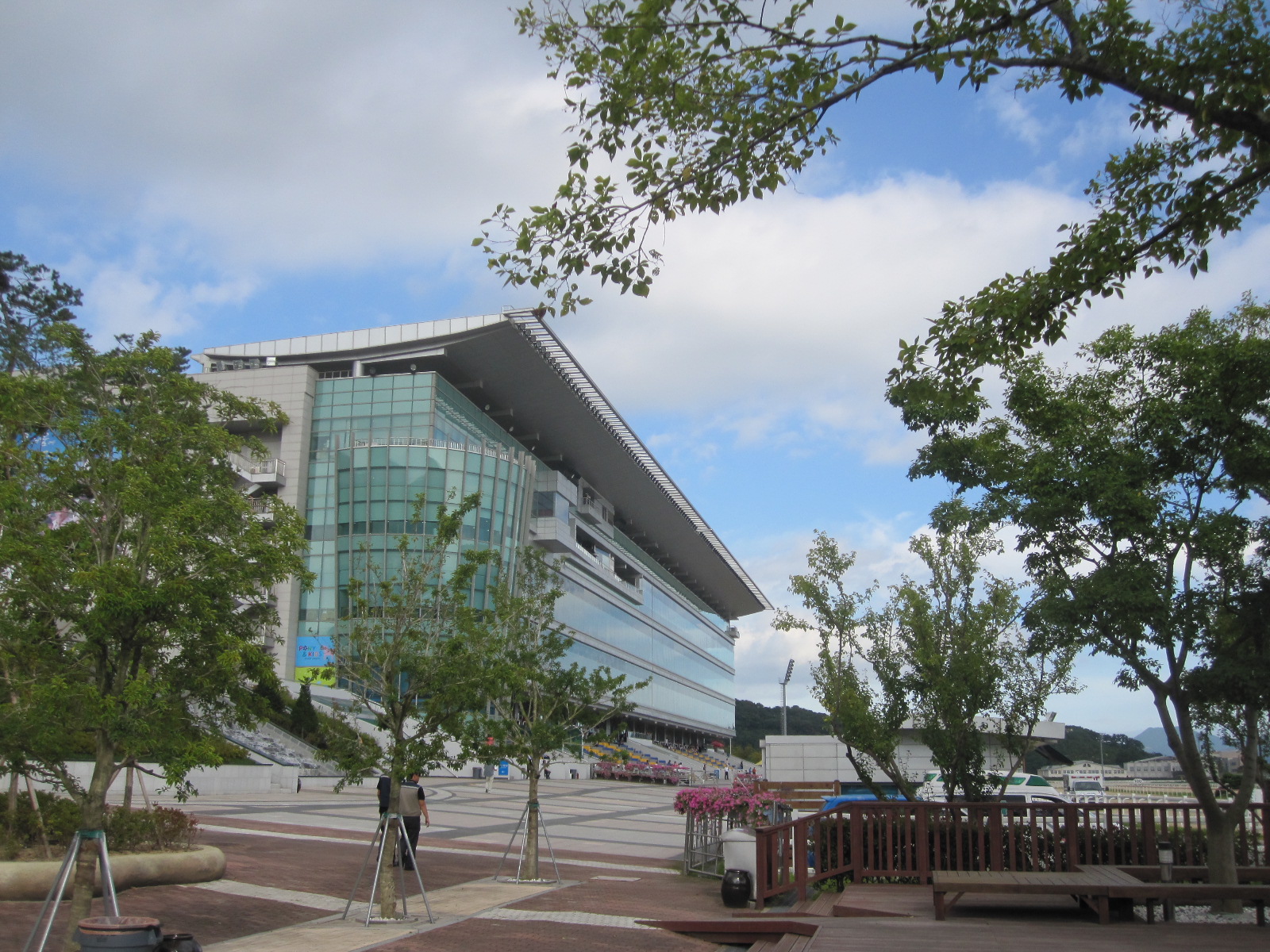
Of particular relevance is the transportation section as, in their infinite wisdom, the track – lovely as it is – could not really have been built in a more inconvenient place to get to in Busan. Regardless, as Korea’s most internationally minded racecourse, it is well worth a visit.
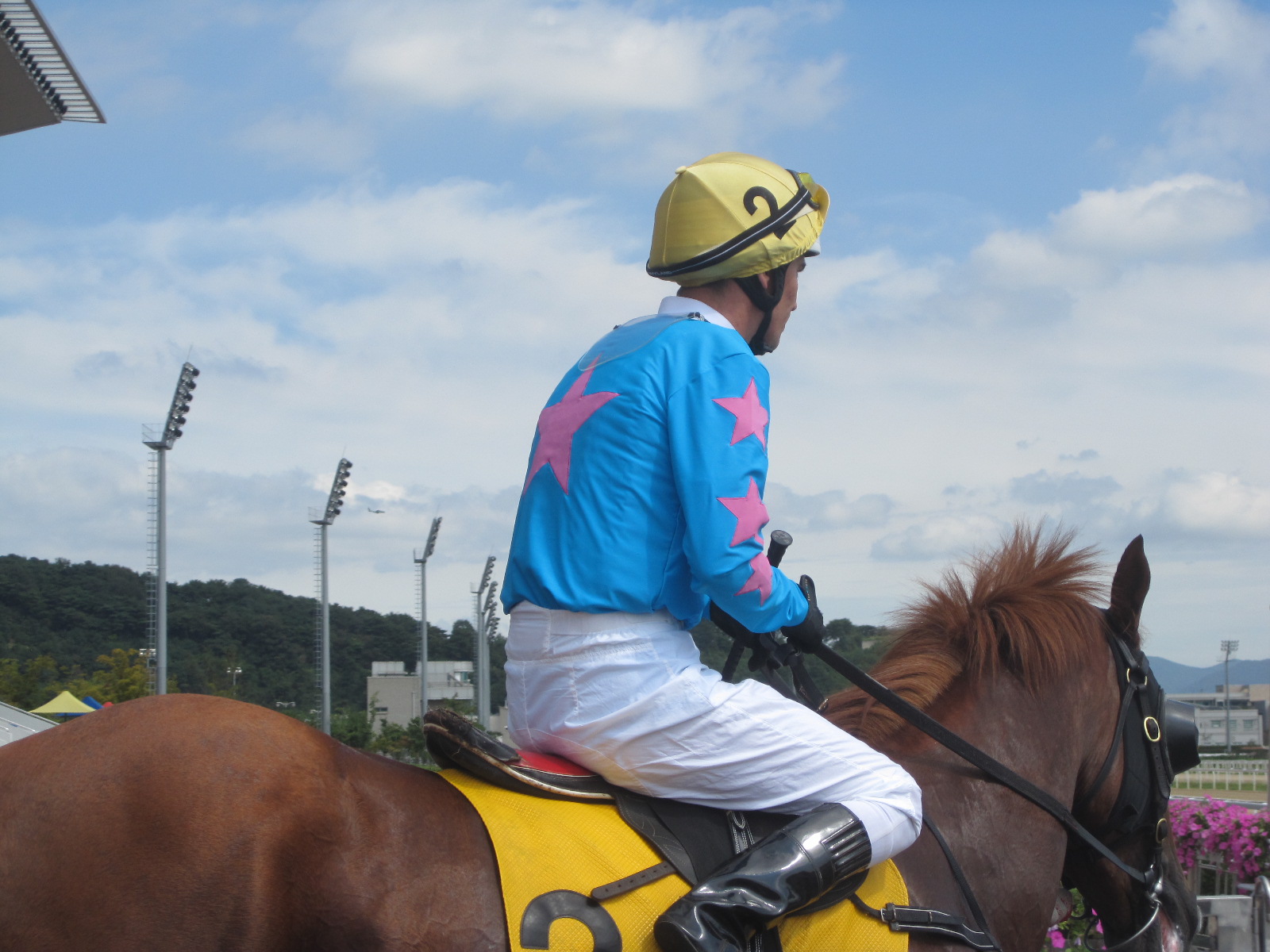
Australia's Nathan Stanley heads out onto the Busan track
Just a reminder there’s no racing anywhere on the peninsula this weekend due to the long “Chuseok” – Korean Thanksgiving – holiday.
Things are back to normal next week with racing getting underway again on Friday September 16 at Busan. The Ilgan Sports Cup at Seoul on Sunday September 18 will be the weekend’s feature race.
“Champ” Set For Thanksgiving Release / Luna Seen As Ideal Racing Story As KRA Seeks To Broaden Racehorse Ownership
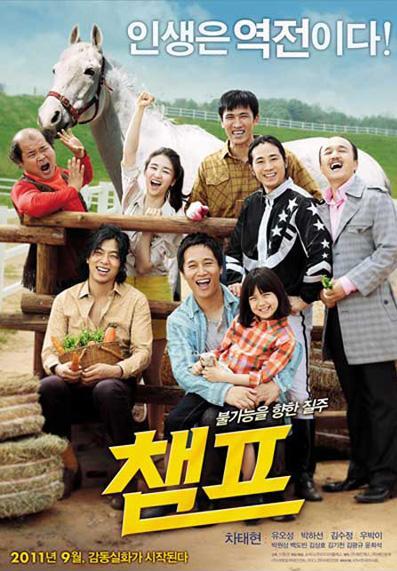
For the second year running a Korean movie based around horse-racing is set to be released in time for Chuseok (Korean Thanksgiving). “Champ” will hit cinemas on September 8.
Publicity poster for the movie "Champ"
It’s the third Korean racing movie of the past few years following 2006’s excellent “Gakseoltang” (Lump Sugar) and 2010’s visually impressive, but largely disappointing, “Grand Prix”. That it’s timed to cash-in on the Chuseok market tends to suggest it may fall into the latter category, however Gakseoltang’s director Lee Hwan Gyeong being in control gives some hope.
According to Hancinema.net, the plot involves a jockey losing his wife in a car accident that partially blinds him. He goes on to lose all his money “cheating” on horses before fleeing to Jeju Island (as everyone always does in Korean racing movies). There he meets a broken down horse who he starts to train. The rest, no doubt, writes itself.
The movie will star actor Cha Tae Hyeon as the jockey and child-star Kim Soo Jeong as his daughter. Here’s the first preview trailer:
Champ is said to be inspired by real-life Korean racehorse Luna (although the real-life story is a little different), who is being used by the KRA to promote racehorse ownership in Korea. As a two-year old going through the sales ring, such were rumours about her unsoundness that Luna [Concept Win – Wu Su Hae (Exactly Sharp)] was very nearly not sold at all. In the end she went for the lowest price in the entire sale (US$9,000).
The rumours weren’t without foundation, but with careful conditioning and sensible campaigning, she went on to become one of Busan’s best known horses. The mare, known affectionately/unkindly (delete as applicable) as “Limping Luna” won the KRA Cup Mile (before it became part of the three-year old Triple Crown) in 2007 and the Busan Owners’ Cup in 2008 as she racked up thirteen wins from thirty-three starts in five years of racing and nearly $800,000 in prize money. On her retirement in 2009, she became one of very few Korean racehorses to be honoured with a ceremony marking the occasion as she was brought back to the track to limp canter down the home straight one final time.
Luna and her owner at the mare's retirement ceremony at Busan Racecourse in 2009 Pic: KRA
Currently there are 1000 registered owners in Korea, 50 of whom are new to the sport this year. The KRA is looking to promote direct ownership by individuals, company ownership and also, for the first time in Korea, syndicate ownership. Aware of the negative image that horse racing has in Korea due to the gambling element, it is seeking to publicise the fact that many prominent figures around the world – Queen Elizabeth II, Steven Spielberg, Sir Alex Ferguson, Michael Owen, and the late George Steinbrenner (among others – these are those quoted in the various press releases) are or were racehorse owners.
Whether it will be successful or not will be seen in due course but it is undoubtedly true that the social stigma attached to horse racing is one that needs to be overcome. “Owning racehorses” is a CV entry that a Korean executive is likely to not want lest it harm his promotion opportunities. As a result, the vast majority of racehorse owners in Korea are either retired or are small business owners. How they solve the second issue – that ownership is expensive and, even though prize money at all levels of racing in Korea is excellent, still likely to be a loss-maker, is another.
Korea’s Most Successful Female Jockey To Begin Training In July
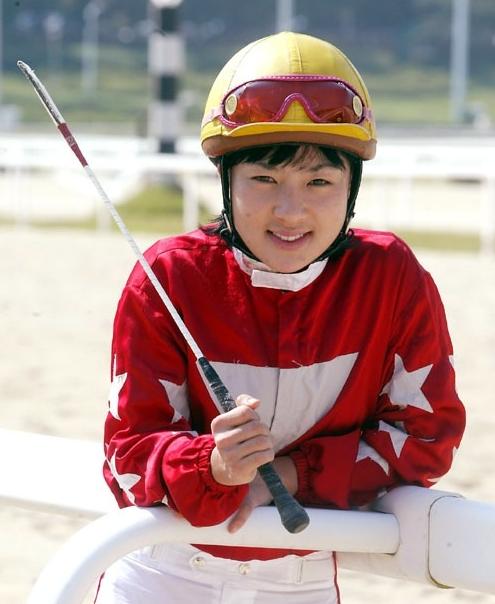
After eighty-nine years of organised horse-racing on the peninsula, Korea is finally getting its first ever female Trainer after it was confirmed that Lee Shin Young will make the transition from riding to saddling on July 1.
Lee Shin Young (Picture: KRA)
As we reported last April Lee successfully passed the Trainer’s License exam to become eligible to take charge of her own barn once a vacancy became available. That vacancy has now arisen and thirty-one year old Lee will give up her Jockey license at the end of June to begin training full-time.
Lee was only the third woman to gain a Jockey license in Korea and in her ten-year career on the track has ridden 90 winners from 893 rides. Known for an aggressive racing style that proved popular with punters but frequently landed her in trouble with stewards, she holds the record for thoroughbred race wins by a female jockey in Korea (Na YuNa having ridden well over 150 winners in pony racing on Jeju Island). That record may soon be under threat from Kim Hae Sun who has notched 23 winners during her apprenticeship at Seoul so far.
Whether Lee will get much support from owners remains to be seen. As Peter Wolsley will testify at Busan, outsiders tend to start off their training careers with the horses nobody else wants. While she has been in Korean racing circles for a very long time, Lee Shin Young will know better than anyone else that there will be those who see her as an outsider. It’s going to be a tough road to success but there will be few who doubt her ability to successfully navigate it.
* Back in 2009, we wrote about the history of women in Korean racing. This was followed in 2010 by the death of jockey Park Jin Hee
While jockey Jo In Kwen reached 100 winners in the saddle yesterday, at Busan last Friday it was one of those doing the saddling who reached the same milestone.
Peter Wolsley (Pic: Herald Media)
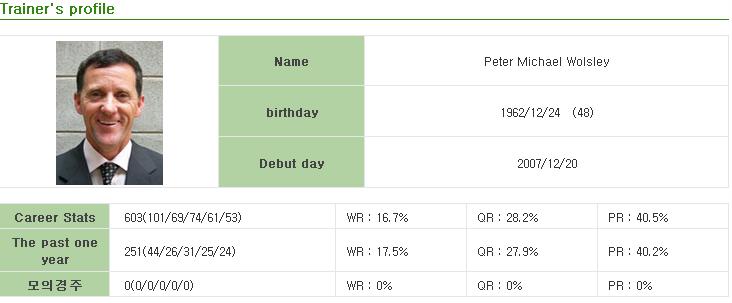
Peter Wolsley became Korea’s first ever foreign trainer when he was granted a license at the end of 2007. On Friday afternoon, Wolsley’s three-year old colt King Austin grabbed a two-length win in race 7 to give the Australian his 100th Korean victory. He didn’t have to wait very long for his 101st either as his Saeroun Taeyang scored in the feature event of the afternoon two races later.
Fittingly, King Austin (Yehudi) is owned by Isidore Farm, the Jeju Island institution that has been, along with fellow foreign influenced Jeju outfit Pegasus, Wolsley’s biggest supporter. The 48-year-old has 33 horses under his care, including seven who compete at class 1, the elite level of Korean racing. It hasn’t always been this way.
On arrival in Korea from his previous posting in Dubai, Wolsley was assigned the “breakdown barn” at Busan Race Park. In common with the majority of foreign jockeys who come to ride here, he got the horses no-one else wanted. It didn’t make for a very rewarding start to his time here but the trainer stuck at it and gradually started grinding out some modest successes. Others began to take note and eventually he started to receive some better horses.
The Numbers Don't Lie: Wolsley is arguably the track's top trainer right now
Perhaps the turning point came in late 2008. Wolsley had been pushing for pacifiers (mesh eye-protectors used to prevent sand getting in the eyes of the horse) to be allowed to be fitted during races – a cause also taken up by his countryman, steward, Brett Wright – and in October of that year, they were finally approved by the KRA. The next month, his mare Gyeongcheonsa became the first racehorse in Korea to run with them and she flew home at odds of 19/1. One race later, his colt Khaosan, also decked out in pacifiers and starting at similarly attractive odds, came from last to second in the home straight.
How would the local trainers respond? To their credit, instead of trying to get them banned again, the majority realised that Wolsley knew what he was talking about and started using them with horses who hated the vicious kickback that is inevitable on the sand track. Now pacifiers, which are compulsory in some jurisdictions which race on sand, are commonplace – both Mister Park, Korea’s current best horse, and Tough Win, the second best, always wear them in their races. More and better horses started to arrive in Wolsley’s barn and winners swiftly followed.
Wolsley's Protege Park Geum Man in the Derby Winner's Circle
Wolsley has also acted as mentor, specifically to jockey Park Geum Man who was his stable jockey for two years. In that time, Park developed into one of Busan’s – and Korea’s – most tactically aware and skilful jockeys. Wolsley told the Korea Herald last year that Park’s victory on Cheonnyeon Daero in the Korean Derby in 2010 – albeit for a different trainer – is his proudest moment in Korea so far.
Wolsley and Park have now gone their separate ways and Kim Nam Sung is the latest jockey to benefit from Wolsley’s guidance.
With 100 wins in the bank there remains one more challenge for Peter Wolsley. He still needs to become the first foreign trainer to saddle a Stakes winner. He has no horse on the Triple Crown trail this year but, now he’s established as one of the track’s top trainers, it can only be a matter of time.
Peter Wolsley is an example of the KRA’s internationalization plan working. Many trainers around the world will have won more races and far more money. But few can genuinely claim to have come to a place and actually made racing better. That is what he has done.
Plum Pretty is America’s Champion Three-Year old filly, but her older half-sister helps beginners learn how to ride at an Equestrian Club in Korea.
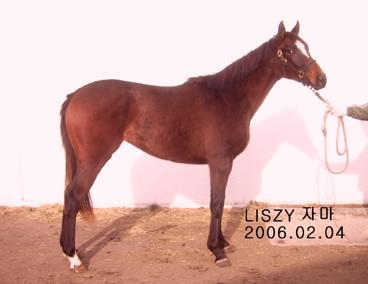
Korean racing fans were a little bemused to watch Plum Pretty bravely hang on in the final furlong at Churchill Downs on Friday to win the Kentucky Oaks. For Plum Pretty (Medaglia D’Oro) is the fourth foal out of a dam called Liszy. And in 2006, Liszy (A.P. Indy) gave birth to a filly by More Than Ready (Southern Halo).
In December the following year, that filly would go through the Fasig-Tipton Midatlantic December Mixed sale and, at a knock-down price, be purchased by a Korean buyer. A month later, in January 2008, she arrived for her new life in Korea.
The filly was bought by Kumak Farm and was named Taeyangui Mabeopsa – or “Magic of the Sun.” She was sent to Seoul Race Park and the barn of trainer Kim Myung Guk. Although not especially impressive in trials, by September of that year she was considered ready to race and made her debut in race 2 on the 28th of that month.
Ridden by Choi Bum Hyun, she was sent off at 35/1 and ran to expectations finishing seventh of twelve over five furlongs. That would set the standard for her next couple of outings and on her fourth start she finished so far behind the winner, she was banned from racing from two months for being uncompetitive.
Taeyangui Mabeopsa given the KRA Studbook treatment (Pic: KRA)
On her return in March 2009, things improved. Now in the ownership of Kim Gwang Young and under American jockey Santos Chavez in another five furlong race, she finished fourth, gaining her first money finish. Two races later and stepping up to six furlongs, she would finish third. This was a position she would go on to achieve three more times for a third owner, Koo Bon Soon, over the next couple of years, but Taeyangui Mabeopsa never won a race and never made it out of class 4 racing – the lowest for imported horses.
She ran at Seoul for the final time in January of this year, finishing tenth of twelve in her thirty-second outing. Owner Koo decided that she was unlikely to add to the 21 Million Korean won (about US$20K) she had won and retired her from racing. She was transferred to the Namyang Riding Club, an equestrian club in Gyeonggi Province, 75 miles south-west of Seoul, an organisation that retrains former racehorses as riding horses.
Once re-trained, the horses are used for various leisure activities while the club is also well-known for appearing in many Korean movies and TV Dramas.
Taeyangui Mabeopsa is in good company. Among many recently retired from the track, Namyang recently took possession of Seonbongbulpae, Korea’s champion juvenile of 2009 who also ran his last race earlier this year. As a Korean born colt, Seonbongbulpae had no stud value. Likewise, Taeyangui Mabeopsa hadn’t been deemed worthy of broodmare duties.
After what happened in Louisville last Friday evening, she may well find herself called back to the farm.

 Horse Racing in Korea