Gambling

“Annuity Lottery” Set For Korea

Racing might be being less than gently encouraged to reduce its revenues – because gambling is bad – but the government is desperately trying to breathe new life into one of its myriad gambling rip-offs “lotteries”. Because gambling blindly on numbers is obviously good for society.

Happy Punting! Good gambling, not that nasty racetrack stuff

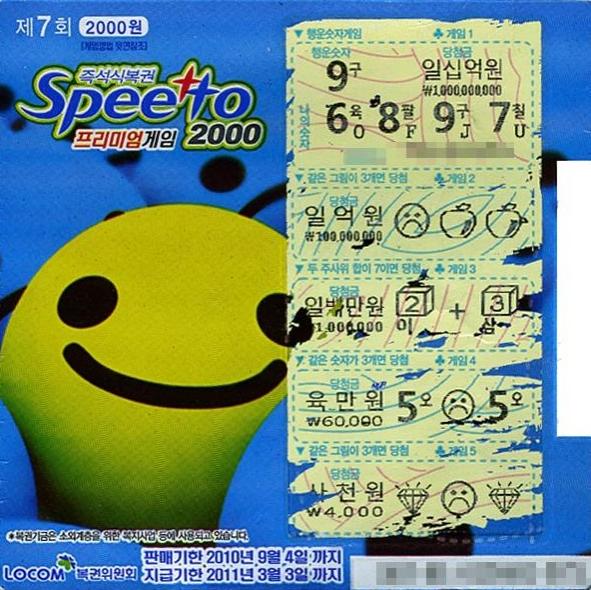
According to the Korea Times, lottery revenues have fallen from 3.8 Trillion won in 2003 to 2.4 Trillion won last year as punter move to more sophisticated online – and illegal – gambling platforms. To try to counter this, one government-run lottery, the scratchcard based “Speetto 2000” is offering players a salary instead of a lump-sum. While a familiar concept around the world, where most lotteries offer winners the chance to receive their prizes in installments, this is a first for Korea.

Marketed as a “Pension” in a society where the idea of a private pension is just taking off, starting next April, Speetto 2000 is offering a first prize of 5 Million won (about $4,6000) won payable every month for twenty years. Previously known for a 2006 incident where they mistakenly printed too many jackpot tickets, Speetto is also abandoning smaller cash prizes for runners-up. Instead, those who score a near-miss will receive an electric car. Which they can use to drive to the track.

Mockery aside, Gyongmaman will be purchasing his ticket come next April. 5 Million won is a pretty healthy pot to start handicapping the weekend’s form with.

Corrupt Five Banned From Racing

Three Korean jockeys and two trainers have been banned from the sport for illegally passing on information to betting rings.

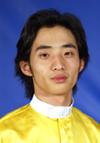
No More Smiles: Kim Ok Sung has lost his license

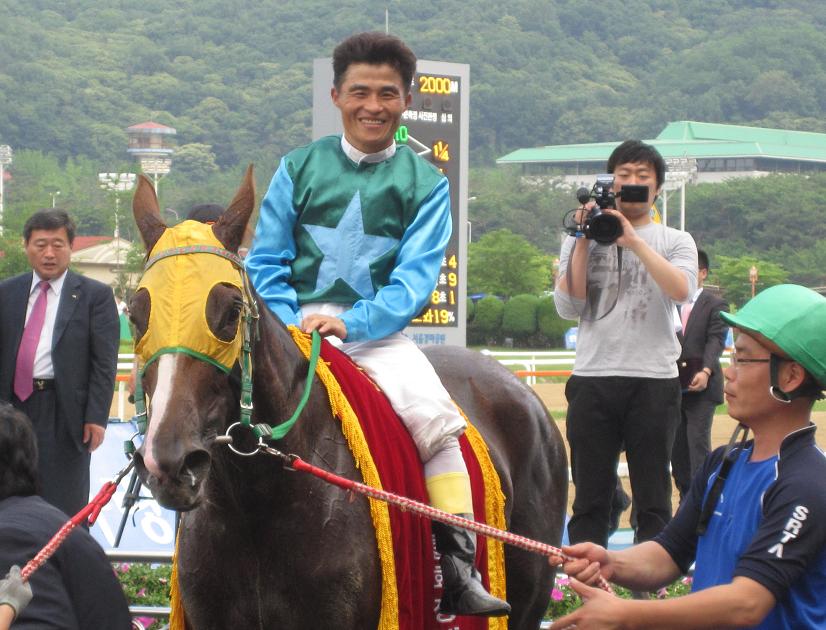
All of the five, who were based at Seoul Race Park, had their licenses revoked last week after the conclusion of an investigation by the KRA’s Finance Committee. Among them, the most well-known is veteran jockey Kim Ok Sung. Nicknamed the “Smile Jockey” because of his ever-present Cheshire-cat grin, Kim scored 443 winners from 5826 rides during his career which spanned 23 years from 1987. His biggest win was in the 1996 Grand Prix Stakes on Hula Mingo (Broadway Aly). He also won the JRA Trophy and the Donga-Ilbo and Segye Ilbo Cups. Only this year, he recorded a Group victory on Serendipper in the Owner’s Cup.

Also involved was Lee Sung Hwan, who turned professional in 2001. He won 74 races from 1434 mounts. Meanwhile, Lee Jung Sun, who originally had his license revoked in April had the decision confirmed.

Kim Hye Sung recently took up a trainer’s license after retiring as a jockey. In the saddle, he qualified on the same day as Kim Ok Sung and scored 477 winners from 4708 rides. He won the Korean Oaks on Espass (Psychobabble) in 2001 and partnered the great Kwaedo Nanma (Didyme) to five Stakes victories between 2001 and 2003.

Five Losing Tickets - Five Kicked Out of Racing

The other trainer was veteran handler Kang Seung Yeoul. Kang saddled 5500 runners returning 512 winners. His biggest win was with Tourney’s Mountain (Lost Mountain) in the 2005 Ilgan Sports.

Corruption in racing is taken extremely seriously in Korea where, with a ferocious regulator and negative public sentiment towards gambling, it is vital that the industry is seen to be clean and fair. Equal access to information for all punters is important. While many form-guides are available for purchase by racegoers, they contain no information that isn’t freely available to everyone on the KRA’s Studbook site including detailed past-performances and workout records.

Jockeys, trainers, grooms and KRA staff are subject to very strict rules and even minor infractions are punished severely – especially if it relates to contact with illegal gaming houses. These criminally run organisations offer higher stakes and lower take-outs than legal betting with the KRA and are thought to be on the rise, especially in rural areas, since – to protect the public from gambling – the National Gaming Control Commission managed to close down the KRA’s internet and telephone betting services last year.

Radioactive Casino Chips

Men Reportedly Planned To Use Geiger Counter to Beat Game!

Not racing related but another insight into the shady world of illegal gambling in Korea which is evidently flourishing. The Joongang Ilbo reports that police in Siheung, Gyeonggi Province (about 30km south of Seoul) have arrested two Vietnamese men after a raid on a farm thought to be used by an illegal gambling ring.

Nothing unusual about that, but the paper goes on to report that the men were found in posession of twelve small pieces of radioactive material. These pieces were to be slipped inside small gambling chips made of paper and used in a “Vietnamese Guessing Game” – the two sides are painted different colours and the men allegedly planned to use a geiger counter to correctly determine which side would be facing up.

The news comes a day after the same paper reported on another Vietnamese gambling ring, this time in North Gyeongsang province. This one was reportedly taking illegal bets on the Vietnamese National Lottery.

* While the only radioactive things at the racecourse this weekend were Gyongmaman’s predictions, on the racing regulatory front, trials of the Electronic Card that the National Gaming Control Commission (NGCC) hopes to make compulsory for all legal gamblers, are underway. An interesting possibility was raised this weekend though in that in order to sweeten the deal for punters, the card would also act as a “mileage card” with bettors potentially getting a 1% rebate on all wagers. As of now, however, it’s pure speculation.

Electronic ID Card Trials Set To Begin

Punters’ Betting To Be Tracked

According to the National Gaming Control Commission (NGCC), 6.1% of Koreans are addicted to gambling. Also, the addiction rate among those who actually attend gambling establishments (i.e. the track and Gangwon Land Casino) is supposedly 61% (Gyongmaman is going to ask for a show of hands on the fourth floor next Saturday). Indeed, according to their criteria, your correspondent is among those in urgent need of help. It is on its way; in October, trials will begin of an Electronic ID card which the NGCC hope to make compulsory for all punters. The card will track every bet made by an individual.

Punters

All legal punters, that is. The move comes in a month where gambling has again been in the news with two high profile cases – one tragic, one mildly pathetic. In the first case, a man in Gangwon Province has been charged with murdering his wife and teenage son following a quarrel over his gambling debts. In the second, entertainer (and that word is used loosely) Shin Jung Hwan is on the run after allegedly running up big gambling debts in Cebu.

Falling foul of not just the loan-sharks, but also the law that makes it illegal for a Korean citizen to gamble even while overseas, Shin can’t return to Korea for fear of being arrested. Shin claimed that in fact, he hadn’t been gambling but had instead contracted dengue fever and a picture purportedly showing him in hospital in the Phillippines was promptly uploaded to his website. However, KBS TV – until recently one of his employers – went to the hospital in question and found that he had been given a clean bill of health. Shin is now reportedly recovering from whatever ails him in Macau. He probably won’t catch Dengue fever there.

Of course, while it is insensitive in the extreme to compare the two cases, both have brought the spotlight back on the issue of gambling. Likewise, in neither of the two cases was the alleged gambling debt run up by legal means. However, it is the legal outlet of racing that is going to bear the brunt of regulation.

Initially the ID card trial is going to involve two sets of subjects. The first group are going to be anonymous – their personal details will not be known, the card will simply track their betting. The second set – and you can be sure that this is the one which will get the final go-ahead – will include punters’ personal information.

Will it have any effect? Perhaps, but while having to produce an ID card imay decrease the practice of “window-hopping” whereby to get round the maximum bet of 100,000 won, a bettor goes to several windows or machines before a race, placing the maximum bet each time, those kinds of punter are generally well aware of the various non-legal options open to them.

Gyongmaman was looking forward to getting his card, however, he remembered it probably won’t apply to him. For the Korean government has a very different approach to non-Koreans gambling as demonstrated by this wonderful quote about the use of credit cards in casinos, which is always worth another airing:

“Currently foreign tourists are able to buy chips only with cash…Government officials said this has discouraged non-Koreans from gambling here adding if visitors were allowed to purchase chips with plastic, they would spend more money”.
(Korea Times, September 2009)

New Racecourse Could Change Face Of Korean Racing

2014 Opening at Yeongcheon to Have Big Impact on Seoul

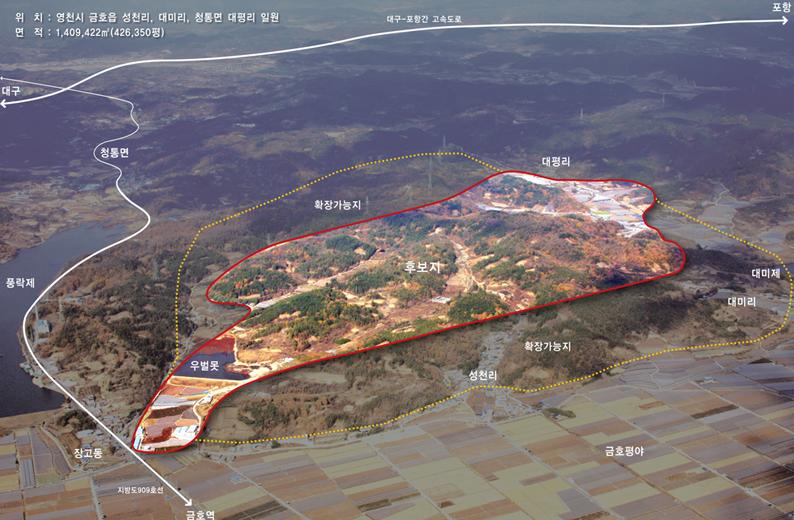
The Korea Racing Authority (KRA) recently confirmed that the nation’s third thoroughbred race track is to be built outside the city of Yeongcheon, North Gyeongsang Province. Given ever-stronger anti-gambling sentiment in government, the opening of Yeongcheon could have major implications for the future of horse racing in Korea.

The site that will be a racecourse by 2014

It may sound counter-intuitive but it is precisely becase of ever increased government regulation that the track is being built. The puritans on the National Gaming Control Commission (NGCC), who last year ordered the KRA to close down its internet betting operations, has also ordered the KRA to decrease the amount of off-track betting activity. It has “recommended” that the ratio of off-course to on-course betting turnover be no greater than 50-50 by 2013. Currently approximately 70% of all wagering is done off-track at the “KRA Plaza” betting outlets located around the country. Privately many in the KRA believe that the NGCC will not stop until all (legal) off-track betting is ended.

A new racecourse therefore has become necessary. Ostensibly, Yeongcheon was chosen due to its location close to Daegu, Korea’s third-largest city, although many believed that a second track in the Seoul/Gyeonggi area, where 50% of the country’s population lives would have been a better option.

The opening of Yeongcheon Racecourse Park – as it will officially be called – could also see some fundamental changes made to the structure of Korean racing. Not only is the KRA required to minimise off-track operations, it is also required to minimise those on-track. The NGCC has long been pushing for a revenue cap on the KRA, that is, it would only be allowed to accept a certain value of bets within a one-year period. While the NGCC might be insane, the government, who have to rubber-stamp any proposal, enjoys the substantial tax revenues it receives from racing. Instead a compromise of a firm cap on the number of races that can be run looks inevitable. This means that Yeongcheon’s opening will dramatically reduce the number of races run at Seoul.

Currently, plans are for each of the three thoroughbred tracks – Seoul, Busan and Yeongcheon – to run 87 days of racing in a year. This is similar to what Seoul does now but instead of the current 11 or 12 races in a day, they will be limited to 8. This means that all three tracks will run 696 races per year for a total on the peninsula of 2392. Each track is also set to get a three or four month shutdown at some point during the year. Accordingly, a large number of trainers will need to be redistributed away from Seoul.
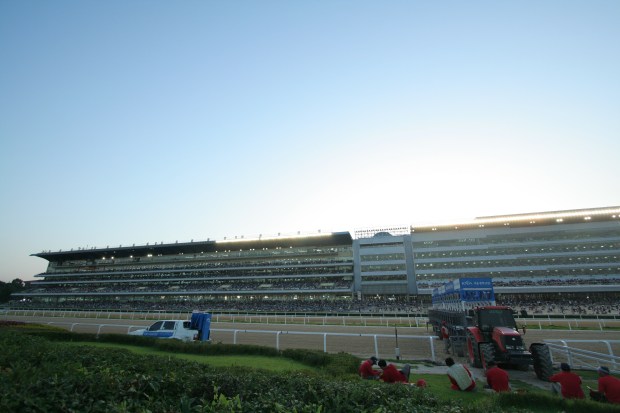
Seoul Race Park may lose its dominance

Plans for Yeongcheon include an official opening in 2014 with an international race to be run within the same year. This would perhaps be the same “international race” that the KRA has been planning to hold every year since 2004 as part of its “internationalization” plan. Overall, while it is bad news for Seoul based punters, perhaps anything that reduces that capital track’s stranglehold over Korean racing is a potential blessing. The vested interests and pre-historic Unions that essentially hold the power at Seoul have long meant that any positive developments in improving the quality of racing in Korea have been frustrated.

Despite their best efforts, particularly earlier this year, Union power at Busan has so far been limited since that track opened in 2005. With a third track to worry about and a smaller power base at Seoul to work from, it could be time for the KRA to wrest back control of Korean racing. If it really wants to.

* Meanwhile, the NGCC’s plans to equate legal gamblers with criminals continue. From next month, trials of Electronic ID cards, which the NGCC plans to make mandatory for any Korean citizen wishing to indulge in a legal wager, will begin. More on this soon.
Gambling News Round-Up

Betting has been in the news in one form or another over the past couple of weeks in Korea. First off, the Starcraft “Match-Fixing” case saw some breakthroughs with arrests and charges and now supposedly confessions. Ultimately it seems a tale of young men being manipulated for surprisingly little money.

Next up is the JoongAng Daily with a glorified advert, masquerading as news, for Sports Toto’s World Cup games. Sports Toto is one of Korea’s licensed lotteries and runs pools on Korean domestic sports leagues as well as European football. It’s run by the Seoul Olympic Sports Promotion Foundation which also operates Track Cycling and Motorboat racing. These, along with horse racing and one casino,are the only legal betting opportunities for Koreans.

Speaking of that one casino, most news outlets covered the story of a Mr Ahn Seung Pil, who won the “Super Mega Jackpot” at Kangwon Land and promptly decided to donate all his winnings – which at 766 Million won were the biggest in the Korean casino history – to the Korea Advanced Institute of Technology and Science (KAIST). KAIST is one of the nation’s richest academic institutions.

Mr Ahn said he was inspired to make his donation after he remembered seeing a KAIST Professor on TV complaining that without adequate funding, Korea’s scientists will end up lagging behind their Chinese counterparts. Whether that happens or not, that Professor surely has a second career in Sales ahead of him.

* Note to any potential jackpot winners: Korean racing currently lags far behind that of Japan. This is not good. Investment is very important if it is to have any chance of catching up. Look at the quality of pictures on Keiblog…Gyongmaman will need a new camera is he is to compete…

Another Jockey…and Pro-Gamers On The Take

As another Korean jockey has his license revoked for allegedly passing on inside information, professional video game players are now under suspicion of being involved with illegal gambling rings.

The Korea Racing Authority (KRA) recently announced that jockey Lee Jung Sun has been suspended pending police investigation into supposed “inside information” being passed to illegal betting syndicates.

Lee’s suspension follows that issued to jockey Park Soo Hong last year, while Seoul jockey Lee Jung Seob (“L Mo”) is currently under investigation as was a Busan jockey last year.

Lee Jung Sun

The information, such that it is, is allegedly passed to organizations who operate in the illegal betting market – not the maximum $100 stakes with the KRA – and it is in these markets where the latest Korean gambling scandal seems to have taken place.

This time it is in the almost uniquely Korean world of professional video gaming. In Korea, video games – or to be be more precise “Massively Multi-Player Online Role Playing Games” are big business. A quick scan of Gyongmaman’s cable tv shows three stations currently showing videogames – of these Starcraft is traditionally the most popular. Now, according to what has been described as “a series of track-backs and hat-tips” several of the top professionally Starcraft players have been involved in a n illegal betting scam.

The story goes that the players either threw games or provided “replay files” to the betting syndicates. The “scandal” reportedly involves most of the great and good of professional gaming including Ma Jae Yoon, the renowned “sAviOr“. See GamePron or Kotaku for more information.

This news comes in the same week that the Korean government is set to crack down on online games in general which, apparently are keeping the youth of Korea up at night. The government wants to prevent youngsters from playing after a certain time and is prepared to legislate to enforce it.

It’s well known that the majority of gambling in Korea is done illegally with a blind and impotent eye turned by the authorities. Meanwhile it is the easy target of legal betting on racing that attracts the vast majority of government attention. It would be no surprise therefore if, after a “scandal” in the video game world, it was innocent gamers who were to be punished.

“Elmo” Case a Gift to Racing’s Enemies

It’s been two weeks since it was revealed that a Seoul based jockey was under investigation for allegedly passing insider information to illegal betting operations. The case involving the jockey – who, although his identity was initially made public, can now only be identified by his initial “L” or “L-Mo” in Korean, could not have come at a worse time as the KRA battles to portray racing in a positive light in the face of an increasingly puritanical regulator.

Support – or at least indifference – from the majority of lawmakers is essential in resisting the recommendations of the National Gaming Control Commission, an organization that makes little secret of its aim to eliminate any form of gambling and has already succeeded in having the KRA close down its “KNetz” Internet betting service which ceased operations in July.

While the NGCC may not be able to grasp the concept, most lawmakers currently accept that the more restrictions there are placed upon legalized gambling, the more the many illegal ones thrive. To keep this support, however, the KRA has to be able to demonstrate that racing is clean. Bent jockeys will always pop up from time to time, but, however this case proceeds, its timing is terrible and has prompted speculation over the likely success of the next recommendations from the NGCC as outlined over the weekend by Korea Racing Journal editor Kim Mun Young.

The Electronic ID Card scheme raised its head again. Under this scheme, when trying to place a bet, a punter would be asked to produce an ID card that they have previously had to apply for and been issued. The card will have a chip that records all his gambling activity. While punters mutter darkly about essentially being put in the same category as sex-offenders by having to be on a register, it would also eliminate racing as an activity for all but those “on the register”.

On a summer’s day, the Seoul Race Park infield and track apron is packed with picnicking families and dating couples. If, in future they’re going to need to be on the government’s list of registered gamblers if they fancy a stroll to the windows to put 500 won each-way on the favourite, it’s likely they’ll spend their weekends elsewhere.

Of course, there was a very easy way of tracking punters’ expenditure. It was called KNetz and it was closed down this July. The ID card scheme, however, is a real possibility – not least because of the lucrative contracts that would need to be dished out for running it

Less likely is a reduction in the maximum bet amount although this is another NGCC proposal. Instead of the current 100,000 won per bet limit, a daily limit of the same amount be imposed. This would of course essentially close racing down and most observers agree that outside of the NGCC, there is little appetite for that due to the huge revenues it generates in both taxes and in support of agriculture.

Meanwhile, one grocery store chain is currently giving away national lottery tickets with all purchases over 10,000 won and the “Sports Toto” – where players predict the results of European football matches – can be gambled on from almost every convenience store on the peninsula. Racing feels picked upon but “Elmo” hasn’t helped its cause.

Pari-Mutuel Machines Learning English

Arriving early at Seoul Race Park on Saturday morning, Gyongmaman was surprised to be accosted by KRA officials outside the Foreigner Lounge on the fourth floor of the Luckyville grandstand. Nursing a hangover and fearing that last Monday’s article about the Karaoke expense claims had hit a little too close to the mark, Gyongmaman broke into a sweat and started looking for the exit.

It transpired that they wanted him to try out a new English language betting terminal. The fourth floor of both grandstands at Seoul (and most of Busan) is entirely automated with machines instead of tellers at all the betting windows. Gyongmaman doesn’t like this – if he’s watching from the fourth floor, he always goes down to the third to bet with one of the armada of women (they are all women) staffing the regular betting windows whom the KRA is hoping to replace with the soulless – and non wage demanding – machines.

Naturally, in the face of officaldom, Gyongmaman was suitably gushing about the brilliance of the proposed new machines. And in fariness, they look very promising. Currently the machines only have Korean instructions and though easy to use, they can deter first-timers. Not only will the new machines accept bets, they will also provide searchable information on the racecard and give results from all three tracks.

End of writing in the third-person. The “Foreigner Lounge” at Seoul Race Park is located on the fourth floor of the Luckyville grandstand and looks out over the furlong marker. With a capacity of approximately 120, it provides an English Language Race Program and “how to” leaflets and once you sign in on arrival, you have a reserved seat for the rest of the day (first come, first served). English and Japanese speaking staff are also on hand to assist. While quiet on Saturdays, it tends to get very busy on summer Sundays and no visitor to the track should spend all their time in there – there’s so much else to see, but it is an extremely useful facility.

One final question the officials had was how could the betting process be made easier for overseas visitors. In truth, betting at the track in Korea is as simple and logical as it could possibly be. The only imprevements that could be made are ones that the regulator won’t allow the KRA to do. But that is another story.

Another Jockey Busted

For the third time in the past year, a jockey has been referred to the police for allegedly trading “insider information”. This time its a Seoul jockey who has supposedly been passing on information, including illicit training videos, to illegal betting rings.

As the case has now been handed over to the police, the jockey in question can only be identified by his initial “L”. Before this development, the suspension of said jockey – and the reason why – was news on the KRA’s website last week but it has now been removed.

Nevertheless, simply scanning the list of current suspensions at Seoul will satisfy those of a curious mind. Two jockeys with the initial “L” were suspended this weekend. It’s not Lee Ae Li, she’ll be back next week. The other one won’t be.

“L” is the third jockey this year to become embroiled in such an affair. Seoul rider Park Soo Hong was warned off for life while a Busan based jockey is currently suspended pending further investigation.